Game Theoretic Methods for the Smart Grid
The future smart grid is envisioned as a large-scale cyber-physical system encompassing advanced power, communications, control, and computing technologies. In order to accommodate these technologies, it will have to build on solid mathematical tools that can ensure an efficient and robust operation of such heterogeneous and large-scale cyber-physical systems. In this context, this paper is an overview on the potential of applying game theory for addressing relevant and timely open problems in three emerging areas that pertain to the smart grid: micro-grid systems, demand-side management, and communications. In each area, the state-of-the-art contributions are gathered and a systematic treatment, using game theory, of some of the most relevant problems for future power systems is provided. Future opportunities for adopting game theoretic methodologies in the transition from legacy systems toward smart and intelligent grids are also discussed. In a nutshell, this article provides a comprehensive account of the application of game theory in smart grid systems tailored to the interdisciplinary characteristics of these systems that integrate components from power systems, networking, communications, and control.
💡 Research Summary
The paper provides a comprehensive overview of how game‑theoretic methods can be employed to address critical challenges in the emerging smart‑grid ecosystem. It begins by framing the smart grid as a large‑scale cyber‑physical system that integrates power generation, distribution, communication networks, control algorithms, and computing platforms. Because these components interact in a strategic, often competitive manner, traditional optimization techniques alone are insufficient to guarantee both efficiency and robustness. Game theory, with its ability to model rational decision‑makers, capture strategic interdependencies, and predict equilibrium outcomes, is presented as a natural analytical tool. The authors organize the discussion around three focal application domains: micro‑grids, demand‑side management (DSM), and communications.
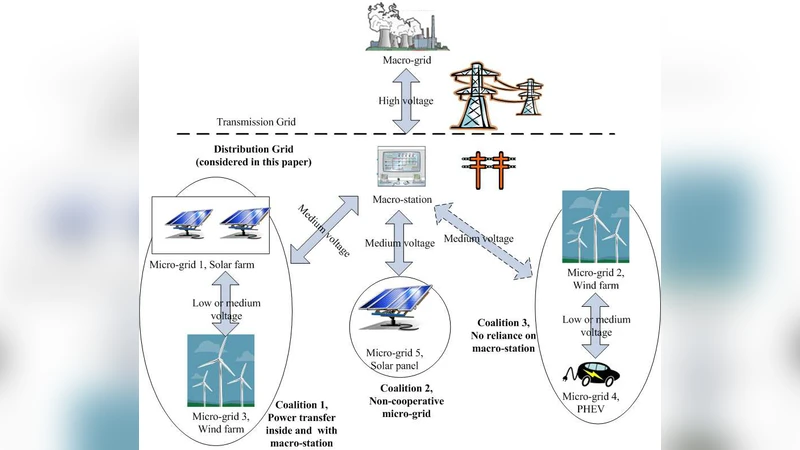
In the micro‑grid section, distributed generators, energy storage units, and local loads are treated as autonomous players. Both non‑cooperative games (e.g., Nash‑equilibrium based power‑trading games) and cooperative games (core, Shapley‑value based cost‑allocation schemes) are examined. The paper highlights that while Nash equilibria can be readily computed, they may be socially inefficient, prompting the need for coalition formation and fair surplus division. Dynamic repeated‑game formulations and reinforcement‑learning algorithms are introduced to cope with limited information and to enable convergence to desirable operating points in real time.
The DSM portion adopts a Stackelberg framework in which the utility (leader) announces time‑varying price signals and consumers (followers) adjust their load profiles accordingly. The authors incorporate realistic utility functions that reflect not only electricity cost but also comfort, appliance flexibility, and user preferences. By solving the leader‑follower game, optimal pricing policies are derived that flatten peak demand, reduce overall system cost, and improve social welfare. Extensions to multi‑leader multi‑follower settings capture interactions among multiple utilities or aggregators, and the paper presents simulation results showing 15‑20 % peak reduction and more than 10 % cost savings relative to baseline tariffs.
The communications segment focuses on the allocation of scarce radio‑frequency, power‑line, and wired bandwidth resources among smart‑grid devices. Non‑cooperative resource‑allocation games are shown to lead to inefficient equilibria due to mutual interference. To mitigate this, the authors propose auction‑based mechanisms (e.g., Vickrey‑Clarke‑Groves, radial auctions) and cooperative coordination protocols that align individual incentives with network‑wide performance metrics. Mixed‑strategy equilibria and evolutionary game dynamics are explored as tools for adapting to time‑varying channel conditions and heterogeneous device capabilities.
Finally, the paper synthesizes common research gaps across the three domains: handling incomplete or asymmetric information, integrating real‑time data streams with learning‑based game dynamics, and developing multi‑scale, multi‑domain hybrid models that simultaneously capture power, communication, and economic layers. The authors argue that future smart‑grid deployments will increasingly rely on such advanced game‑theoretic frameworks to transition from legacy, centrally‑controlled grids to decentralized, intelligent, and resilient energy infrastructures.