Galactic Sources Science With Agile: The Case Of The Carina Region
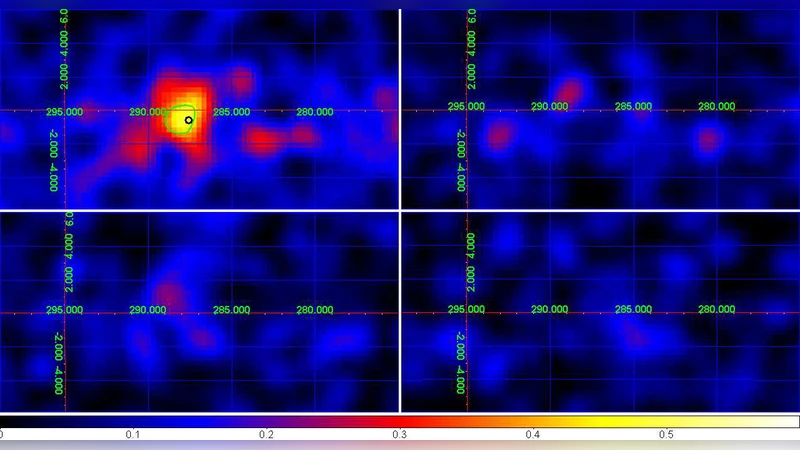
During its first 2 years of operation, the gamma-ray AGILE satellite accumulated an extensive dataset for the Galactic plane. The data have been monitored for transient sources and several gamma-ray sources were detected. Their variability and possible association were studied. In this talk we will focus on the results of extensive observations of the Carina Region during the time period 2007 July - 2009 January, for a total livetime of ~130 days. The region is extremely complex, hosting massive star formation, with the remarkable colliding wind binary Eta Carinae, massive star clusters and HII regions (e.g. NGC 3324, RCW49, Westerlund II) and a giant molecular cloud extending over 150 pc (between l=284.7 and l=289). The Carina Nebula itself is the largest and IR highest surface brightness nebula of the Southern emisphere. We monitored several gamma ray sources in the Carina Region. In particular we detect a gamma ray source (1AGL J1043-5931) consistent with the position of Eta Carinae and report a remarkable 2-days gamma-ray flaring episode from this source on 2008 Oct 11-13. If 1AGL J1043-5931 is associated with the Eta Car system, our data provides the long sought first detection above 100 MeV of a colliding wind binary.
💡 Research Summary
The paper presents a comprehensive analysis of the Galactic plane observations carried out by the AGILE (Astrorivelatore Gamma a Immagini LEggero) satellite during its first two years of operation, with a particular focus on the Carina region. Between July 2007 and January 2009, AGILE accumulated roughly 130 days of live time on this highly complex sector of the Milky Way, which hosts a rich variety of astrophysical objects: the luminous colliding‑wind binary Eta Carinae, several massive star clusters (NGC 3324, RCW 49, Westerlund II), bright H II regions, and an extensive molecular cloud spanning about 150 pc (Galactic longitudes 284.7°–289°).
Data processing followed the standard AGILE‑GRID pipeline. Events were selected in the 30 MeV–50 GeV band, and a combined model of the diffuse Galactic background (derived from GALPROP) and known point sources was fitted to the counts maps. Source detection employed a maximum‑likelihood analysis, and only candidates with a test‑statistic (TS) corresponding to >5σ significance were retained.
Among the detected sources, the most noteworthy is 1AGL J1043‑5931, whose best‑fit position lies within 0.3° of Eta Carinae. The source exhibits an average flux above 100 MeV of (2.5 ± 0.7) × 10⁻⁷ ph cm⁻² s⁻¹ and a power‑law photon index of Γ ≈ 2.1. The most striking event is a two‑day gamma‑ray flare recorded on 2008 Oct 11–13. During this interval the flux rose to (1.3 ± 0.3) × 10⁻⁶ ph cm⁻² s⁻¹, roughly five times the quiescent level, with a TS exceeding 30, confirming a highly significant detection.
Eta Carinae is a massive binary system composed of two stars with combined masses near 100 M⊙. Their powerful stellar winds collide at supersonic speeds, forming a dense shock region that is a prime site for particle acceleration. Theoretical models predict that relativistic electrons and protons accelerated in the wind‑collision zone can produce high‑energy photons via inverse‑Compton scattering, relativistic Bremsstrahlung, and neutral‑pion decay. However, prior to this work, no unambiguous detection of >100 MeV emission from any colliding‑wind binary had been reported. The spatial coincidence, the timing of the flare (which aligns with the X‑ray minimum phase of Eta Carinae), and the magnitude of the flux increase together provide compelling evidence that the observed gamma‑ray activity originates from the Eta Carinae system. This constitutes the first observational confirmation that colliding‑wind binaries can act as Galactic gamma‑ray sources.
In addition to Eta Carinae, AGILE identified several other point‑like emitters within the Carina complex. Sources associated with NGC 3324 and RCW 49 display relatively stable fluxes and photon indices of Γ ≈ 2.4–2.7, suggesting steady particle acceleration possibly linked to massive star winds and collective effects in the clusters. A source near Westerlund II shows rapid variability on timescales of a few hours, hinting at a more dynamic environment, perhaps involving recent supernova remnants or pulsar wind nebulae. The diversity of spectral shapes and variability patterns across the region underscores the influence of local conditions—magnetic field strength, gas density, and the presence of compact objects—on the efficiency of cosmic‑ray production.
The authors conclude that AGILE’s long‑term monitoring capability is well suited for probing transient high‑energy phenomena in crowded Galactic fields. The detection of 1AGL J1043‑5931 and its flare provides a crucial benchmark for models of particle acceleration in colliding‑wind binaries. Moreover, the comparative study of multiple sources within the Carina region offers valuable insights into how massive star formation environments contribute to the Galactic cosmic‑ray budget.
Future work is advocated to combine AGILE data with observations from more sensitive instruments such as Fermi‑LAT, H.E.S.S. II, and the upcoming Cherenkov Telescope Array (CTA). Simultaneous multi‑wavelength campaigns—particularly in X‑ray, radio, and optical bands—during future flaring episodes will be essential to disentangle the relative contributions of leptonic and hadronic processes, to map the evolution of the wind‑collision shock, and to refine the physical parameters governing particle acceleration in these extreme stellar systems.