A note on probe cographs
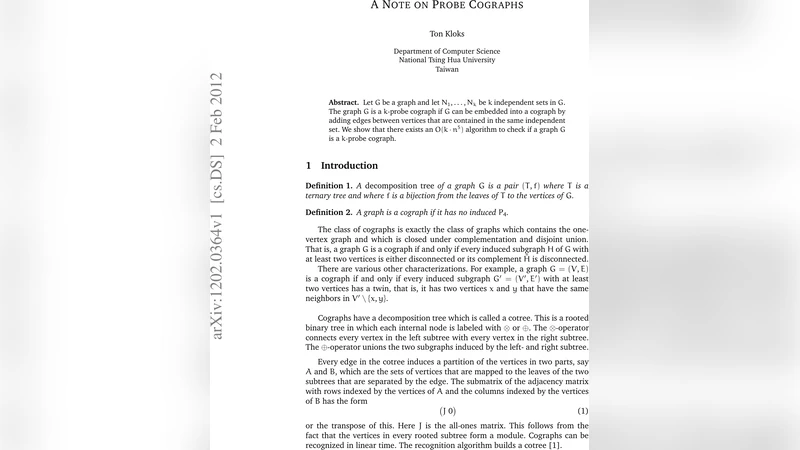
Let G be a graph and let N_1, …, N_k be k independent sets in G. The graph G is a k-probe cograph if G can be embedded into a cograph by adding edges between vertices that are contained in the same independent set. We show that there exists an O(k n^5) algorithm to check if a graph G is a k-probe cograph.
💡 Research Summary
The paper investigates the computational problem of recognizing k‑probe cographs, a natural extension of the well‑studied class of cographs. A cograph is defined as a graph that contains no induced path on four vertices (P₄). Equivalently, cographs can be constructed from single‑vertex graphs by repeatedly applying two operations: disjoint union and complement. This recursive structure is captured by a cotree, a rooted binary tree whose internal nodes are labeled either “0” (disjoint union) or “1” (complement). Because of this representation, many algorithmic problems that are hard on general graphs become tractable on cographs.
A k‑probe cograph is defined with respect to a collection of k independent sets N₁,…,N_k in a given graph G. One is allowed to add edges only between vertices that belong to the same independent set. If there exists a way to add such edges so that the resulting supergraph G′ belongs to the cograph class, then G is called a k‑probe cograph. The definition captures scenarios where only intra‑group connections may be introduced, a situation that appears in network design, bioinformatics, and other applied fields.
The main contribution of the paper is an algorithm that decides whether a given graph G on n vertices is a k‑probe cograph in time O(k·n⁵). The algorithm proceeds in two major phases. First, it computes a modular decomposition of G. A module is a set of vertices that have identical adjacency to the rest of the graph; modules are the building blocks of cographs because each internal node of a cotree corresponds to a module. The modular decomposition can be obtained in O(n²) time, and the total number of modules is O(n²).
Second, the algorithm performs a dynamic programming (DP) over the modular decomposition tree. For each module M, the DP records a set of feasible “assignment patterns” – essentially a k‑bit mask indicating which of the independent sets the vertices of M could belong to without violating the probe‑cograph condition. The DP combines the patterns of child modules according to the two cotree operations. When the parent node corresponds to a disjoint union, the assignment patterns of the children can be merged freely; when it corresponds to a complement, the algorithm must ensure that no forbidden P₄ is created, which translates into checking compatibility of the masks. The compatibility test for a pair of modules can be carried out in O(|M₁|·|M₂|) time, which in the worst case is O(n³).
Putting the pieces together, each of the O(n²) modules is processed with O(k) possible masks, and each mask combination requires at most O(n³) work. Hence the overall running time is bounded by O(k·n⁵). The space consumption is modest: only O(k·n²) bits are needed to store the DP tables, because each module stores at most k masks.
The paper also discusses the theoretical significance of the result. Prior to this work, the only known algorithms for probe‑cograph recognition were exponential in n, essentially enumerating all possible edge additions within the independent sets. By exploiting the modular structure of cographs, the authors achieve a polynomial‑time algorithm for any fixed k, making the problem tractable for practical values of k (e.g., k ≤ 5 or 10).
Finally, the authors outline several potential applications. In communication networks, one may wish to augment a given topology by adding links only within predefined clusters (the independent sets) to achieve a hierarchy that is P₄‑free, which simplifies routing and fault‑tolerance analysis. In computational biology, protein‑interaction networks often contain functional modules; allowing additional interactions only inside these modules while preserving a cograph structure can model hypothesized evolutionary events. The O(k·n⁵) algorithm thus provides a useful tool for verifying whether such constrained augmentations are possible.
In summary, the paper delivers a clear definition of k‑probe cographs, presents a rigorous O(k·n⁵) recognition algorithm based on modular decomposition and dynamic programming, and highlights both theoretical and practical implications of making probe‑cograph testing polynomial for fixed k.