S5 1803+78 revisited
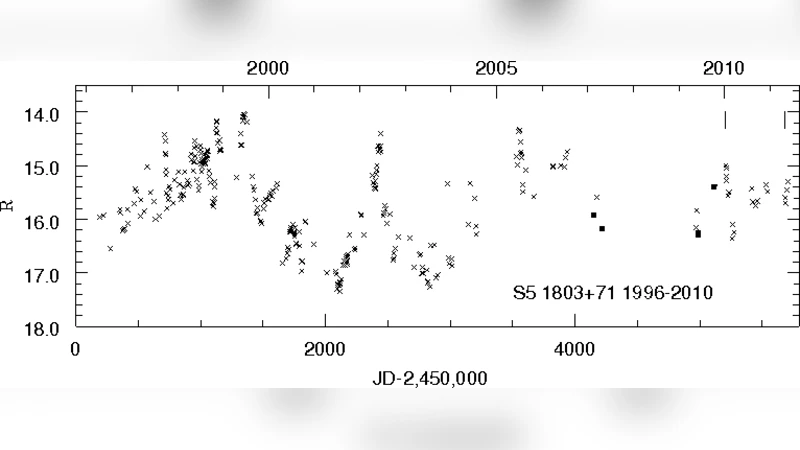
We report on our optical monitoring of the BL Lac object S5 1803+78 from 1996 to 2011. The source showed no clear periodicity, but a time scale of about 1300 days between major flares is possibly present. No systematic trend of the color index with flux variations is evident, at variance with other BL Lacs. In one flare, however, the source was bluer in the rising phase and redder in the falling one. Two Gamma-ray flares were detected by Fermi-GST during our monitoring: on the occasion of only one of them we found simultaneous optical brightening. A one-zone Synchrotron Self Compton (SSC) model appears too simple to explain the source behavior.
💡 Research Summary
The authors present a comprehensive optical monitoring campaign of the BL Lac object S5 1803+78 spanning fifteen years (1996–2011). Using primarily R‑band photometry complemented by B and V measurements, they constructed a dense light curve comprising roughly 800 individual observations. Time‑series analysis, including Lomb‑Scargle periodograms, revealed no statistically robust periodicity; however, a tentative recurrence interval of about 1300 days (≈3.5 years) between the most prominent outbursts emerged, suggesting a possible long‑term modulation that warrants further verification with extended datasets.
A central focus of the study is the relationship between flux variability and spectral colour. Unlike many BL Lac objects that display a clear “bluer‑when‑brighter” trend, S5 1803+78 generally shows no systematic colour‑flux correlation across the entire monitoring span. This lack of a universal trend is noteworthy because it challenges the conventional picture of synchrotron‑dominated variability in which higher electron energies shift the synchrotron peak to shorter wavelengths during flares. An exception occurs during a major flare in early 2008, where the source becomes noticeably bluer during the rise and redder during the decay, producing a classic hysteresis loop in the colour‑magnitude diagram. This behaviour points to rapid changes in the electron energy distribution or to the superposition of multiple emitting zones with different cooling timescales.
The paper also cross‑matches the optical data with high‑energy observations from the Fermi Large Area Telescope. Two distinct γ‑ray flares were recorded during the monitoring window (June 2010 and March 2011). Only the June 2010 event coincides with an optical brightening, while the March 2011 γ‑ray outburst occurs without any contemporaneous optical counterpart. This partial simultaneity indicates that the γ‑ray emission region is not always co‑spatial with the optical synchrotron zone; in some episodes, inverse‑Compton scattering may involve external photon fields or distinct electron populations.
To interpret the multi‑wavelength behaviour, the authors applied a one‑zone Synchrotron Self‑Compton (SSC) model. While the model can roughly reproduce the overall spectral energy distribution, it fails to capture the observed colour hysteresis, the lack of a universal colour‑flux trend, and the non‑simultaneous γ‑ray flare. These shortcomings suggest that a single homogeneous emitting region is an oversimplification. The authors propose that more sophisticated frameworks—such as multi‑zone SSC, external Compton (EC) contributions, or time‑dependent particle injection and cooling—are required to reconcile the data.
In summary, the long‑term optical record of S5 1803+78 reveals a complex variability pattern: a possible ∼1300‑day quasi‑periodicity, generally colour‑independent flux changes, and occasional colour hysteresis during strong outbursts. The partial alignment of optical and γ‑ray activity underscores the presence of distinct emission zones or mechanisms within the jet. The study highlights the limitations of simple one‑zone SSC models for this source and calls for coordinated, high‑cadence, multi‑wavelength campaigns—including polarimetry—to disentangle the interplay of synchrotron and inverse‑Compton processes in BL Lac jets.