Interval edge-colorings of Cartesian products of graphs I
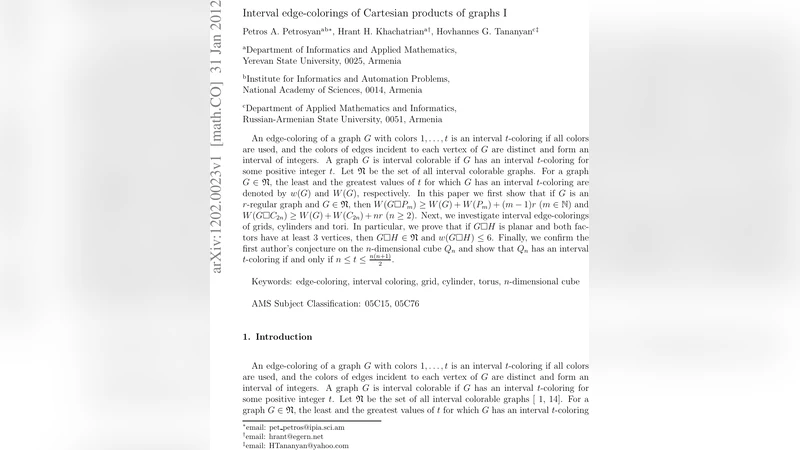
An edge-coloring of a graph $G$ with colors $1,…,t$ is an interval $t$-coloring if all colors are used, and the colors of edges incident to each vertex of $G$ are distinct and form an interval of integers. A graph $G$ is interval colorable if $G$ has an interval $t$-coloring for some positive integer $t$. Let $\mathfrak{N}$ be the set of all interval colorable graphs. For a graph $G\in \mathfrak{N}$, the least and the greatest values of $t$ for which $G$ has an interval $t$-coloring are denoted by $w(G)$ and $W(G)$, respectively. In this paper we first show that if $G$ is an $r$-regular graph and $G\in \mathfrak{N}$, then $W(G\square P_{m})\geq W(G)+W(P_{m})+(m-1)r$ ($m\in \mathbb{N}$) and $W(G\square C_{2n})\geq W(G)+W(C_{2n})+nr$ ($n\geq 2$). Next, we investigate interval edge-colorings of grids, cylinders and tori. In particular, we prove that if $G\square H$ is planar and both factors have at least 3 vertices, then $G\square H\in \mathfrak{N}$ and $w(G\square H)\leq 6$. Finally, we confirm the first author’s conjecture on the $n$-dimensional cube $Q_{n}$ and show that $Q_{n}$ has an interval $t$-coloring if and only if $n\leq t\leq \frac{n(n+1)}{2}$.
💡 Research Summary
The paper investigates interval edge‑colorings of Cartesian product graphs, focusing on three main themes: (1) lower bounds for the maximum interval‑coloring number W of products involving regular graphs, (2) interval‑colorability of planar grid‑like products, and (3) a complete characterization of interval colorings for the n‑dimensional hypercube Qₙ.
An interval t‑coloring of a graph G assigns colors 1,…,t to its edges so that (i) every color is used, (ii) incident edges at each vertex receive distinct colors, and (iii) the set of colors incident to any vertex forms a consecutive integer interval. A graph belonging to the family 𝔑 admits at least one such coloring; the smallest and largest feasible t are denoted w(G) and W(G), respectively.
Regular graphs and products with paths or even cycles.
Let G be an r‑regular graph that already lies in 𝔑. The authors prove two additive lower bounds:
-
For the product with a path Pₘ (m ≥ 1),
W(G □ Pₘ) ≥ W(G) + W(Pₘ) + (m − 1)·r. -
For the product with an even cycle C₂ₙ (n ≥ 2),
W(G □ C₂ₙ) ≥ W(G) + W(C₂ₙ) + n·r.
Since W(Pₘ)=m and W(C₂ₙ)=2n are known, the extra terms (m−1)r and nr quantify the additional colors forced by the replication of G across the m (or 2n) layers of the product. The proof constructs an interval coloring of each layer by copying a fixed interval coloring of G, then introduces new colors on the inter‑layer edges while carefully preserving the interval property at every vertex. This technique yields a systematic way to estimate the maximal color range for a broad class of product graphs.
Planar grids, cylinders, and tori.
The second part addresses Cartesian products where both factors have at least three vertices and the resulting graph is planar. The authors show that any such product G □ H belongs to 𝔑 and that its minimum interval coloring number satisfies w(G □ H) ≤ 6. The argument proceeds by decomposing the product into “ladder” or “grid” layers, assigning colors in a step‑wise fashion, and exploiting the planar embedding to avoid color conflicts. Consequently, classic planar structures—rectangular grids (Pₘ □ Pₙ), cylindrical grids (Pₘ □ Cₙ), and toroidal grids (Cₘ □ Cₙ)—are all interval‑colorable with a relatively small palette. This result has practical implications for frequency assignment in mesh networks and for scheduling in parallel processor arrays that possess a planar topology.
The hypercube Qₙ.
The final contribution resolves a conjecture posed by the first author concerning the hypercube. The authors prove that Qₙ admits an interval t‑coloring if and only if
n ≤ t ≤ n(n + 1)/2.
The lower bound follows directly from the degree of Qₙ (each vertex has degree n), while the upper bound is achieved by an explicit constructive scheme. The construction colors each dimension with a distinct set of consecutive colors, then adds auxiliary colors in a hierarchical pattern that preserves the interval condition at every vertex. The resulting coloring uses exactly n(n + 1)/2 colors, which is shown to be optimal. This theorem fully determines the interval‑coloring spectrum of hypercubes, a class of graphs central to interconnection networks, parallel computing, and coding theory.
Overall significance.
By establishing additive lower bounds for W in product graphs, proving universal interval‑colorability for planar Cartesian products, and delivering a complete interval‑coloring range for hypercubes, the paper substantially advances the theory of interval edge‑colorings. The results provide both combinatorial insight—linking graph regularity, product structure, and planarity to coloring parameters—and practical tools for designing networks where contiguous resource blocks (e.g., time slots, frequencies) are desirable. Future work suggested by the authors includes extending these techniques to non‑regular factors, non‑planar products, and algorithmic aspects such as the computational complexity of constructing optimal interval colorings.
Comments & Academic Discussion
Loading comments...
Leave a Comment