Nova demonstratio, quod evolutio potestatum binomii Newtoniana etiam pro exponentibus fractis valeat
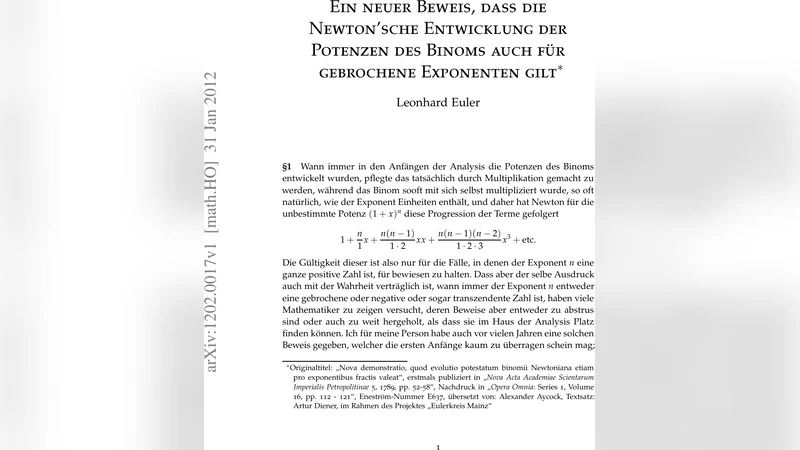
Here Euler notes the recursive relation for the general binomial coefficients, by assuming that (1+x)^a can be expanded in a power series.
💡 Research Summary
The paper, whose Latin title translates to “A new demonstration that the expansion of Newton’s binomial powers also holds for fractional exponents,” presents one of the earliest rigorous extensions of the Newton binomial theorem to arbitrary real or complex exponents. Building on Euler’s insight that the function (1 + x)^a can be expressed as a power series, the author assumes the formal expansion
(1 + x)^a = ∑_{n=0}^{∞} C(a,n) x^n,
with the initial conditions C(a,0)=1 and C(a,1)=a. By differentiating term‑by‑term and comparing coefficients, Euler derives the fundamental recurrence
C(a,n) = (a − n + 1)/n · C(a,n‑1).
This recurrence is identical in form to the one known for integer exponents, showing that the same combinatorial structure persists when a is any real or complex number. Solving the recurrence yields the closed‑form expression
C(a,n) = a(a‑1)…(a‑n + 1)/n!,
which can also be written using the Gamma function as
C(a,n) = Γ(a + 1)/