Some Problems in Automata Theory Which Depend on the Models of Set Theory
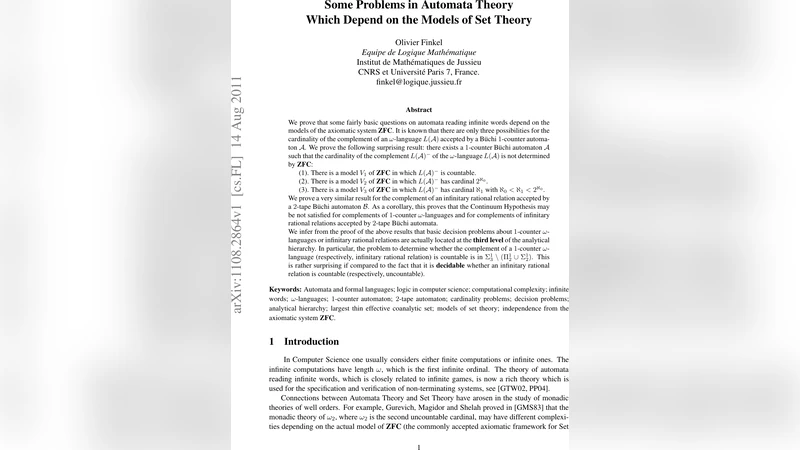
We prove that some fairly basic questions on automata reading infinite words depend on the models of the axiomatic system ZFC. It is known that there are only three possibilities for the cardinality of the complement of an omega-language $L(A)$ accepted by a B"uchi 1-counter automaton $A$. We prove the following surprising result: there exists a 1-counter B"uchi automaton $A$ such that the cardinality of the complement $L(A)^-$ of the omega-language $L(A)$ is not determined by ZFC: (1). There is a model $V_1$ of ZFC in which $L(A)^-$ is countable. (2). There is a model $V_2$ of ZFC in which $L(A)^-$ has cardinal $2^{\aleph_0}$. (3). There is a model $V_3$ of ZFC in which $L(A)^-$ has cardinal $\aleph_1$ with $\aleph_0<\aleph_1<2^{\aleph_0}$. We prove a very similar result for the complement of an infinitary rational relation accepted by a 2-tape B"uchi automaton $B$. As a corollary, this proves that the Continuum Hypothesis may be not satisfied for complements of 1-counter omega-languages and for complements of infinitary rational relations accepted by 2-tape B"uchi automata. We infer from the proof of the above results that basic decision problems about 1-counter omega-languages or infinitary rational relations are actually located at the third level of the analytical hierarchy. In particular, the problem to determine whether the complement of a 1-counter omega-language (respectively, infinitary rational relation) is countable is in $\Sigma_3^1 \setminus (\Pi_2^1 \cup \Sigma_2^1)$. This is rather surprising if compared to the fact that it is decidable whether an infinitary rational relation is countable (respectively, uncountable).
💡 Research Summary
The paper investigates the surprising dependence of certain basic questions about automata that read infinite words on the underlying set‑theoretic model of ZFC. It focuses on Büchi 1‑counter automata, a subclass of ω‑automata whose accepted languages belong to the effective analytic class Σ₁¹, and on 2‑tape Büchi automata that recognize infinitary rational relations (also Σ₁¹).
The authors first recall that for any ω‑language L accepted by a Büchi 1‑counter automaton, the complement L⁻ is a co‑analytic set (Π₁¹). Classical descriptive set theory tells us that a co‑analytic set can have only three possible cardinalities: countable, ℵ₁, or the continuum 2^{ℵ₀}. The key set‑theoretic tool used is the “largest thin Π₁¹ set” C₁, whose existence was proved independently by Kechris and by Guaspari‑Sacks. Crucially, the cardinality of C₁ is not fixed by ZFC: depending on the model of set theory, C₁ can be countable, have size ℵ₁, or have size 2^{ℵ₀}.
Using C₁, the authors construct a specific 1‑counter Büchi automaton A. The automaton reads an input ω‑word split into two parts: the first part is used to test membership in C₁ (via a simple encoding into the counter’s behavior), while the second part is always accepted. Consequently, the complement language L(A)⁻ is essentially C₁ itself.
Three ZFC models are exhibited:
- Model V₁ – a model where the Continuum Hypothesis holds and C₁ is forced to be countable. In V₁, L(A)⁻ is countable.
- Model V₂ – a model where CH fails, so 2^{ℵ₀}>ℵ₁, and C₁ has cardinality 2^{ℵ₀}. Here L(A)⁻ has the size of the continuum.
- Model V₃ – a model obtained by forcing over a constructible universe L so that ω₁^{L}<ω₁. In this setting C₁ has cardinality ℵ₁, and thus L(A)⁻ has size ℵ₁ (strictly between ℵ₀ and 2^{ℵ₀}).
Thus the cardinality of the complement of a 1‑counter ω‑language cannot be decided within ZFC alone. An analogous construction is carried out for a 2‑tape Büchi automaton B, showing that the complement of an infinitary rational relation can also have a ZFC‑independent cardinality.
From these constructions the authors derive complexity‑theoretic consequences. The decision problem “Is the complement of a given 1‑counter ω‑language (or of a given infinitary rational relation) countable?” is shown to lie in the third level of the analytical hierarchy, specifically in Σ₃¹ \ (Π₂¹ ∪ Σ₂¹). This places the problem strictly above the lower analytical levels, contrasting sharply with the fact that for general infinitary rational relations the countability problem is decidable. The proof uses Shoenfield’s Absoluteness Theorem to argue that any Σ₂¹ or Π₂¹ description would be absolute between models, which is not the case for the constructed languages.
The paper also revisits known equivalences: Σ₁¹ languages are exactly those accepted by non‑deterministic Büchi Turing machines, and also by Büchi 2‑counter automata (hence by Büchi 2‑tape automata). By embedding the thin set C₁ into a 1‑counter automaton, the authors bridge descriptive set theory and automata theory, demonstrating that even very low‑resource automata can encode set‑theoretic independence phenomena.
In conclusion, the work shows that fundamental properties of ω‑languages recognized by extremely simple automata—such as the size of their complements—may be independent of the standard axioms of set theory. This reveals a deep and unexpected interaction between automata theory, descriptive set theory, and the foundations of mathematics, and opens new avenues for exploring independence results within computational models.
Comments & Academic Discussion
Loading comments...
Leave a Comment