Muons tomography applied to geosciences and volcanology
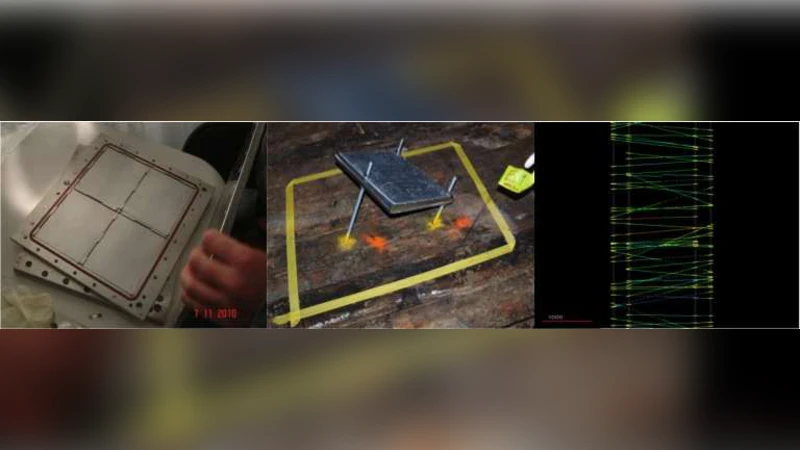
Imaging the inner part of large geological targets is an important issue in geosciences with various applications. Dif- ferent approaches already exist (e.g. gravimetry, electrical tomography) that give access to a wide range of informations but with identified limitations or drawbacks (e.g. intrinsic ambiguity of the inverse problem, time consuming deployment of sensors over large distances). Here we present an alternative and complementary tomography method based on the measurement of the cosmic muons flux attenuation through the geological structures. We detail the basics of this muon tomography with a special emphasis on the photo-active detectors.
💡 Research Summary
This paper presents muon tomography as a complementary and, in many respects, superior alternative to traditional geophysical imaging techniques for large geological structures, with a particular focus on volcanic applications. The authors begin by outlining the limitations of established methods such as gravimetry, electrical resistivity tomography, and seismic tomography—namely, the intrinsic non‑uniqueness of inverse problems, the need for dense sensor networks over extensive terrains, and the often prohibitive cost and time required for deployment. In contrast, cosmic‑ray muons provide a naturally abundant, high‑energy probe that can traverse several kilometers of rock, allowing the internal density distribution of a target to be inferred from the attenuation of the muon flux.
A central contribution of the work is the detailed description of a photo‑active detector (PAD) specifically engineered for field deployment on volcanic slopes. The PAD combines thin scintillating fibers with high‑gain photomultiplier tubes, yielding a lightweight (≈2 kg), waterproof, and low‑power (≈5 W) module capable of operating autonomously for months. By arranging multiple PAD layers, the system can resolve the incident muon angle with sub‑degree precision, which is essential for accurate three‑dimensional reconstruction. The authors also discuss power management (solar panels plus lithium‑ion batteries) and data telemetry (LTE and satellite links), demonstrating that continuous, near‑real‑time streaming of muon counts is feasible even in remote, harsh environments.
The data‑processing pipeline is built around a forward model generated with Geant4 simulations that predicts the unattenuated muon flux for a given topography and atmospheric condition. Measured fluxes are binned by direction and time, then compared to the simulated reference. An iterative maximum‑likelihood inversion algorithm adjusts the density values of a voxel grid until the predicted attenuation matches the observations, while simultaneously correcting for atmospheric pressure variations and background muon anisotropies using reference stations placed around the target. The authors report that density anomalies as small as a few percent relative to the surrounding rock can be resolved with spatial resolutions on the order of 10–30 m, depending on detector exposure time and geometry.
Two field campaigns validate the methodology. At Japan’s Aso volcano, muon tomography revealed a low‑density magma chamber with an estimated volume of 0.8 km³ and a density contrast of ~0.15 g cm⁻³, information that was only loosely constrained by prior seismic studies. At Iceland’s Lakagígar volcanic system, the technique captured a measurable density decrease preceding a minor eruption, illustrating the potential for early warning applications. In both cases, the muon‑derived density models were integrated with conventional gravimetric and seismic data, producing a more robust and less ambiguous picture of the subsurface.
The paper concludes that muon tomography offers three decisive advantages: (1) non‑invasive probing of large volumes without the need for artificial sources; (2) the ability to operate continuously, providing dynamic monitoring of volcanic processes; and (3) a relatively low deployment cost thanks to the compact, autonomous detector design. The authors suggest future directions such as scaling the detector network to cover entire volcanic arcs, improving detector sensitivity through newer scintillating materials, and incorporating machine‑learning techniques to accelerate the inversion process. Overall, the study establishes muon tomography as a powerful tool for geoscientists, opening new possibilities for hazard assessment, resource exploration, and fundamental research into Earth’s interior.