Axiomatizing Resource Bounds for Measure
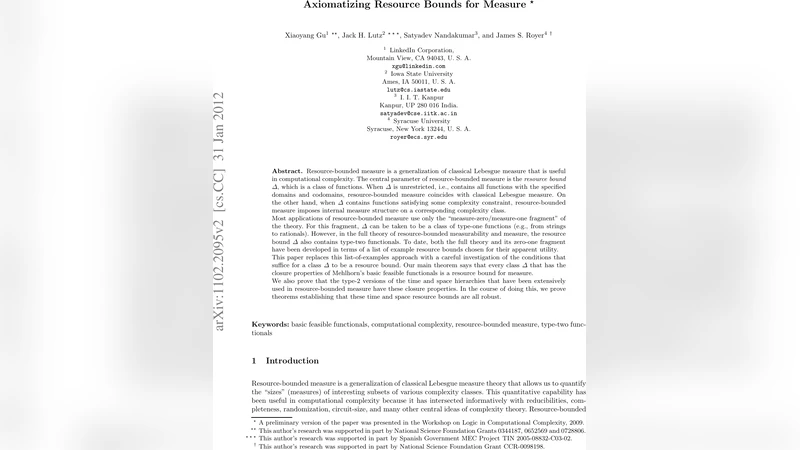
Resource-bounded measure is a generalization of classical Lebesgue measure that is useful in computational complexity. The central parameter of resource-bounded measure is the {\it resource bound} $\Delta$, which is a class of functions. When $\Delta$ is unrestricted, i.e., contains all functions with the specified domains and codomains, resource-bounded measure coincides with classical Lebesgue measure. On the other hand, when $\Delta$ contains functions satisfying some complexity constraint, resource-bounded measure imposes internal measure structure on a corresponding complexity class. Most applications of resource-bounded measure use only the “measure-zero/measure-one fragment” of the theory. For this fragment, $\Delta$ can be taken to be a class of type-one functions (e.g., from strings to rationals). However, in the full theory of resource-bounded measurability and measure, the resource bound $\Delta$ also contains type-two functionals. To date, both the full theory and its zero-one fragment have been developed in terms of a list of example resource bounds chosen for their apparent utility. This paper replaces this list-of-examples approach with a careful investigation of the conditions that suffice for a class $\Delta$ to be a resource bound. Our main theorem says that every class $\Delta$ that has the closure properties of Mehlhorn’s basic feasible functionals is a resource bound for measure. We also prove that the type-2 versions of the time and space hierarchies that have been extensively used in resource-bounded measure have these closure properties. In the course of doing this, we prove theorems establishing that these time and space resource bounds are all robust.
💡 Research Summary
Resource‑bounded measure extends classical Lebesgue measure to the setting of computational complexity, allowing one to assign “sizes” to subsets of complexity classes. The central parameter of this theory is a resource bound Δ, a class of functions (and, for the full theory, also type‑2 functionals). Historically, Δ has been instantiated by a handful of concrete examples—polynomial‑time functions, quasi‑polynomial time, polynomial space, etc.—and each new application required a separate verification that the chosen Δ satisfied the technical conditions needed for the measure theory to go through. This ad‑hoc “list‑of‑examples” approach, while useful in the early development of the field, hampers generalization and creates a burden of repetitive proofs.
The present paper replaces the example‑driven approach with an axiomatic one. It observes that Mehlhorn’s basic feasible functionals (BFF) are defined by a small set of initial functionals (the constant‑0 function, the binary successor functions s₀ and s₁, and the smash function #) together with three closure operations: composition, limited recursion on notation, and functional expansion. The authors propose to drop Mehlhorn’s minimality requirement and to declare any class Δ that (i) contains the initial functionals, (ii) is closed under the three operations, and (iii) contains all type‑1 polynomial‑time functions, to be a valid resource bound for measure. This definition is purely algebraic, does not refer to any particular computational model, and is easy to check for new classes.
The main theorem shows that any Δ satisfying these axioms is sufficient for developing the full theory of resource‑bounded measurability and measure as presented in Lutz’s earlier work. In particular, the standard constructions—measure, outer measure, measurable sets, martingale characterizations, and the fundamental theorems (e.g., countable additivity, Kolmogorov’s zero‑one law)—remain valid when Δ is an arbitrary axiomatic resource bound.
To demonstrate the adequacy of the axioms, the paper examines the type‑2 time and space hierarchies that have been used extensively in the literature. For each hierarchy (e.g., polynomial time, quasi‑polynomial time, polynomial space, quasi‑polynomial space) the authors build a functional algebra showing that the class is closed under composition, limited recursion on notation, and expansion, and that it contains the required initial functionals. They introduce the notion of basic i‑feasible functionals BFFᵢ, which generalizes BFF by allowing the growth function gᵢ (where g₁(n)=n², g₂(n)=n log n, etc.) to bound the size of intermediate results in limited recursion. They prove that BFFᵢ coincides with the class of type‑2 functionals computable in basic quasi‑i‑polynomial time (as defined via Kapron‑Cook oracle Turing machines). Consequently, all the standard time and space resource bounds satisfy the axioms and are therefore legitimate resource bounds for measure.
The authors also verify that the “measure‑zero/measure‑one fragment” of the theory—where only sets of measure 0 or 1 are considered—coincides with the fragment used in earlier papers. Thus, all previously published zero‑one results automatically carry over to the new axiomatic framework.
Finally, the paper acknowledges that some recent developments (e.g., measures inside small classes such as P, probabilistic classes like BPE, or doubly‑exponential classes like EE, as well as Dai’s outer‑measure approach) are not captured by the current axioms. These cases remain confined to the zero‑one fragment or to a local notion of measurability. The authors suggest that extending the axiomatization to encompass these settings is an important direction for future work.
In summary, by characterizing resource bounds through the closure properties of Mehlhorn’s basic feasible functionals, the paper provides a clean, robust, and widely applicable foundation for resource‑bounded measure. It unifies existing examples under a single algebraic scheme, proves the robustness of the standard time and space hierarchies, and opens the door for systematic extensions to new complexity‑theoretic contexts.
Comments & Academic Discussion
Loading comments...
Leave a Comment