Conditional and Unique Coloring of Graphs (revised resubmission)
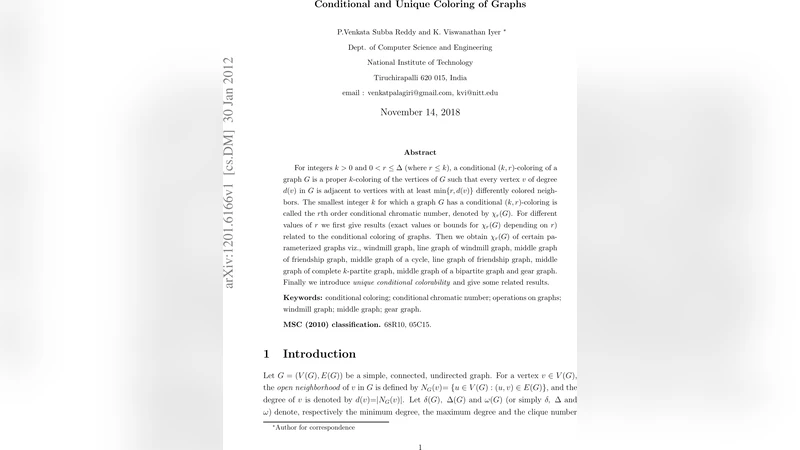
For integers $k>0$ and $0<r \leq \Delta$ (where $r \leq k$), a conditional $(k,r)$-coloring of a graph $G$ is a proper $k$-coloring of the vertices of $G$ such that every vertex $v$ of degree $d(v)$ in $G$ is adjacent to vertices with at least $\min{r, d(v)}$ differently colored neighbors. The smallest integer $k$ for which a graph $G$ has a conditional $(k,r)$-coloring is called the $r$th order conditional chromatic number, denoted by $\chi_r(G)$. For different values of $r$ we first give results (exact values or bounds for $\chi_r(G)$ depending on $r$) related to the conditional coloring of graphs. Then we obtain $\chi_r(G)$ of certain parameterized graphs viz., windmill graph, line graph of windmill graph, middle graph of friendship graph, middle graph of a cycle, line graph of friendship graph, middle graph of complete $k$-partite graph, middle graph of a bipartite graph and gear graph. Finally we introduce \emph{unique conditional colorability} and give some related results.
💡 Research Summary
The paper introduces the notion of a conditional ((k,r))-coloring of a graph (G). A proper (k)-coloring is required, but additionally every vertex (v) of degree (d(v)) must be adjacent to at least (\min{r,d(v)}) differently colored neighbors. The smallest (k) for which such a coloring exists is the (r)‑th order conditional chromatic number (\chi_r(G)). After establishing basic bounds—(\chi_r(G)\ge \max{\chi(G),r+1}) and (\chi_r(G)\le \Delta(G)+1)—the authors determine exact values or tight bounds for (\chi_r(G)) on a variety of parameterized graph families.
For windmill graphs (W_{d,n}) (a central vertex shared by (n) copies of (K_d)), they show (\chi_r(W_{d,n})=d) when (r\le d-1) and (\chi_r(W_{d,n})=d+1) for (r\ge d). The line graph (L(W_{d,n})) needs one extra color: (\chi_r(L(W_{d,n}))=d+1) for (r\le d-1) and (d+2) for (r\ge d).
The middle graph of the friendship graph (F_n) (denoted (M(F_n))) exhibits a three‑stage behavior: (\chi_r(M(F_n))=3) for (r\le2), (4) for (r=3), and (5) for (r\ge4). Similar stepwise results are obtained for the middle graph of a cycle (M(C_n)) and the line graph of a friendship graph (L(F_n)).
For complete (k)-partite graphs (K_{n_1,\dots,n_k}) and their middle graphs (M(K_{n_1,\dots,n_k})), the authors prove that (\chi_r) depends only on (k): it equals (k+1) when (r\le k) and (k+2) when (r>k), regardless of the part sizes. Corresponding formulas are given for bipartite graphs and gear graphs, showing that only a small constant number of colors (3–5) suffice for all values of (r).
The second major contribution is the concept of unique conditional colorability. A graph (G) is said to be uniquely ((k,r))-colorable if every minimum conditional ((k,r))-coloring yields the same partition of the vertex set. The paper establishes uniqueness for several families: complete graphs are uniquely ((n-1))-colorable for all admissible (r); stars are unique only for (r=1); windmill graphs are unique when (r\le d-1) but not when (r\ge d); and the middle graphs of complete multipartite graphs are unique for (r\le k). These results highlight that the additional diversity constraint can either enforce a rigid coloring structure or allow multiple distinct optimal colorings, depending on the graph’s topology and the parameter (r).
Overall, the work systematically extends classical graph coloring by incorporating a local diversity requirement, provides exact conditional chromatic numbers for a broad spectrum of well‑studied graph constructions, and opens a new line of inquiry into the uniqueness of optimal conditional colorings. This enriches both the theoretical landscape of graph coloring and its potential applications where diversity of neighboring attributes is essential (e.g., frequency assignment, resource distribution, and network security).
Comments & Academic Discussion
Loading comments...
Leave a Comment