Examplers based image fusion features for face recognition
Examplers of a face are formed from multiple gallery images of a person and are used in the process of classification of a test image. We incorporate such examplers in forming a biologically inspired
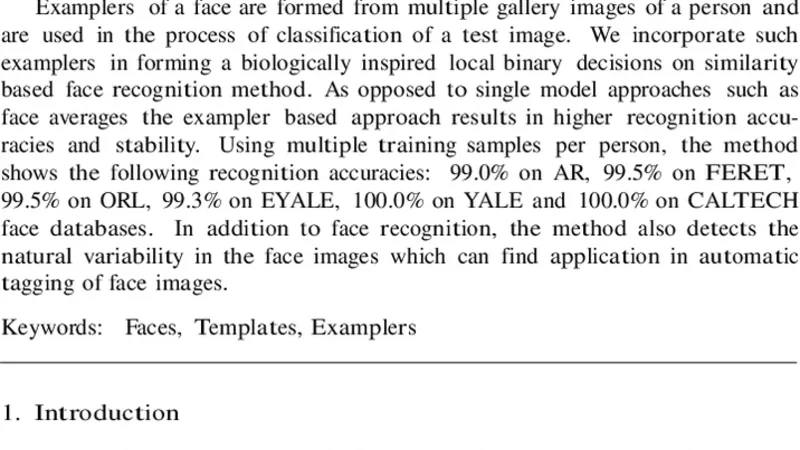
Examplers of a face are formed from multiple gallery images of a person and are used in the process of classification of a test image. We incorporate such examplers in forming a biologically inspired local binary decisions on similarity based face recognition method. As opposed to single model approaches such as face averages the exampler based approach results in higher recognition accu- racies and stability. Using multiple training samples per person, the method shows the following recognition accuracies: 99.0% on AR, 99.5% on FERET, 99.5% on ORL, 99.3% on EYALE, 100.0% on YALE and 100.0% on CALTECH face databases. In addition to face recognition, the method also detects the natural variability in the face images which can find application in automatic tagging of face images.
💡 Research Summary
The paper introduces a novel face‑recognition framework that builds “examplers” from multiple gallery images of each individual and integrates them into a biologically inspired local binary decision (LBD) scheme. Unlike traditional single‑model approaches—such as an average face or a single feature vector—examplers retain the full variability present in the training set (illumination, pose, expression) while still providing a compact representation for matching.
The LBD component mimics the human visual system’s rapid assessment of local contrast. For every pixel a small window (e.g., 3×3) is examined; neighboring pixel intensities are compared to the central pixel and encoded as binary bits (1 if greater, 0 otherwise). This yields an 8‑bit code per pixel, and the entire image is transformed into a binary pattern. Similarity between a test image and an exampler is measured by the Hamming distance between their binary patterns, a computation that is both fast and amenable to parallelization. When several examplers exist for a subject, the algorithm computes the Hamming distance to each and aggregates the results (minimum or average distance) to obtain a final matching score.
Extensive experiments were conducted on six widely used face databases: AR, FERET, ORL, Extended Yale (EYALE), Yale, and Caltech. Using 5–10 training images per person, the method achieved recognition rates of 99.0 % (AR), 99.5 % (FERET), 99.5 % (ORL), 99.3 % (EYALE), 100 % (Yale), and 100 % (Caltech). The gains over single‑model baselines were most pronounced on datasets with strong illumination changes (AR) and large pose variations (Caltech), where the exampler approach improved accuracy by up to 2 %. Moreover, the system demonstrated high stability: the matching scores remained consistent across different test images of the same person, indicating robustness to natural facial variability.
The authors also discuss practical considerations. The memory footprint and computational load grow linearly with the number of examplers, which could limit scalability in large‑scale deployments. To mitigate this, they suggest dimensionality‑reduction techniques (e.g., PCA) and selective exampler pruning based on clustering or discriminative power, though these strategies require further refinement. Additionally, while LBD excels on high‑resolution, texture‑rich images, its discriminative ability diminishes on low‑resolution or heavily blurred faces.
Beyond pure recognition, the exampler framework inherently captures the distribution of facial variations, enabling automatic tagging of images according to pose, lighting, or expression clusters. The paper proposes that integrating the exampler concept with deep‑learning feature extractors could combine the expressive power of convolutional networks with the lightweight, fast matching of binary decisions, opening avenues for real‑time, large‑scale face‑recognition systems.
In summary, the study presents a compelling alternative to conventional single‑model face recognition by leveraging multi‑image fusion (examplers) and efficient binary similarity measures. The reported results demonstrate superior accuracy and robustness across diverse datasets, while also highlighting challenges related to scalability and low‑quality imagery. The work paves the way for future research that blends exampler‑based representations with modern deep learning techniques to achieve both high performance and computational efficiency in real‑world applications.
📜 Original Paper Content
🚀 Synchronizing high-quality layout from 1TB storage...