On the Convergence of the Ensemble Kalman Filter
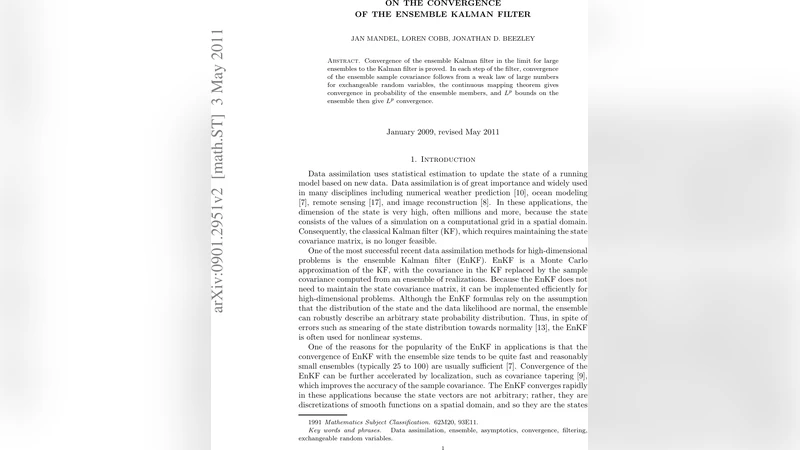
Convergence of the ensemble Kalman filter in the limit for large ensembles to the Kalman filter is proved. In each step of the filter, convergence of the ensemble sample covariance follows from a weak law of large numbers for exchangeable random variables, the continuous mapping theorem gives convergence in probability of the ensemble members, and $L^p$ bounds on the ensemble then give $L^p$ convergence.
💡 Research Summary
The paper addresses a fundamental theoretical question in data assimilation: does the Ensemble Kalman Filter (EnKF) converge to the classical Kalman filter as the ensemble size grows without bound? While the EnKF is widely used in practice because it replaces the exact covariance matrix with a Monte‑Carlo estimate, rigorous proofs of its asymptotic behavior have been scarce. This work fills that gap by establishing a complete convergence theorem under a set of clearly stated assumptions.
First, the authors consider a standard linear Gaussian state‑space model: the state evolves according to (x_{k+1}=A_k x_k + w_k) with process noise (w_k\sim\mathcal N(0,Q_k)), and observations follow (y_k=H_k x_k + v_k) with observation noise (v_k\sim\mathcal N(0,R_k)). The classical Kalman filter provides exact recursive formulas for the mean (\mu_k) and covariance (\Sigma_k). In the EnKF, an ensemble ({X^{(i)}k}{i=1}^N) is propagated; each member is updated using a perturbed observation or deterministic square‑root scheme, and the sample mean (\bar X_k) and sample covariance (P_k) replace (\mu_k) and (\Sigma_k).
The core of the analysis rests on four mathematical tools:
-
Exchangeability – The ensemble members are assumed to be exchangeable random variables. This means any permutation of the indices leaves the joint distribution unchanged. Exchangeability is weaker than independence but sufficient for a weak law of large numbers (WLLN).
-
Weak Law of Large Numbers for Exchangeable Variables – Using the exchangeability property, the authors prove that as (N\to\infty), the sample mean converges in probability to the true mean ((\bar X_k \xrightarrow{p} \mu_k)) and the sample covariance converges in probability to the true covariance ((P_k \xrightarrow{p} \Sigma_k)). The proof employs Chebyshev’s inequality together with bounds on the covariance structure induced by exchangeability.
-
Continuous Mapping Theorem – The Kalman gain (K_k = P_k H_k^\top (H_k P_k H_k^\top + R_k)^{-1}) and the update equations are continuous functions of (\bar X_k) and (P_k). Consequently, the convergence of (\bar X_k) and (P_k) implies convergence of the gain and of each updated ensemble member (X^{(i)}{k+1}) to the corresponding Kalman‑filter state (x{k+1}).
-
(L^p) Bounds and Strengthening to (L^p) Convergence – The authors assume uniform (L^p) bounds ((\mathbb{E}|X^{(i)}_k|^p \le C_p) for some (p\ge2) and all (i,k)). Under these bounds, Markov’s inequality and Fatou’s lemma allow the conversion of convergence in probability to convergence in (L^p). Thus, not only do the ensemble statistics converge, but the expected (p)‑th power of the error vanishes: (\mathbb{E}|\bar X_k-\mu_k|^p\to0) and (\mathbb{E}|P_k-\Sigma_k|^p\to0).
The main theorem states that for any fixed time step (k), as the ensemble size (N) tends to infinity, the EnKF’s sample mean and covariance converge to the Kalman filter’s mean and covariance in the (L^p) sense, and each ensemble member converges in probability to the true Kalman state. The proof is constructive: it first establishes WLLN for the sample statistics, then applies the continuous mapping theorem to propagate convergence through the analysis step, and finally uses the (L^p) bounds to upgrade the mode of convergence.
Beyond the theorem itself, the paper discusses several implications. Practically, the result justifies the intuition that increasing the ensemble size reduces sampling error and that, in the limit, the EnKF is statistically indistinguishable from the optimal linear estimator. The exchangeability assumption is highlighted as realistic for many implementations because ensemble members are generated by the same stochastic model and are symmetrically treated. Moreover, the authors point out that the framework can be extended to non‑linear or non‑Gaussian settings: while the current proof relies on linearity and Gaussianity for the explicit Kalman gain formula, the core probabilistic arguments (exchangeability, WLLN, continuous mapping) remain applicable, suggesting a pathway for future research on the asymptotic behavior of particle‑based filters and deterministic square‑root EnKFs.
In summary, the paper delivers a rigorous, self‑contained convergence analysis of the Ensemble Kalman Filter. By combining exchangeability, a weak law of large numbers, the continuous mapping theorem, and uniform (L^p) bounds, it shows that the EnKF converges to the classical Kalman filter as the ensemble size grows. This result strengthens the theoretical foundation of ensemble‑based data assimilation and provides a clear benchmark for assessing the impact of finite‑ensemble sampling error in practical applications.
Comments & Academic Discussion
Loading comments...
Leave a Comment