Neutrinos from Cosmic Accelerators Including Magnetic Field and Flavor Effects
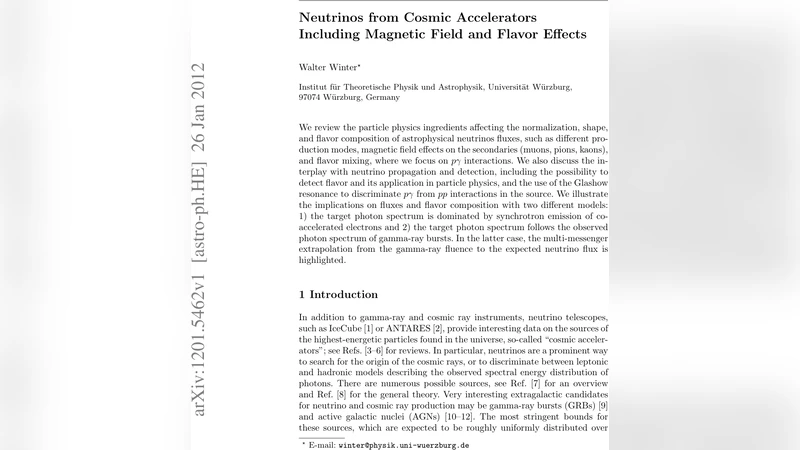
We review the particle physics ingredients affecting the normalization, shape, and flavor composition of astrophysical neutrinos fluxes, such as different production modes, magnetic field effects on the secondaries (muons, pions, kaons), and flavor mixing, where we focus on p-gamma interactions. We also discuss the interplay with neutrino propagation and detection, including the possibility to detect flavor and its application in particle physics, and the use of the Glashow resonance to discriminate p-gamma from p-p interactions in the source. We illustrate the implications on fluxes and flavor composition with two different models: 1) the target photon spectrum is dominated by synchrotron emission of co-accelerated electrons and 2) the target photon spectrum follows the observed photon spectrum of gamma-ray bursts. In the latter case, the multi-messenger extrapolation from the gamma-ray fluence to the expected neutrino flux is highlighted.
💡 Research Summary
This paper presents a comprehensive review and quantitative analysis of the particle‑physics ingredients that shape the normalization, spectral shape, and flavor composition of astrophysical neutrino fluxes, with a particular focus on proton‑photon (p‑γ) interactions. The authors begin by outlining the current status of high‑energy neutrino observations (e.g., IceCube’s PeV events) and the traditional view that such neutrinos are produced either in proton‑proton (p‑p) or p‑γ collisions within cosmic accelerators such as active galactic nuclei, gamma‑ray bursts (GRBs), and supernova remnants. They argue that many existing models oversimplify the treatment of secondary particles (pions, kaons, muons) and often assume a fixed flavor ratio of (νe : νμ : ντ) = (1 : 2 : 0) at the source, which after vacuum oscillations becomes roughly (1 : 1 : 1) at Earth.
The core of the work is organized around four technical pillars. First, the authors extend the standard Δ‑resonance description of p‑γ interactions by incorporating higher resonances, multi‑pion production, and kaon channels. They employ state‑of‑the‑art Monte‑Carlo tools (e.g., SOPHIA, NeuCosmA) to compute energy‑dependent production efficiencies for a range of target‑photon spectra. Second, they calculate synchrotron cooling of secondaries in strong magnetic fields (B ≈ 10⁴–10⁶ G) that are expected in the acceleration zones. By comparing the cooling timescale with the decay lifetime of each secondary, they demonstrate that at sufficiently high energies the secondaries lose a substantial fraction of their energy before decaying, leading to a suppression of the high‑energy neutrino tail. Third, they propagate the resulting source‑level flavor composition through three‑flavor oscillations using the latest mixing parameters (θ₁₂≈33°, θ₂₃≈45°, θ₁₃≈8°, δ≈1.4π). The analysis shows that magnetic‑field‑induced cooling can reduce the νe fraction to below 10 % at PeV energies, while νμ and ντ dominate. Fourth, the paper discusses the Glashow resonance (ν̄e + e⁻ → W⁻ at 6.3 PeV) as a diagnostic tool: p‑γ sources, which produce few ν̄e, should exhibit a markedly reduced resonance rate compared with p‑p sources that generate ν̄e in roughly equal numbers to νe.
To illustrate the impact of these effects, two representative photon‑target models are examined. Model 1 assumes that the target photons are synchrotron radiation from co‑accelerated electrons, yielding a spectrum peaked in the keV–MeV range. In this environment the Δ‑resonance dominates, kaon contributions are modest, and magnetic cooling suppresses the neutrino flux above a few hundred TeV, with the νe fraction falling to ≈ 5–10 %. Model 2 adopts the observed Band‑function spectrum of GRBs, which extends to GeV energies and possesses a high‑energy tail. Here multi‑pion and kaon production become significant, enhancing the neutrino flux at PeV energies by a factor of 2–3 relative to Model 1. The stronger magnetic fields expected in GRB jets further reduce the νe component, making the flavor ratio at Earth approach (νe : νμ : ντ) ≈ (0.05 : 0.5 : 0.45).
The authors also address the multi‑messenger connection between γ‑ray fluence and neutrino flux. In p‑γ interactions, neutral pions decay into γ‑rays while charged pions generate neutrinos; thus, a naïve scaling of the observed γ‑ray fluence to predict the neutrino flux can overestimate the latter if magnetic cooling and kaon channels are ignored. By incorporating the full suite of effects, the paper provides corrected normalization factors, showing that for typical GRB parameters the naïve estimate overshoots the true neutrino flux by roughly 30 %.
Finally, the paper outlines observational strategies to test these predictions. Current and upcoming neutrino telescopes (IceCube‑Gen2, KM3NeT, Baikal‑GVD) have sufficient energy resolution to search for the Glashow resonance and to measure energy‑dependent flavor ratios. A detection (or lack) of resonance events around 6.3 PeV would directly discriminate between p‑γ‑dominated and p‑p‑dominated sources. Moreover, joint analyses that combine neutrino data with γ‑ray observations (e.g., from Fermi‑GBM, Swift) and, where possible, with cosmic‑ray or gravitational‑wave alerts, can constrain the underlying magnetic field strength, photon spectral shape, and acceleration efficiency.
In summary, the paper delivers a detailed, physics‑driven framework for modeling astrophysical neutrino production that goes beyond simplistic source‑flavor assumptions. By accounting for magnetic‑field‑induced cooling, kaon contributions, and precise flavor mixing, it refines the expected neutrino spectra and flavor composition for realistic cosmic accelerators. These results have immediate relevance for interpreting existing IceCube data, guiding the design of future neutrino observatories, and exploiting neutrinos as messengers of high‑energy astrophysical processes and potential probes of fundamental particle physics.