The weak theory of monads
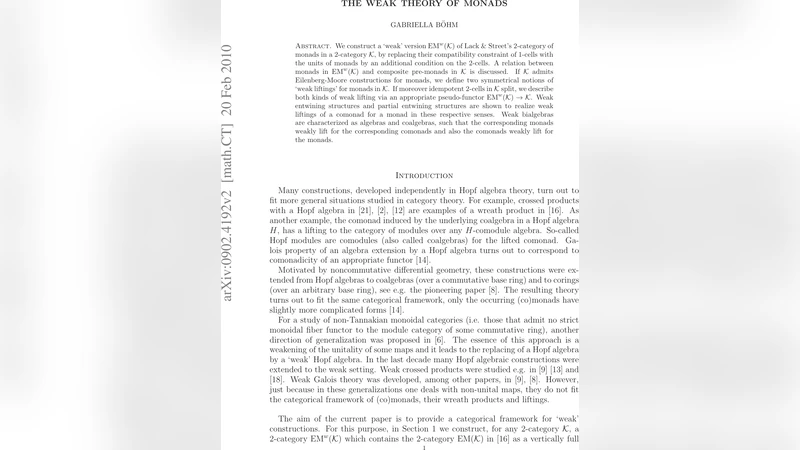
We construct a weak' version EM^w(K) of Lack & Street's 2-category of monads in a 2-category K, by replacing their compatibility constraint of 1-cells with the units of monads by an additional condition on the 2-cells. A relation between monads in EM^w(K) and composite pre-monads in K is discussed. If K admits Eilenberg-Moore constructions for monads, we define two symmetrical notions of weak liftings’ for monads in K. If moreover idempotent 2-cells in K split, we describe both kinds of a weak lifting via an appropriate pseudo-functor EM^w(K) –> K. Weak entwining structures and partial entwining structures are shown to realize weak liftings of a comonad for a monad in these respective senses. Weak bialgebras are characterized as algebras and coalgebras, such that the corresponding monads weakly lift for the corresponding comonads and also the comonads weakly lift for the monads.
💡 Research Summary
The paper introduces a weakened version of the 2‑category of monads, denoted EM⁽ʷ⁾(K), built on an arbitrary 2‑category K. In the classical construction of Lack and Street, the 2‑category EM(K) consists of monads as objects, monad morphisms (1‑cells) that must strictly preserve the unit, and monad transformations (2‑cells) that respect both unit and multiplication. The authors observe that the strict unit‑preservation requirement on 1‑cells is often too restrictive for many applications, especially when dealing with structures that only satisfy unit laws up to coherent isomorphism or when idempotent 2‑cells are present.
To address this, they relax the compatibility condition on 1‑cells: instead of demanding that a monad morphism f : (T,μ,η) → (T′,μ′,η′) satisfy f ∘ η = η′, they require only the existence of a 2‑cell α : f ∘ η ⇒ η′ that fits into a specific commutative diagram involving the multiplication 2‑cells. This extra 2‑cell α replaces the strict unit law and is required to satisfy a coherence equation that ensures the usual associativity constraints are still respected. Consequently, EM⁽ʷ⁾(K) has the same objects as EM(K), the same underlying 1‑cells, but a richer class of 2‑cells that encode the weakened unit compatibility.
The first major result is a bijective correspondence between monads in EM⁽ʷ⁾(K) and what the authors call “composite pre‑monads” in K. A composite pre‑monad consists of two 1‑cells T and S together with a 2‑cell τ : S ∘ T ⇒ T ∘ S satisfying a set of axioms that mimic the interchange law of a distributive law, but without requiring invertibility. The paper proves that giving a monad in EM⁽ʷ⁾(K) is equivalent to giving such a pre‑monad, thereby showing that EM⁽ʷ⁾(K) captures precisely the data needed to describe monads that are “twisted” by another endofunctor.
Next, the authors assume that K admits Eilenberg‑Moore constructions for all monads, i.e., that each monad (T,μ,η) has a universal EM‑object and a comparison 1‑cell. Under this assumption they define two symmetric notions of “weak lifting”. For a monad T and a comonad G on the same object, a weak lifting of T along G consists of a monad structure on the EM‑object of G together with a 2‑cell that witnesses the weakened compatibility between the unit of T and the counit of G. Dually, a weak lifting of G along T is defined analogously. These liftings are “weak” because the usual strict equations are replaced by the existence of appropriate 2‑cells satisfying coherence diagrams.
A crucial technical condition is the splitting of idempotent 2‑cells in K. When every idempotent 2‑cell e : f ⇒ f splits as f → p → f with p an equivalence, the authors construct two pseudo‑functors L : EM⁽ʷ⁾(K) → K and R : EM⁽ʷ⁾(K) → K, which send a weak monad to its underlying monad in K together with the data of the weak lifting. The pseudo‑functoriality encodes precisely how the extra 2‑cells α (from the weakened unit condition) are transported along morphisms. This provides a concrete method to pass from the abstract weak monad in EM⁽ʷ⁾(K) back to ordinary monads and comonads in K while retaining the weak lifting information.
The final sections illustrate the theory with three families of examples. First, weak entwining structures (also called weak distributive laws) consist of a monad T, a comonad G, and a 2‑cell λ : T ∘ G ⇒ G ∘ T satisfying weakened versions of the usual distributive law axioms. The paper shows that such a λ exactly gives a weak lifting of G along T (and dually of T along G). Second, partial entwining structures, where the compatibility holds only on a sub‑object determined by an idempotent, are treated similarly; the splitting of the idempotent provides the necessary data for the pseudo‑functors L and R. Third, weak bialgebras in a braided monoidal category are characterized categorically: an algebra A equipped with a coalgebra structure is a weak bialgebra iff the monad (A ⊗ –) weakly lifts the comonad (A ⊗ –) and the comonad weakly lifts the monad. This recovers known results about weak Hopf algebras while placing them firmly in the EM⁽ʷ⁾(K) framework.
In summary, the paper achieves three intertwined goals: (1) it defines a new 2‑category EM⁽ʷ⁾(K) that relaxes the unit‑preservation requirement on monad morphisms, (2) it relates this weakened structure to composite pre‑monads and to weak liftings of monads/comonads when K has EM‑objects, and (3) it provides concrete pseudo‑functorial constructions that translate weak liftings back into K, illustrated by weak entwining, partial entwining, and weak bialgebra examples. By doing so, it opens a systematic categorical pathway to study algebraic structures where unit or counit laws hold only up to coherent idempotent or non‑invertible 2‑cells, a situation that frequently appears in quantum algebra, Hopf‑type theories, and higher‑dimensional category theory.
Comments & Academic Discussion
Loading comments...
Leave a Comment