Monads and comonads in module categories
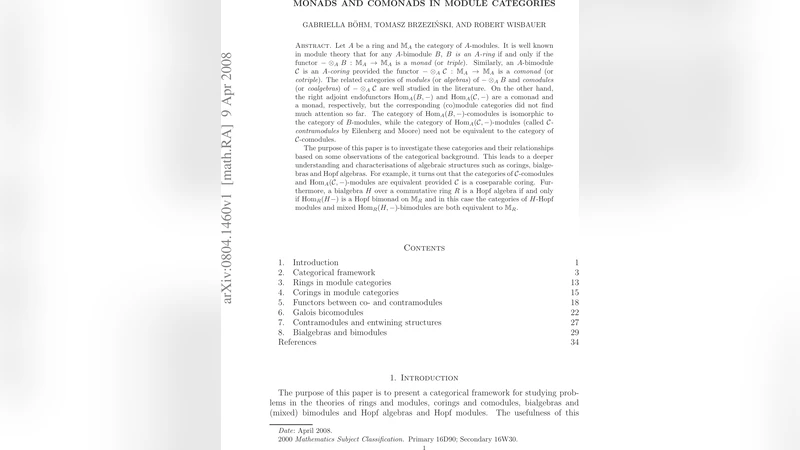
Let $A$ be a ring and $\M_A$ the category of $A$-modules. It is well known in module theory that for any $A $-bimodule $B$, $B$ is an $A$-ring if and only if the functor $-\otimes_A B: \M_A\to \M_A$ is a monad (or triple). Similarly, an $A $-bimodule $\C$ is an $A$-coring provided the functor $-\otimes_A\C:\M_A\to \M_A$ is a comonad (or cotriple). The related categories of modules (or algebras) of $-\otimes_A B$ and comodules (or coalgebras) of $-\otimes_A\C$ are well studied in the literature. On the other hand, the right adjoint endofunctors $\Hom_A(B,-)$ and $\Hom_A(\C,-)$ are a comonad and a monad, respectively, but the corresponding (co)module categories did not find much attention so far. The category of $\Hom_A(B,-)$-comodules is isomorphic to the category of $B$-modules, while the category of $\Hom_A(\C,-)$-modules (called $\C$-contramodules by Eilenberg and Moore) need not be equivalent to the category of $\C$-comodules. The purpose of this paper is to investigate these categories and their relationships based on some observations of the categorical background. This leads to a deeper understanding and characterisations of algebraic structures such as corings, bialgebras and Hopf algebras. For example, it turns out that the categories of $\C$-comodules and $\Hom_A(\C,-)$-modules are equivalent provided $\C$ is a coseparable coring. Furthermore, a bialgebra $H$ over a commutative ring $R$ is a Hopf algebra if and only if $\Hom_R(H-)$ is a Hopf bimonad on $\M_R$ and in this case the categories of $H$-Hopf modules and mixed $\Hom_R(H,-)$-bimodules are both equivalent to $\M_R$.
💡 Research Summary
The paper investigates the interplay between monads, comonads and their (co)module categories in the setting of module categories over a ring A. It begins by recalling the classical fact that an A‑bimodule B carries an A‑ring structure precisely when the tensor functor –⊗ₐB is a monad on 𝑀ₐ; the category of algebras for this monad coincides with the usual category of B‑modules. Dually, an A‑bimodule C is an A‑coring exactly when –⊗ₐC is a comonad, and its coalgebras are the familiar C‑comodules.
The novel contribution lies in turning to the right adjoint functors Homₐ(B,–) and Homₐ(C,–). The former is a comonad and its comodules are shown to be naturally isomorphic to B‑modules, a result that follows from the adjunction but had received little explicit attention. The latter, Homₐ(C,–), is a monad; its algebras are the so‑called C‑contramodules originally introduced by Eilenberg and Moore. Unlike the comodule case, contramodules need not be equivalent to comodules. The authors identify coseparability of the coring C as the precise condition guaranteeing an equivalence: when C is coseparable, the comparison functor between C‑comodules and Homₐ(C,–)‑modules is an equivalence of categories. This is proved by constructing a splitting of the counit of the comonad and showing that the induced forgetful‑free adjunction satisfies the Beck monadicity theorem.
The second major theme concerns bialgebras and Hopf algebras. For a bialgebra H over a commutative ring R, the functor –⊗₍R₎H is a bimonad (both monad and comonad) and its mixed modules are the classical Hopf modules. The paper proves that H is a Hopf algebra if and only if the right adjoint Hom₍R₎(H,–) forms a Hopf bimonad on 𝑀_R. In this situation the categories of H‑Hopf modules, of mixed Hom₍R₎(H,–)‑bimodules, and of the base category 𝑀_R are all equivalent. This characterisation provides a purely categorical criterion for the existence of an antipode and clarifies the role of the antipode as the invertibility datum required for the bimonad to be Hopf.
The authors also discuss situations where the equivalences fail. If C is not coseparable, contramodules can be strictly larger than comodules, and the comparison functor is only faithful, not essentially surjective. For bialgebras that are not Hopf, Hom₍R₎(H,–) fails to be a Hopf bimonad; the lack of an antipode manifests as the failure of the monad and comonad structures to satisfy the Hopf compatibility axioms. Additional hypotheses such as flatness of H as an R‑module or finite generation are examined, showing how they affect the monadicity and comonadicity conditions.
Concrete examples illustrate the theory: the authors treat finite‑dimensional coalgebras over a field, where coseparability is automatic, and demonstrate the equivalence of comodules and contramodules. They also analyze group algebras and quantum groups, highlighting how the Hopf bimonad condition recovers known results about Hopf modules and Yetter‑Drinfel’d modules.
In conclusion, the paper provides a unified categorical framework that links monads/comonads, (co)module categories, contramodules, and Hopf algebra theory. By identifying precise conditions—coseparability for corings and the Hopf bimonad property for bialgebras—it clarifies when the various module‑like categories coincide, thereby deepening our understanding of algebraic structures through the lens of category theory. Future directions suggested include extending the analysis to non‑coseparable corings, exploring higher‑dimensional bimonads, and applying the framework to braided and quasi‑Hopf algebras.
{# ── Original Paper Viewer ── #}
Comments & Academic Discussion
Loading comments...
Leave a Comment