Examples of para-cocyclic objects induced by BD-laws
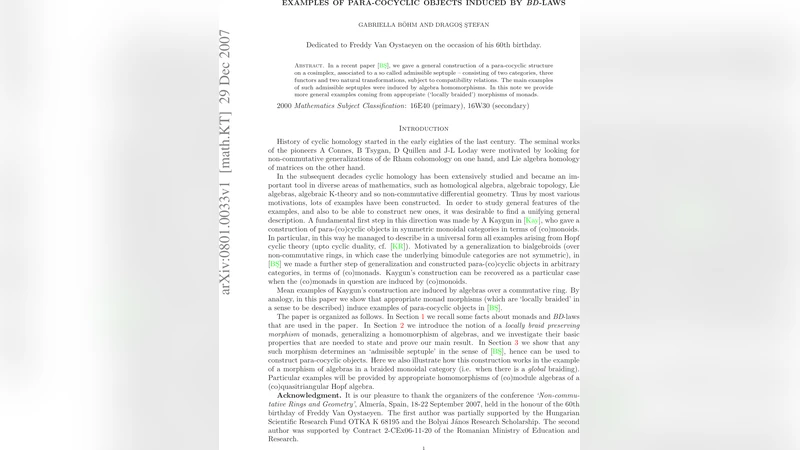
In a recent paper arXiv:0705.3190, we gave a general construction of a para-cocyclic structure on a cosimplex, associated to a so called admissible septuple – consisting of two categories, three functors and two natural transformations, subject to compatibility relations. The main examples of such admissible septuples were induced by algebra homomorphisms. In this note we provide more general examples coming from appropriate (`locally braided’) morphisms of monads.
💡 Research Summary
The paper revisits the construction of a para‑cocyclic structure on a cosimplicial object that was introduced in arXiv:0705.3190. In that earlier work the authors showed that a so‑called admissible septuple – consisting of two categories, three functors and two natural transformations satisfying four compatibility relations – is sufficient to endow a cosimplex with a para‑cocyclic operator. The main examples there were obtained from algebra homomorphisms.
In the present note the authors broaden the scope by showing that admissible septuples arise naturally from certain “locally braided” morphisms of monads, i.e. from a pair of monads equipped with a BD‑law. A BD‑law is a natural transformation β: T S ⇒ S T between two monads (T,μ,η) on a category 𝔄 and (S,ν,ε) on a category ℬ that satisfies four equations expressing compatibility of β with the units and multiplications of the monads. These equations are precisely the braided‑distributive (BD) relations familiar from the theory of braided monoidal categories, but they are formulated at the level of monads rather than at the level of the underlying tensor product.
When such a β exists, the authors construct the two natural transformations required for an admissible septuple by inserting β into the obvious composites involving the functor F: 𝔄 → ℬ and the monad structures. Explicitly, \
Comments & Academic Discussion
Loading comments...
Leave a Comment