(Co)cyclic (co)homology of bialgebroids: An approach via (co)monads
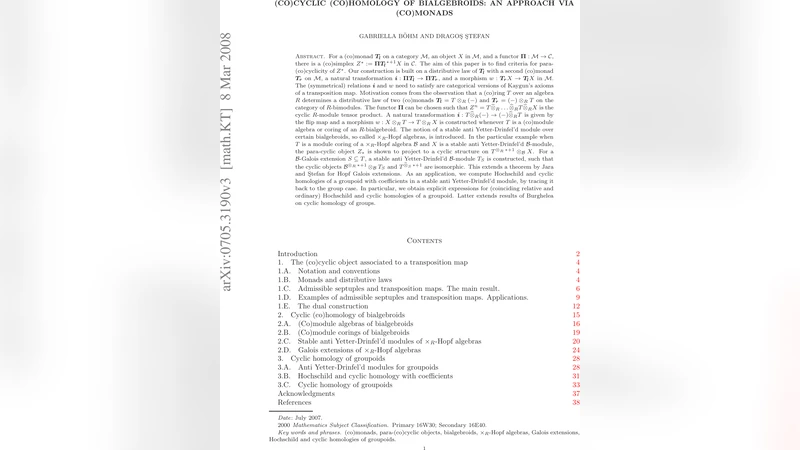
For a (co)monad T_l on a category M, an object X in M, and a functor \Pi: M \to C, there is a (co)simplex Z^:=\Pi T_l^{ +1} X in C. Our aim is to find criteria for para-(co)cyclicity of Z^. Construction is built on a distributive law of T_l with a second (co)monad T_r on M, a natural transformation i:\Pi T_l \to \Pi T_r, and a morphism w: T_r X \to T_l X in M. The relations i and w need to satisfy are categorical versions of Kaygun’s axioms of a transposition map. Motivation comes from the observation that a (co)ring T over an algebra R determines a distributive law of two (co)monads T_l=T \otimes_R (-) and T_r = (-)\otimes_R T on the category of R-bimodules. The functor \Pi can be chosen such that Z^n= T\hat{\otimes}_R… \hat{\otimes}_R T \hat{\otimes}_R X is the cyclic R-module tensor product. A natural transformation i:T \hat{\otimes}_R (-) \to (-) \hat{\otimes}R T is given by the flip map and a morphism w: X \otimes_R T \to T\otimes_R X is constructed whenever T is a (co)module algebra or coring of an R-bialgebroid. Stable anti Yetter-Drinfel’d modules over certain bialgebroids, so called x_R-Hopf algebras, are introduced. In the particular example when T is a module coring of a x_R-Hopf algebra B and X is a stable anti Yetter-Drinfel’d B-module, the para-cyclic object Z is shown to project to a cyclic structure on T^{\otimes_R *+1} \otimes_B X. For a B-Galois extension S \to T, a stable anti Yetter-Drinfel’d B-module T_S is constructed, such that the cyclic objects B^{\otimes_R *+1} \otimes_B T_S and T^ {\hat{\otimes}_S *+1} are isomorphic. As an application, we compute Hochschild and cyclic homology of a groupoid with coefficients, by tracing it back to the group case. In particular, we obtain explicit expressions for ordinary Hochschild and cyclic homology of a groupoid.
💡 Research Summary
The paper develops a categorical framework for constructing para‑(co)cyclic objects from a (co)monad Tₗ on a category M, an object X∈M, and a functor Π:M→C. The basic construction yields a (co)simplex Zⁿ = Π Tₗ^{n+1} X. To promote Z⁎ to a para‑(co)cyclic object, the authors introduce a second (co)monad Tᵣ together with a distributive law λ:Tₗ Tᵣ⇒Tᵣ Tₗ, a natural transformation i:Π Tₗ⇒Π Tᵣ, and a morphism w:Tᵣ X→Tₗ X. These data must satisfy categorical analogues of Kaygun’s transposition‑map axioms: (i) i and λ commute in a square, (ii) w intertwines the face, degeneracy and cyclic operators induced by λ and i in a triangular diagram, and (iii) w respects the (co)monad structures. When these conditions hold, Z⁎ becomes a para‑(co)cyclic object; additional normalisation (e.g., w an isomorphism) yields a genuine cyclic object.
The main source of such data comes from a coring (or ring) T over an algebra R. The coring determines two (co)monads on the category of R‑bimodules: Tₗ = T⊗_R (–) and Tᵣ = (–)⊗_R T. The distributive law λ is the canonical associativity isomorphism, while i is simply the flip map t⊗x↦x⊗t. A morphism w can be built whenever T carries a (co)module algebra or coring structure over a bialgebroid B. In that situation B is an x_R‑Hopf algebra (a bialgebroid equipped with an antipode‑like map satisfying suitable axioms). For a stable anti‑Yetter‑Drinfel’d (SAYD) B‑module X, the map w:X⊗_R T→T⊗_R X is defined using the B‑action and coaction, and it satisfies all required axioms. Consequently the associated para‑cyclic object has components
Zⁿ = T ⊗̂_R … ⊗̂_R T ⊗̂_R X (n+1 copies of T),
where ⊗̂_R denotes the cyclic R‑module tensor product. The face, degeneracy and cyclic operators are precisely those induced by the (co)monad structures together with i and w, reproducing the familiar cyclic structure on the Hochschild complex when B is a Hopf algebra and T is a module coring.
A further significant result concerns B‑Galois extensions S→T. The authors construct a SAYD B‑module T_S and prove a natural isomorphism
B^{⊗_R *+1} ⊗_B T_S ≅ T^{⊗̂_S *+1}.
Thus the cyclic object built from the B‑module tensor product coincides with the cyclic object obtained from the S‑relative tensor powers of T. This identification allows one to transfer homological calculations between the B‑side and the S‑side.
The theory is applied to groupoids. By viewing a groupoid as a Hopf algebroid (or as a Galois extension of its object algebra), the authors reduce the computation of its Hochschild and cyclic homology with coefficients to the classical group case. Explicit formulas are derived for ordinary Hochschild homology HH_(𝔾) and cyclic homology HC_(𝔾) of a groupoid 𝔾, showing that they decompose as direct sums over the connected components, each component contributing the homology of the corresponding isotropy group.
In summary, the paper provides a unifying categorical approach to (co)cyclic homology for bialgebroids, corings, and their module/comodule structures. By exploiting distributive laws of two (co)monads, together with a flip natural transformation and a transposition map w, it extends the classical Hopf‑algebra cyclic theory to the broader setting of x_R‑Hopf algebras and Galois extensions. The framework yields concrete computational tools, illustrated by the explicit homology formulas for groupoids, and opens the way for further applications to noncommutative geometry and quantum groupoid theory.
Comments & Academic Discussion
Loading comments...
Leave a Comment