Scrabble is PSPACE-Complete
In this paper we study the computational complexity of the game of Scrabble. We prove the PSPACE-completeness of a derandomized model of the game, answering an open question of Erik Demaine and Robert Hearn.
💡 Research Summary
The paper “Scrabble is PSPACE‑Complete” investigates the computational complexity of a deterministic version of the popular word‑placement game Scrabble. The authors first formalize a “derandomized” Scrabble model in which the sequence of tiles is fixed in advance, the initial board configuration is given, and the dictionary of allowable words is known to both players. Under these assumptions the game becomes a perfect‑information, turn‑based two‑player game, allowing the authors to treat it within the standard framework of combinatorial game complexity.
The central decision problem, called Scrabble‑PSPACE, asks whether the player whose turn it is can force a win from a given position, assuming optimal play from both sides. To show that this problem lies in PSPACE, the authors describe a depth‑first search algorithm that explores the game tree using only linear space. The algorithm stores the current board state and the multiset of remaining tiles, both of which require O(n) space where n is the size of the board plus the number of tiles. Because each recursive call reduces the number of remaining tiles, the recursion depth is bounded by n, and the total space consumption remains polynomial. Consequently, Scrabble‑PSPACE belongs to PSPACE.
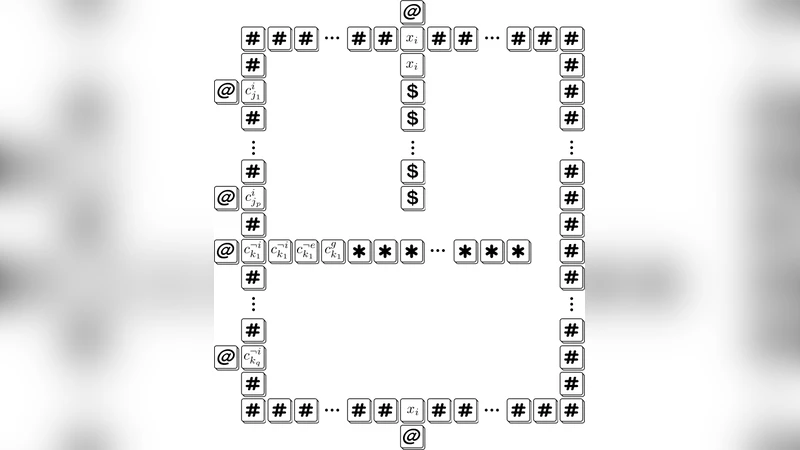
The more challenging part of the proof is establishing PSPACE‑hardness. The authors construct a polynomial‑time reduction from Quantified Boolean Formula (QBF), a canonical PSPACE‑complete problem, to an instance of deterministic Scrabble. The reduction encodes each quantified variable as a “plug” of tiles placed at a designated region of the board, and each clause as a “socket” where plugs intersect. An existential quantifier (∃) corresponds to a move where the current player chooses a placement that represents setting the variable to true or false; a universal quantifier (∀) forces the opponent to make the complementary choice, thereby simulating the alternating quantifier structure of QBF.
Each clause is represented by a set of intersecting word patterns that can only be completed if at least one of its literals is satisfied. The dictionary is carefully crafted so that the only legal words are those that correspond to valid literal assignments and clause satisfaction. The construction respects all ordinary Scrabble constraints: word length limits, board boundaries, and tile availability. Auxiliary “blocking” tiles and a restricted dictionary are introduced to prevent unintended word formations that could break the reduction.
When the reduction is applied, the resulting Scrabble position has the property that the first player can force a win if and only if the original QBF formula is true. If the formula is false, the opponent can always block the necessary word completions, preventing a win. The size of the board, the number of tiles, and the dictionary all grow linearly with the size of the QBF instance, ensuring that the transformation is indeed polynomial‑time.
By combining the PSPACE membership argument with the QBF reduction, the authors conclude that deterministic Scrabble is PSPACE‑complete. This result places Scrabble in the same complexity class as classic strategic games such as Chess, Go, and Checkers, demonstrating that even a seemingly simple word game can encode arbitrarily complex logical reasoning. The paper also discusses the implications of re‑introducing randomness (the usual tile draw) and suggests that the stochastic version may be even harder, potentially lying beyond PSPACE. Future work is proposed on approximation algorithms, heuristic AI for Scrabble, and extensions of the reduction technique to other word‑based puzzles.
Comments & Academic Discussion
Loading comments...
Leave a Comment