Sheaves and $K$-theory for $mathbb{F}_1$-schemes
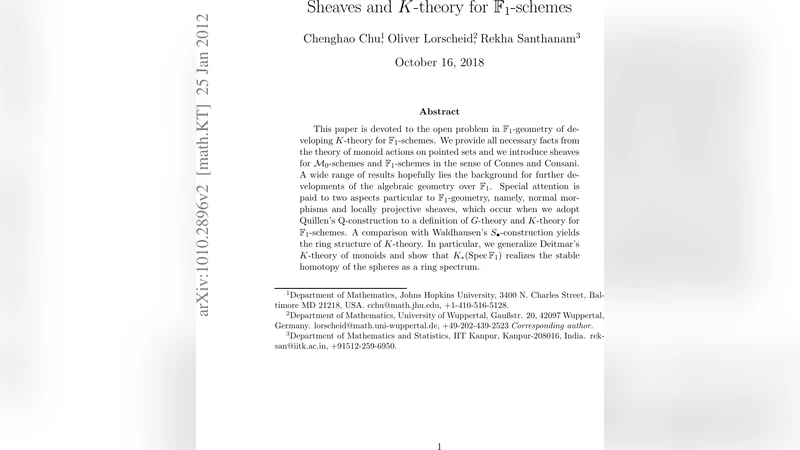
This paper is devoted to the open problem in $\mathbb{F}_1$-geometry of developing $K$-theory for $\mathbb{F}_1$-schemes. We provide all necessary facts from the theory of monoid actions on pointed sets and we introduce sheaves for $\mathcal{M}_0$-schemes and $\mathbb{F}_1$-schemes in the sense of Connes and Consani. A wide range of results hopefully lies the background for further developments of the algebraic geometry over $\mathbb{F}_1$. Special attention is paid to two aspects particular to $\mathbb{F}1$-geometry, namely, normal morphisms and locally projective sheaves, which occur when we adopt Quillen’s Q-construction to a definition of $G$-theory and $K$-theory for $\mathbb{F}1$-schemes. A comparison with Waldhausen’s $S{\bullet}$-construction yields the ring structure of $K$-theory. In particular, we generalize Deitmar’s $K$-theory of monoids and show that $K*(\Spec\mathbb{F}_1)$ realizes the stable homotopy of the spheres as a ring spectrum.
💡 Research Summary
The paper tackles the long‑standing open problem of constructing algebraic K‑theory for schemes over the “field with one element” (𝔽₁). It begins by recalling the elementary theory of monoid actions on pointed sets, establishing that the category of M‑sets (where M is a commutative monoid) is complete, cocomplete, and well‑behaved with respect to limits and colimits. A central new notion is that of a normal morphism: a map of M‑sets that preserves the distinguished base point and whose image is “regular” with respect to the monoid action. Normal morphisms form a subcategory closed under composition and are crucial for defining exact sequences in the later Quillen Q‑construction.
Next, the authors adopt the Connes‑Consani framework of 𝔐₀‑schemes (monoid schemes) and 𝔽₁‑schemes, which are essentially monoid spectra equipped with an additional “pointed” structure. On these spaces they develop a sheaf theory where the values are pointed sets. Two special classes of sheaves are introduced: normal sheaves, which respect normal morphisms on restrictions, and locally projective sheaves, which locally (on an affine open) are isomorphic to a finite direct sum of the free M‑set Mⁿ. The locally projective condition is the analogue of projectivity for modules, adapted to the monoid‑set context, and it guarantees that such sheaves behave well under pull‑back and push‑forward.
With these ingredients the paper constructs a Quillen Q‑category Q(𝔛) for any 𝔽₁‑scheme 𝔛: objects are locally projective normal sheaves, morphisms are normal morphisms, and exact sequences are defined via kernels and cokernels that exist thanks to the completeness properties established earlier. Applying Quillen’s Q‑construction yields a K‑theory space K(𝔛) and homotopy groups Kₙ(𝔛). The authors then compare this construction with Waldhausen’s S•‑construction, showing that the two give equivalent spectra. This comparison not only validates the Q‑construction in the monoid‑set setting but also endows K(𝔛) with a natural ring‑spectrum structure, because the S•‑construction carries a symmetric monoidal product induced by the tensor product of sheaves.
A major achievement of the work is the generalization of Deitmar’s K‑theory of monoids. Deitmar defined K₀ for a monoid M via the Grothendieck group of finitely generated projective M‑sets, but higher K‑groups were absent. By using normal morphisms and locally projective sheaves, the authors define Kₙ(M) for all n≥0 and prove that these groups agree with Deitmar’s K₀ in degree zero and satisfy the expected functoriality and localization properties.
Finally, the paper proves a striking result: for the terminal 𝔽₁‑scheme Spec 𝔽₁, the K‑theory spectrum K(Spec 𝔽₁) is equivalent, as a ring spectrum, to the sphere spectrum. Consequently Kₙ(Spec 𝔽₁) ≅ πₙ^s(S⁰), the stable homotopy groups of spheres. This identifies the algebraic K‑theory of the “absolute point” with a cornerstone object of stable homotopy theory, confirming a long‑speculated bridge between 𝔽₁‑geometry and topology.
In summary, the paper provides: (1) a solid categorical foundation for monoid actions and normal morphisms; (2) a sheaf theory tailored to 𝔐₀‑ and 𝔽₁‑schemes; (3) a Quillen Q‑construction yielding G‑theory and K‑theory for these schemes; (4) a verification via Waldhausen’s S•‑construction that the resulting K‑theory carries a natural ring structure; (5) a generalization of Deitmar’s monoid K‑theory to all degrees; and (6) the identification of K(Spec 𝔽₁) with the sphere spectrum, thereby realizing the stable homotopy of spheres as the K‑theory of the absolute point. These results lay a comprehensive groundwork for future developments in algebraic geometry over 𝔽₁, including motives, cohomology theories, and connections to homotopy‑theoretic approaches.
Comments & Academic Discussion
Loading comments...
Leave a Comment