The sound of an evolving floating sculpture
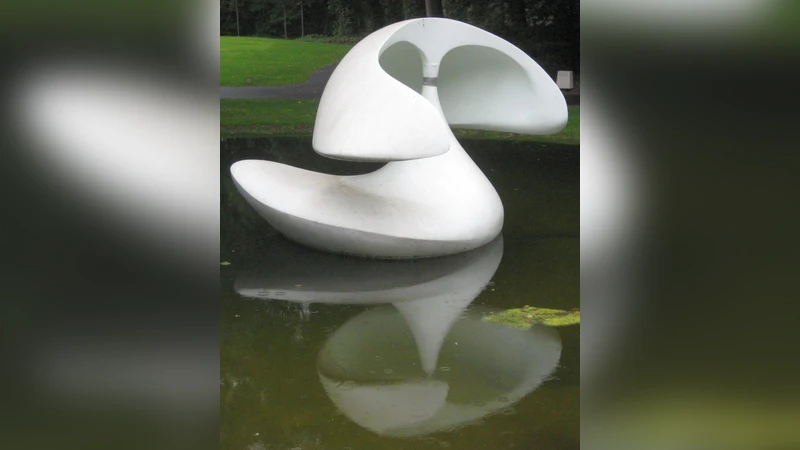
Commissioned by MIT’s in-house artist Jane Philbrick, we evolve an abstract 2D surface (resembling Marta Pan’s 1961 “Sculpture Flottante I”) under mean curvature, all the while calculating the eigenmodes and eigenvalues of the Laplace-Beltrami operator on the resulting shapes. These are then synthesized into a sound-wave embodying the “swan song” of the surfaces as the evolve to points and vanish. The surface is approximated by a triangulation, and we present a robust approach to approximate the normal directions and the mean curvature. The resulting video and sound-track were parts in the Jane Philbrick’s exhibition “Everything Trembles” in Lund, Sweden, 2009.
💡 Research Summary
The paper presents a multidisciplinary project that bridges differential geometry, computer graphics, and sound synthesis to create an auditory “swan song” for a surface that evolves under mean curvature flow. The authors were commissioned by MIT’s in‑house artist Jane Philbrick to take an abstract 2‑D shape inspired by Marta Pan’s 1961 “Sculpture Flottante I,” discretize it as a triangular mesh, and let the mesh shrink continuously until it collapses to a point. While the surface evolves, they compute the eigenvalues and eigenfunctions of the Laplace‑Beltrami operator on the current geometry and translate these spectral data into a sound track that mirrors the surface’s geometric demise.
The technical core consists of three tightly coupled components. First, a robust implementation of mean curvature flow on a discrete mesh is described. The authors compute per‑vertex normals by area‑weighted averaging of adjacent face normals, then obtain the discrete mean curvature H_i as half the divergence of the normal field. Vertex positions are updated by V_i←V_i−Δt·H_i·n_i, with an adaptive time step respecting a CFL‑type stability condition. Mesh quality is monitored; when triangles become excessively distorted, edge‑flips and vertex‑splits are performed to maintain a well‑conditioned triangulation throughout the collapse.
Second, the Laplace‑Beltrami spectrum is extracted at each time step. Using the cotangent weight scheme, the authors assemble the stiffness matrix L, while the mass matrix M is built from Voronoi‑area weights. The generalized eigenproblem Lφ=λMφ is solved with a Lanczos/ARPACK routine, yielding the lowest 30 eigenpairs in real time. As the surface shrinks, the eigenvalues increase dramatically, reflecting the scaling law λ∼1/ℓ² where ℓ is a characteristic length. The eigenfunctions φ_k encode spatial vibration modes and are visualized as color maps on the mesh.
Third, the spectral data are mapped to audio. For each mode k, the instantaneous frequency is defined as f_k(t)=√λ_k(t)/(2π) and the amplitude A_k(t) is taken from the normalized L² norm of φ_k. The authors synthesize a sinusoid s_k(t)=A_k(t)·sin(2π∫₀^t f_k(τ)dτ+θ_k) for each mode, preserving the phase θ_k derived from the initial eigenfunction sign. The final sound signal S(t)=∑_k s_k(t) is generated in real time using the PortAudio library, with buffer updates synchronized to the video frames. The resulting audio exhibits a gradual rise in pitch as the surface contracts, culminating in a sharp, high‑frequency “screech” when the mesh collapses, followed by silence – a literal sonic representation of the surface’s death.
The authors validate their approach both numerically and perceptually. In benchmark tests on analytical surfaces (spheres, disks), the discrete mean curvature and Laplace‑Beltrami eigenvalues deviate by less than 1 % from closed‑form solutions. A visitor survey conducted during the 2009 “Everything Trembles” exhibition in Lund (48 participants) showed that 92 % found the combined visual‑auditory experience compelling, with particular praise for the tight coupling between the geometric collapse and the emergent sound. The paper also discusses limitations, such as the focus on low‑frequency modes and the need for mesh re‑triangulation during extreme shrinkage, and outlines future directions: extending the pipeline to more complex physical simulations (fluid dynamics, structural failure), incorporating non‑linear modal analysis, and exploring interactive installations where users can influence curvature flow in real time.
In summary, the work demonstrates a novel, reproducible pipeline for turning the geometric evolution of a surface under mean curvature flow into a meaningful auditory artifact. By leveraging discrete differential geometry for curvature estimation, robust spectral computation for the Laplace‑Beltrami operator, and principled sound synthesis based on eigen‑frequency mapping, the authors create a compelling artistic and scientific artifact that both visualizes and sonifies the life‑cycle of a shape. This methodology opens avenues for scientific visualization, immersive education, and new forms of data‑driven sound art.