The Knowledge-Based Economy and the Triple Helix Model
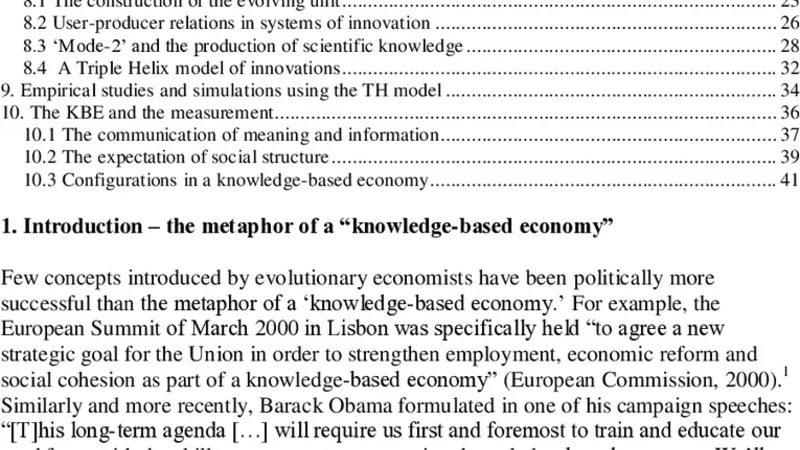
- Introduction - the metaphor of a “knowledge-based economy”; 2. The Triple Helix as a model of the knowledge-based economy; 3. Knowledge as a social coordination mechanism; 4. Neo-evolutionary dynamics in a Triple Helix of coordination mechanism; 5. The operation of the knowledge base; 6. The restructuring of knowledge production in a KBE; 7. The KBE and the systems-of-innovation approach; 8. The KBE and neo-evolutionary theories of innovation; 8.1 The construction of the evolving unit; 8.2 User-producer relations in systems of innovation; 8.3 ‘Mode-2’ and the production of scientific knowledge; 8.4 A Triple Helix model of innovations; 9. Empirical studies and simulations using the TH model; 10. The KBE and the measurement; 10.1 The communication of meaning and information; 10.2 The expectation of social structure; 10.3 Configurations in a knowledge-based economy
💡 Research Summary
The paper offers a comprehensive theoretical and empirical treatment of the Knowledge‑Based Economy (KBE) by foregrounding the Triple Helix (TH) model—an interaction framework among universities, industry, and government. It begins by critiquing the metaphor of a “knowledge‑based economy,” emphasizing that knowledge differs from traditional material inputs: it is non‑tangible, highly networked, and circulates rapidly, thereby reshaping economic coordination.
The authors adopt the TH model as the structural backbone of KBE. Each helix strand retains a distinctive functional niche—universities generate basic research and human capital, industry translates research into marketable products and services, and government provides policy, regulation, and financing. While these roles are institutionally distinct, their intersections become “innovation hotspots” where new knowledge flows emerge, are recombined, and diffuse across the system.
A central contribution is the reconceptualization of knowledge as a social coordination mechanism. In this view, information reduces uncertainty, whereas meaning aligns expectations and values among actors. The dual process of communication thus simultaneously reconfigures economic performance and social structure, moving beyond price‑centric models of classical economics.
The paper then embeds the TH dynamics within a neo‑evolutionary framework. Knowledge evolves through a two‑step cycle of variation (novel ideas, technologies, or policies generated by any helix) and selection (market demand, academic peer review, and policy priorities acting across multiple layers). Self‑organization and network codes guide which variations become entrenched, producing a path‑dependent trajectory of systemic change.
The operation of the knowledge base is described as a circular flow: universities produce new knowledge, industry commercializes it, and government shapes the institutional environment that facilitates diffusion. Feedback loops ensure continuous adjustment, allowing the system to respond to shifting external conditions.
A significant portion of the manuscript addresses the shift from “Mode‑1” (discipline‑centric, hierarchical) to “Mode‑2” (problem‑oriented, transdisciplinary, socially embedded) knowledge production. Mode‑2 is portrayed as a co‑creation process where users and producers jointly shape outcomes, a dynamic that aligns naturally with the collaborative ethos of the Triple Helix.
Comparisons with the broader Systems‑of‑Innovation literature reveal that while the latter emphasizes geographic or national networks, the TH model focuses on functional cross‑overs and dynamic re‑configuration among the three institutional spheres. The authors argue that integrating both perspectives yields a richer policy toolkit.
In the neo‑evolutionary section, the paper details how to define and measure the “evolving unit” of analysis, examines user‑producer relations, and explicates the role of Mode‑2 in generating systemic novelty. A schematic Triple Helix innovation model is presented, illustrating pathways from knowledge creation to market uptake and policy reinforcement.
Empirical validation is provided through case studies and simulation experiments. Bibliometric indicators (patents, publications, R&D expenditures) are combined with network‑analysis metrics (collaboration density, betweenness centrality) to quantify the strength of inter‑helix ties and their impact on innovation performance. Simulations explore how variation rates and selection pressures affect system stability, growth, and resilience.
The final measurement chapter distinguishes between “information” (raw data) and “meaning” (semantic content), models societal expectations, and introduces the concept of “configurations” to capture evolving network structures within the KBE. These methodological tools enable scholars and policymakers to track the dynamic re‑shaping of knowledge flows over time.
In conclusion, the authors portray the Knowledge‑Based Economy not as a static accumulation of intellectual assets but as a continuously self‑organizing, adaptive system driven by the synergistic interaction of universities, industry, and government. The integrated theoretical‑empirical approach offers actionable insights for policymakers and managers seeking to nurture innovation ecosystems, manage variation‑selection dynamics, and sustain long‑term economic and social value creation.
Comments & Academic Discussion
Loading comments...
Leave a Comment