On trajectories of vortices in the compressible fluid on a two-dimensional manifold
For the model of a compressible barotropic fluid on a two dimensional rotating Riemmanian manifold we discuss a special class of smooth solutions having a form of a steady non-singular vortex moving with a bearing field. The model can be obtained from the system of primitive equations governing the motion of air over the Earth surface after averaging over the height and therefore the solution obtained can be interpreted as a tropical cyclone which is known as a long time existing stable vortex. We consider approximations of $l$- plane and $\beta$ - plane used in geophysics for modeling of middle scale processes and equations on the whole sphere as well. We show that the solutions of the mentioned form satisfy the equations of the model either exactly or with a discrepancy which is small in a neighborhood of the trajectory of the center of vortex. We perform a numeric study of the change of the shape of the vortex affected by the neglecting the discrepancy term.
💡 Research Summary
The paper investigates a class of smooth, non‑singular vortex solutions for a compressible barotropic fluid on a rotating two‑dimensional Riemannian manifold. Starting from the primitive equations governing atmospheric motion, the authors perform a vertical averaging to obtain a two‑dimensional model that retains the essential dynamics of large‑scale tropical cyclones. The central idea is to look for solutions that consist of a steady vortex structure, described by a stream‑function that depends only on the distance from the vortex centre, together with a uniform background flow (the “bearing field”). The vortex centre is allowed to move in time, and its trajectory is determined by the interaction between the bearing field, the Coriolis parameter, and the pressure gradient.
The analysis is carried out under three common geophysical approximations. In the l‑plane case the Coriolis parameter is taken as a constant; the vortex centre follows a circular path with a constant angular speed, and the vortex shape remains unchanged. In the β‑plane case the Coriolis parameter varies linearly with latitude (l = l₀ + βy). Here the centre experiences a slow meridional drift (the well‑known β‑drift) while the vortex core may expand or contract depending on the strength of the bearing field. Finally, the authors treat the full‑sphere geometry by expressing the governing equations in spherical coordinates, expanding the stream‑function in spherical harmonics, and incorporating the curvature‑induced modifications of the Laplacian and Coriolis terms. They show that, provided the vortex radius is small compared with the Earth’s radius, the spherical solution reduces to the planar ones up to corrections of order (radius/earth)².
A key technical step is the decomposition of the velocity field into a rotational part derived from a scalar potential Ψ(ξ) and a translational part U₀, where ξ denotes the coordinate relative to the moving centre X(t). Substituting this ansatz into the momentum and continuity equations yields a coupled system for Ψ and the pressure perturbation P₁(ξ). The authors choose specific functional forms for Ψ (e.g., Gaussian or Rankine profiles) that satisfy the vorticity equation exactly, and then derive the associated pressure field. The resulting equations for X(t) are ordinary differential equations that involve the gradient of the bearing pressure field and the spatial variation of the Coriolis parameter.
Because the bearing field is generally not perfectly uniform, a discrepancy term appears in the reduced equations. The authors quantify this term by evaluating its L²‑norm in a neighbourhood Ωε of the vortex centre. They prove that the norm scales as O(ε²), meaning that the discrepancy becomes negligible as the neighbourhood shrinks. Consequently, the approximate vortex solution satisfies the full compressible model to high accuracy in the region where the cyclone actually resides.
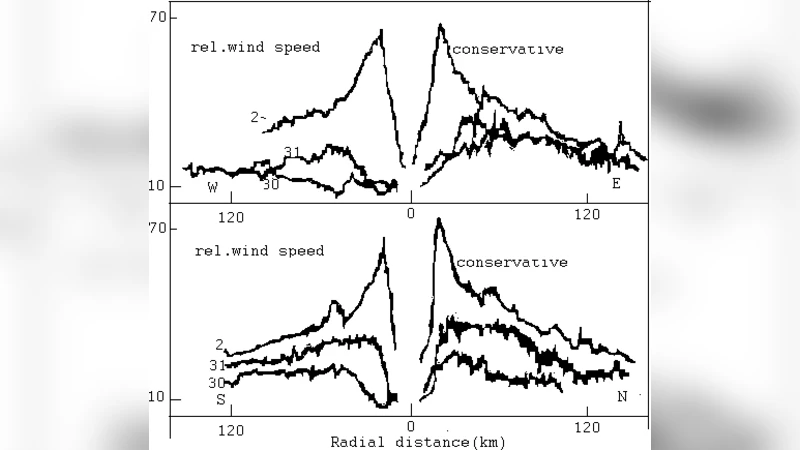
To assess the practical impact of neglecting the discrepancy term, the paper presents numerical experiments. An initial Gaussian vortex is prescribed, and the system is integrated forward in time on the l‑plane, β‑plane, and spherical domains. The simulations confirm the analytical predictions: on the l‑plane the vortex retains its circular shape and moves on a closed orbit; on the β‑plane the centre drifts north‑south while the vortex core slightly widens and its central pressure drops, reflecting the influence of the meridional gradient of the Coriolis parameter; on the sphere the trajectory follows a curved path that mirrors the combined effects of latitude‑dependent Coriolis force and curvature, yet the vortex remains coherent for many rotation periods.
The paper’s contributions are threefold. First, it provides an explicit construction of non‑singular vortex solutions for a compressible rotating fluid, bridging the gap between idealized incompressible vortex models and realistic atmospheric dynamics. Second, it demonstrates that these solutions are exact on the l‑plane and β‑plane, and are accurate up to a small, controllable error on the sphere. Third, it offers a clear quantitative framework for evaluating the error introduced by ignoring the bearing‑field discrepancy, thereby justifying the use of such simplified vortex models in operational tropical‑cyclone forecasting and in theoretical studies of mid‑scale geophysical flows.
Comments & Academic Discussion
Loading comments...
Leave a Comment