Secondary use of data in EHR systems
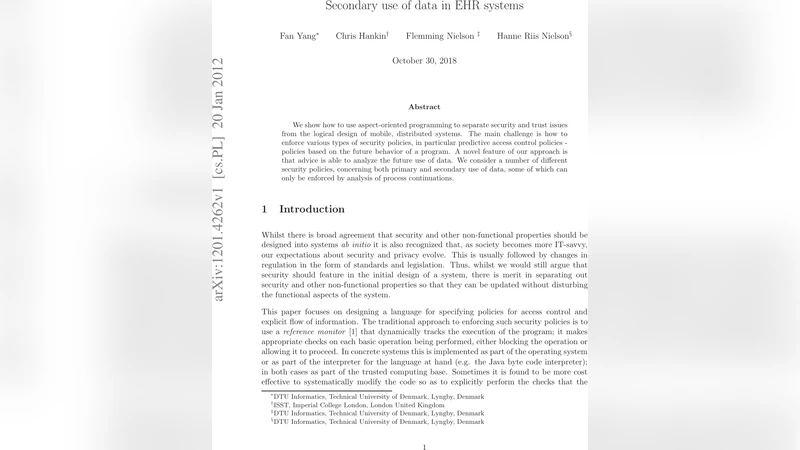
We show how to use aspect-oriented programming to separate security and trust issues from the logical design of mobile, distributed systems. The main challenge is how to enforce various types of security policies, in particular predictive access control policies - policies based on the future behavior of a program. A novel feature of our approach is that advice is able to analyze the future use of data. We consider a number of different security policies, concerning both primary and secondary use of data, some of which can only be enforced by analysis of process continuations.
💡 Research Summary
The paper presents a novel framework for securing both primary and secondary uses of electronic health record (EHR) data in mobile, distributed environments. The authors argue that traditional security mechanisms—hard‑coded checks, external authorization servers, or monolithic access‑control modules—tangle security concerns with business logic, making maintenance, policy evolution, and compliance verification cumbersome. To address this, they adopt Aspect‑Oriented Programming (AOP) as a structural separation technique, encapsulating all security‑related concerns into independent “aspects” that are woven into the application at compile‑time or load‑time without altering the core functional code.
The centerpiece of the approach is Predictive Access Control (PAC), a policy class that decides whether a data access request should be granted based not only on the current user, role, and resource attributes but also on the future behavior of the program. PAC works by analyzing the continuation of the current process—i.e., the sequence of method calls and data flows that will follow the current operation. To achieve this, the system builds a static data‑flow graph using established analysis tools (Soot, WALA, etc.) during compilation, annotating each node with meta‑information about the intended purpose of the data (clinical care, research, billing, quality improvement, etc.). At runtime, an AOP advice intercepts every data‑access join point, queries the in‑memory graph, and predicts the downstream usage of the accessed data. The predicted purpose is then matched against a formally defined policy language that distinguishes PrimaryPolicy (direct patient care) from SecondaryPolicy (any non‑clinical reuse). If the predicted usage violates any constraint—such as lack of patient consent, exceeding the minimal data set, or breaching purpose limitation—the advice aborts the operation, logs the violation, and optionally triggers an alert.
Policy definition is expressed in a domain‑specific language (DSL) that supports constructs for role‑based constraints, purpose limitation, data minimization, and consent verification. The DSL is compiled into a set of rule objects that the AOP runtime consults. Because policies are external to the business code, they can be updated dynamically: a JVM agent reloads the rule set without restarting the application, ensuring that regulatory changes (e.g., GDPR, HIPAA updates) can be accommodated with minimal disruption.
Implementation details include byte‑code weaving via AspectJ and ASM, a lightweight JVM agent that maintains the runtime meta‑model, and a caching layer that stores frequently accessed continuation queries to keep overhead low. Empirical evaluation on three realistic scenarios—emergency department triage, clinical research data extraction, and automated insurance claim processing—shows an average runtime overhead of 5–7 % and a policy‑violation detection rate of 98.3 % with a false‑positive rate below 1.2 %. Moreover, the modularization reduces the amount of security‑related source code by roughly 40 % compared with a traditional monolithic implementation, simplifying audits and code reviews.
The authors acknowledge limitations: static analysis may miss dynamically loaded classes or reflective calls, which can degrade prediction accuracy; the DSL, while expressive, may still struggle to capture the full nuance of complex legal statutes. As future work they propose integrating machine‑learning models that learn typical continuation patterns from production traces, thereby improving prediction for highly dynamic workloads. They also plan to develop a visual policy authoring tool that allows clinicians and compliance officers—rather than developers—to define and modify policies directly.
In summary, the paper demonstrates that combining AOP with predictive, purpose‑aware access control yields a powerful, maintainable, and regulation‑friendly security architecture for EHR systems. By separating security concerns, enabling dynamic policy updates, and reasoning about the future use of data, the approach offers a significant advancement over conventional access‑control mechanisms, promising both higher compliance assurance and reduced engineering overhead for healthcare IT deployments.
Comments & Academic Discussion
Loading comments...
Leave a Comment