QCD against BlackHoles of Stellar Mass
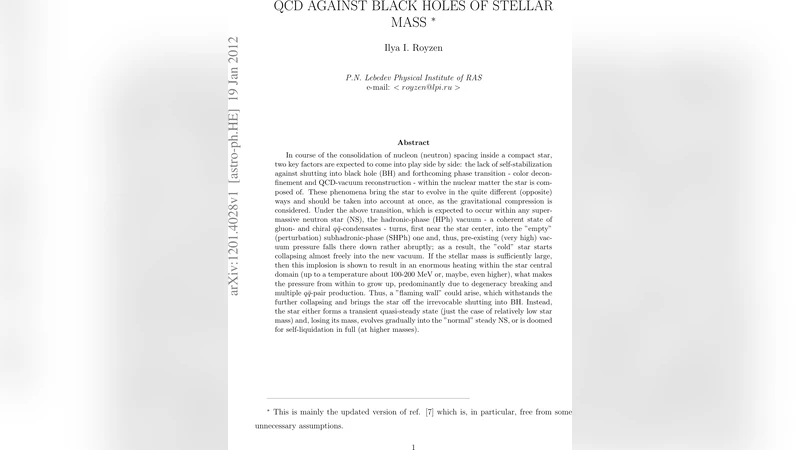
In course of the consolidation of nucleon (neutron) spacing inside a compact star, two key factors are expected to come into play side by side: the lack of self-stabilization against shutting into black hole (BH) and forthcoming phase transition - color deconfinement and QCD-vacuum reconstruction - within the nuclear matter the star is composed of. These phenomena bring the star to evolve in the quite different (opposite) ways and should be taken into account at once, as the gravitational compression is considered. Under the above transition, which is expected to occur within any supermassive neutron star (NS), the hadronic-phase (HPh) vacuum - a coherent state of gluon- and chiral $q\bar q$-condensates - turns, first near the star center, into the “empty” (perturbation) subhadronic-phase (SHPh) one and, thus, pre-existing (very high) vacuum pressure falls there down rather abruptly; as a result, the “cold” star starts collapsing almost freely into the new vacuum. If the stellar mass is sufficiently large, then this implosion is shown to result in an enormous heating within the star central domain (up to a temperature about 100-200 MeV or, maybe, even higher), what makes the pressure from within to grow up, predominantly due to degeneracy breaking and multiple $q\bar q$-pair production. Thus, a “flaming wall” could arise, which withstands the further collapsing and brings the star off the irrevocable shutting into BH. Instead, the star either forms a transient quasi-steady state (just the case of relatively low star mass) and, losing its mass, evolves gradually into the “normal” steady NS, or is doomed for self-liquidation in full (at higher masses).
💡 Research Summary
The paper tackles the long‑standing problem of what ultimately happens to a neutron star (NS) whose mass approaches or exceeds the conventional black‑hole (BH) formation threshold. It argues that two processes, which are usually treated separately, must be considered simultaneously: (i) the gravitational compression that drives a massive compact star toward collapse, and (ii) a quantum‑chromodynamic (QCD) phase transition in the dense nuclear matter that changes the nature of the vacuum. In the hadronic phase (HPh) the vacuum is a coherent condensate of gluons and chiral quark‑antiquark pairs, providing a large “vacuum pressure” that contributes to the star’s overall pressure support. When the central density becomes high enough, the paper posits that the HPh vacuum abruptly converts into a sub‑hadronic (SHPh) or perturbative vacuum, essentially a deconfined quark‑gluon plasma (QGP). This conversion eliminates the vacuum pressure in the core, allowing the inner region to fall almost freely toward the new vacuum state.
Because the transition releases a huge amount of latent energy, the core temperature is expected to rise to 100–200 MeV, i.e., the temperature range where QCD predicts a deconfined plasma. At such temperatures the thermal pressure of the QGP, dominated by the breaking of fermionic degeneracy and prolific quark‑antiquark pair creation, can become comparable to or exceed the gravitational pull. The authors call this high‑temperature barrier a “flaming wall.” If the wall is sufficiently robust, it can halt further collapse, preventing the formation of an event horizon.
Two possible outcomes are then outlined. For a relatively modest excess mass, the flaming wall can persist long enough for the star to settle into a quasi‑steady configuration. In this state the hot plasma gradually cools, primarily by emitting neutrinos and possibly other particles, thereby shedding mass. The star would then evolve back into a conventional, “cold” neutron star. For a larger excess mass, the wall would be short‑lived; the core would continue collapsing, leading to a catastrophic “self‑liquidation” in which the star disintegrates, likely accompanied by an intense burst of high‑energy particles and radiation.
The paper’s strengths lie in highlighting a potentially crucial interplay between QCD microphysics and macroscopic relativistic collapse, and in proposing a concrete mechanism (the sudden loss of vacuum pressure) that could dramatically alter the collapse dynamics. However, several critical issues remain unresolved. First, the quantitative magnitude of the vacuum‑pressure drop is not rigorously calculated; it is unclear whether the loss of HPh pressure can truly offset the combined degeneracy pressure of neutrons/quarks and the gravitational binding energy. Second, the thermal evolution of the core is oversimplified. At 100–200 MeV, neutrino emission becomes extremely efficient, and the cooling timescale may be far shorter than the time required for the flaming wall to develop, potentially preventing the wall from ever reaching the necessary pressure. Third, the relativistic spacetime structure is not fully addressed. General relativity predicts that once the mass exceeds the Tolman‑Oppenheimer‑Volkoff limit (≈2.5–3 M⊙), an apparent horizon forms before any internal pressure can halt collapse, raising the question of whether the wall can appear before the horizon or only after the star has already become a black hole from an external viewpoint. Fourth, the mass‑loss mechanism is described qualitatively (quark‑gluon and neutrino outflows) but lacks a detailed model of how much mass can be expelled, in what direction, and how the remaining configuration re‑stabilizes.
Observationally, the existence of a “mass gap” between the heaviest known neutron stars (~2.1 M⊙) and the lightest black holes (~3 M⊙) could be interpreted as evidence that some additional physics—perhaps a QCD‑driven transition—prevents smooth collapse across this interval. Yet the paper does not provide a concrete prediction that could be tested with current or near‑future data, such as specific gravitational‑wave signatures, neutrino burst profiles, or electromagnetic transients that would uniquely identify a flaming‑wall event.
In summary, the manuscript proposes an intriguing hypothesis: that a QCD vacuum reconstruction inside an ultra‑massive neutron star can generate a high‑temperature, high‑pressure plasma that acts as a “flaming wall,” potentially averting black‑hole formation or leading to a violent self‑destruction. While the conceptual framework is appealing and draws attention to an under‑explored coupling between microphysical phase transitions and macroscopic collapse, the analysis remains qualitative. Robust conclusions will require detailed equations of state that incorporate the vacuum‑pressure term, relativistic hydrodynamic simulations of the transition, realistic neutrino cooling rates, and a careful treatment of horizon formation. Only with such quantitative work can the community assess whether QCD truly offers a viable escape route from black‑hole collapse or whether the traditional picture of inevitable BH formation at the TOV limit remains dominant.