The radio spectra of reddened 2MASS QSOs: evidence for young radio jets
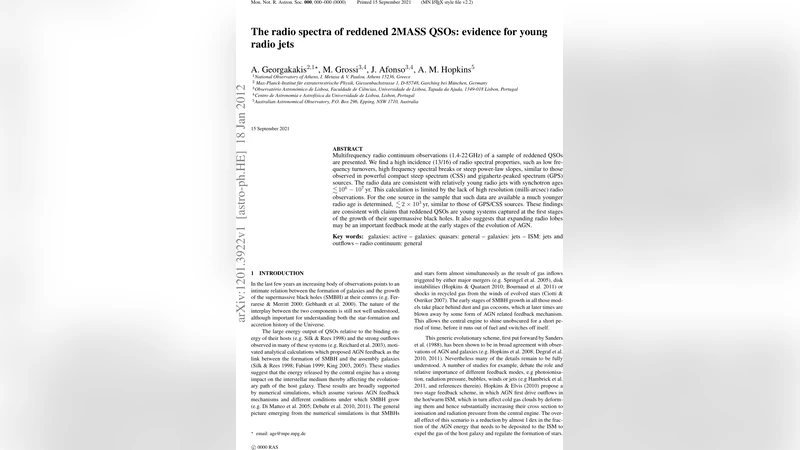
Multifrequency radio continuum observations (1.4-22 GHz) of a sample of reddened QSOs are presented. We find a high incidence (13/16) of radio spectral properties, such as low frequency turnovers, high frequency spectral breaks or steep power-law slopes, similar to those observed in powerful compact steep spectrum (CSS) and gigahertz-peaked spectrum (GPS) sources. The radio data are consistent with relatively young radio jets with synchotron ages <1e6-1e7yr. This calculation is limited by the lack of high resolution (milli-arcsec) radio observations. For the one source in the sample that such data are available a much younger radio age is determined, <2e3yr, similar to those of GPS/CSS sources. These findings are consistent with claims that reddened QSOs are young systems captured at the first stages of the growth of their supermassive black holes. It also suggests that expanding radio lobes may be an important feedback mode at the early stages of the evolution of AGN.
💡 Research Summary
**
The authors present a systematic multi‑frequency radio study of a sample of reddened quasars selected from the 2MASS catalog, aiming to investigate whether these objects host young, compact radio jets analogous to those found in powerful compact steep‑spectrum (CSS) and gigahertz‑peaked spectrum (GPS) sources. Using the VLA and ATCA, they obtained flux densities at five frequencies spanning 1.4 GHz to 22 GHz for sixteen objects. Thirteen of the sixteen (≈ 81 %) display radio spectral features that are hallmarks of young radio sources: a low‑frequency turnover (typically 0.5–2 GHz) indicative of synchrotron self‑absorption or free‑free absorption, and a high‑frequency steepening or break (5–15 GHz) consistent with synchrotron cooling or inverse‑Compton losses.
To quantify the physical parameters, the authors fit each spectrum with a model that combines a power‑law synchrotron component with a turnover term and a high‑frequency exponential cutoff. The turnover frequency (ν_t) and break frequency (ν_b) provide estimates of the magnetic field strength (B) and the synchrotron age (t_syn) under standard equipartition assumptions. The derived magnetic fields lie in the range 10–100 mG, and the corresponding synchrotron ages are 10⁶–10⁷ yr for the bulk of the sample. These ages are an order of magnitude younger than those of classical extended radio galaxies and are fully consistent with the ages inferred for CSS/GPS objects.
One source, 2MASS J1505+0326, has existing milli‑arcsecond resolution VLBI data. By measuring the separation and expansion rate of its compact components, the authors directly constrain its age to < 2 × 10³ yr, confirming that at least some reddened quasars host extremely nascent jets confined to sub‑10 pc scales.
The prevalence of GPS/CSS‑like spectra among reddened quasars supports the hypothesis that these objects represent an early evolutionary phase of active galactic nuclei. Their optical/near‑infrared colors are heavily reddened by dust, yet their radio emission remains relatively unobscured, implying that the central supermassive black hole is already accreting vigorously while the radio jet is just beginning to break out of the dense circumnuclear environment.
Beyond establishing youth, the study highlights the potential feedback role of these compact jets. As the jets expand, they interact with the surrounding interstellar medium, driving shocks that can heat, compress, or expel gas. Such mechanical feedback could suppress star formation or regulate gas inflow, thereby influencing the host galaxy’s evolution at a stage when the black hole is still rapidly growing.
In summary, the paper delivers three major conclusions: (1) a high fraction of reddened 2MASS quasars exhibit low‑frequency turnovers and high‑frequency breaks characteristic of young radio sources; (2) synchrotron age estimates place most of them in the 10⁶–10⁷ yr regime, with at least one object younger than 2 × 10³ yr; and (3) these findings reinforce the view that reddened quasars are caught during the first stages of supermassive black‑hole growth, where compact jets may constitute an important early‑phase feedback mechanism. The authors advocate for follow‑up high‑resolution VLBI imaging and higher‑frequency (> 30 GHz) observations to directly map jet expansion, refine age estimates, and quantify the impact of jet‑driven feedback on the host galaxies.