The weights of closed subgroups of a locally compact group
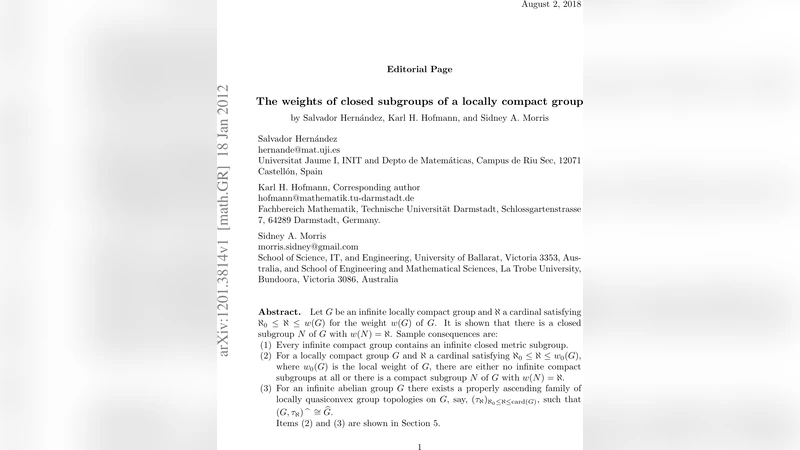
Let $G$ be an infinite locally compact group and $\aleph$ a cardinal satisfying $\aleph_0\le\aleph\le w(G)$ for the weight $w(G)$ of $G$. It is shown that there is a closed subgroup $N$ of $G$ with $w(N)=\aleph$. Sample consequences are: (1) Every infinite compact group contains an infinite closed metric subgroup. (2) For a locally compact group $G$ and $\aleph$ a cardinal satisfying $\aleph_0\le\aleph\le \lw(G)$, where $\lw(G)$ is the local weight of $G$, there are either no infinite compact subgroups at all or there is a compact subgroup $N$ of $G$ with $w(N)=\aleph$. (3) For an infinite abelian group $G$ there exists a properly ascending family of locally quasiconvex group topologies on $G$, say, $(\tau_\aleph){\aleph_0\le \aleph\le \card(G)}$, such that $(G,\tau\aleph)\hat{\phantom{m}}\cong\hat G$. Items (2) and (3) are shown in Section 5.
💡 Research Summary
The paper investigates the relationship between the weight of a locally compact group and the weights of its closed subgroups. The weight w(X) of a topological space X is the smallest cardinality of a base for its topology; for a locally compact group G the local weight lw(G) is the weight of a neighbourhood base at the identity. The main theorem asserts that for any infinite locally compact group G and any cardinal ℵ with ℵ₀ ≤ ℵ ≤ w(G), there exists a closed subgroup N ≤ G such that w(N)=ℵ. In other words, the weight of G can be realised by a closed subgroup at every intermediate cardinal between countable and the full weight of G.
The proof proceeds by exploiting the structural decomposition of locally compact groups. Every such group contains a maximal compact normal subgroup K, and the quotient G/K is a Lie group. If ℵ equals w(G) one may simply take N=G. When ℵ is strictly smaller, the argument splits according to the nature of K. If K is profinite (i.e., a compact totally disconnected group), one uses the lattice of open normal subgroups of K. By selecting a family {U_i : i<ℵ} of distinct open subgroups and intersecting them, one obtains a closed subgroup N=⋂_{i<ℵ}U_i whose weight is exactly ℵ; the construction relies on the fact that the family of cosets of these open subgroups forms a base of size ℵ. If K has a non‑trivial connected component K₀, then K₀ is a compact Lie group. When K₀ has positive dimension, it contains a torus T^n with n≥1, and by taking appropriate closed sub‑tori one can realise any countable weight (in particular a metric subgroup). If K₀ is finite, the situation reduces again to the profinite case. Thus, regardless of the internal structure of K, one can carve out a closed subgroup of any prescribed weight ℵ.
From the main theorem several immediate corollaries follow. (1) Every infinite compact group contains an infinite closed metric subgroup. Indeed, a compact group splits into a connected component and a profinite part; the connected component yields a torus (hence a metric subgroup) when it is infinite, while the profinite part supplies a countable‑weight closed subgroup via the open‑subgroup intersection method. (2) Replacing the global weight by the local weight, the authors prove that for any ℵ with ℵ₀ ≤ ℵ ≤ lw(G), either G has no infinite compact subgroups at all, or else G possesses a compact subgroup N with w(N)=ℵ. The proof uses the same open‑subgroup chain technique applied to a compact neighbourhood of the identity, showing that the local weight controls the possible weights of compact subgroups. (3) For an infinite abelian group G the paper constructs a strictly increasing family of locally quasiconvex group topologies (τ_ℵ) indexed by ℵ₀ ≤ ℵ ≤ |G| such that each (G,τ_ℵ) has the same Pontryagin dual as the original group. The construction proceeds by taking, for each ℵ, the closed subgroup N_ℵ obtained from the main theorem, endowing the quotient G/N_ℵ with its natural compact‑metric topology, and pulling this topology back to G via the quotient map. The resulting τ_ℵ are locally quasiconvex, strictly finer as ℵ grows, and all share the same dual group \hat G, because the dual of a quotient by a closed subgroup embeds canonically into the dual of the whole group and the pull‑back does not alter the character group.
Section 5 of the paper is devoted to the detailed proofs of statements (2) and (3). The authors carefully analyse the lattice of compact neighbourhoods, verify that the constructed subgroups are indeed compact and have the required weight, and then apply Pontryagin duality to establish the invariance of the dual under the new topologies. The paper thus not only resolves a natural question about the spectrum of possible weights of closed subgroups in locally compact groups, but also demonstrates how this information can be leveraged to obtain new structural results for compact groups, to relate local and global weight invariants, and to generate a rich hierarchy of compatible topologies on abelian groups without changing their duals. These contributions enrich the interplay between topological group theory, harmonic analysis, and the theory of locally quasiconvex spaces, opening avenues for further exploration of weight‑controlled subgroup constructions and their applications.
Comments & Academic Discussion
Loading comments...
Leave a Comment