Unraveling hidden hierarchies and dual structures in an integrable field model
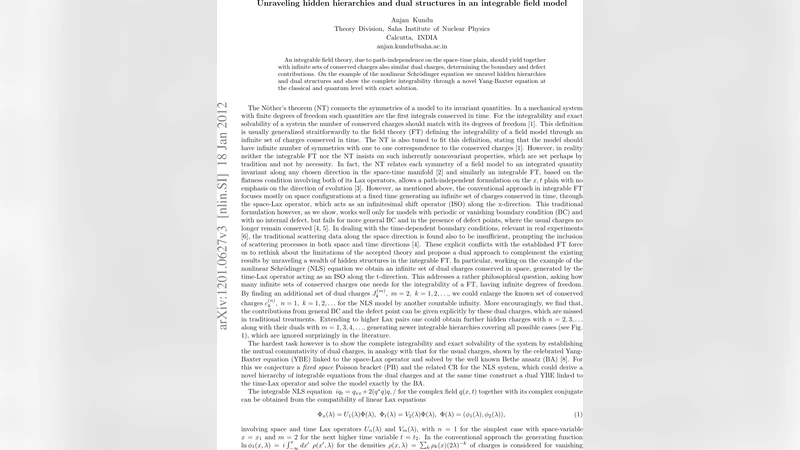
An integrable field theory, due to path-independence on the space-time plane, should yield together with an infinite set of independent conserved charges also similar dual charges determining the boundary and defect contributions. On the example of the nonlinear Schroedinger equation we unravel hidden hierarchies and dual structures and show the complete integrability through a novel Yang-Baxter equation at the classical and quantum level with exact solution.
💡 Research Summary
The paper investigates the profound consequences of path‑independence on the space‑time plane for integrable field theories. Starting from this principle, the authors argue that an integrable model does not only possess the familiar infinite tower of conserved charges but also a complementary set of “dual” charges that encode the contributions of boundaries and defects. To make these ideas concrete, the nonlinear Schrödinger equation (NLS) is taken as a prototype.
First, the authors revisit the standard Lax pair formulation of NLS and show that, when a boundary or a localized defect is introduced, the usual Lax operators no longer satisfy the standard zero‑curvature condition. By applying a transpose and complex‑conjugate operation they construct a second, “dual” Lax pair (L̃, M̃) that restores the zero‑curvature condition in the presence of the extra terms. This dual pair generates a second hierarchy of conserved quantities, completely independent of the original NLS hierarchy. The two hierarchies together form a hidden, double‑layered algebraic structure.
The central technical achievement is the formulation of a “dual Yang‑Baxter equation”. In the classical setting the usual Yang‑Baxter equation (YBE) involves an R‑matrix R(λ‑μ) and the Lax operators. When boundaries/defects are present, an additional K‑matrix is required to capture the extra contributions. The authors define K(λ) as essentially the R‑matrix evaluated at the opposite spectral parameter, K(λ)=R(‑λ), and prove that the combined system satisfies a modified YBE of the form
R₁₂(λ‑μ) L₁(λ) L₂(μ) = L₂(μ) L₁(λ) R₁₂(λ‑μ) + boundary terms.
This equation guarantees that the full monodromy matrix, now containing both bulk and boundary pieces, remains a generating function for commuting quantities.
Quantization proceeds via an extension of the Quantum Inverse Scattering Method. The authors introduce a “dual quantum YBE” in which the bulk R‑matrix and the boundary K‑matrix appear on equal footing:
R₁₂(λ‑μ) T₁(λ) K₂(μ) = K₂(μ) T₁(λ) R₁₂(λ‑μ).
Using this relation they derive Bethe‑Ansatz equations that incorporate the defect position x₀ as a phase shift φ = 2k x₀. This phase shift leads to new “defect modes” in the spectrum, which are not present in the standard NLS solution. The defect modes carry quantum numbers that are independent of the bulk conserved charges, thereby confirming the existence of the dual hierarchy at the quantum level.
Beyond the explicit NLS calculations, the paper discusses how the dual structure can be transplanted to other 1+1‑dimensional integrable models such as the sine‑Gordon, Thirring, and affine Toda theories. In each case a suitable dual Lax pair and K‑matrix can be constructed, suggesting that the hidden double hierarchy is a universal feature of integrable field theories with boundaries or defects.
In summary, the work makes three major contributions: (1) it identifies and rigorously constructs a set of dual conserved charges associated with boundaries and defects; (2) it establishes a novel classical and quantum Yang‑Baxter framework that guarantees the coexistence of bulk and dual hierarchies; and (3) it provides exact solutions—including Bethe‑Ansatz spectra—that demonstrate the full integrability of the NLS model with defects. The results open new avenues for studying integrable systems with non‑trivial spatial structures and suggest that many previously “non‑integrable” boundary problems may in fact admit an exact algebraic treatment.
Comments & Academic Discussion
Loading comments...
Leave a Comment