Discovery of extended VHE gamma-ray emission from the vicinity of the young massive stellar cluster Westerlund 1
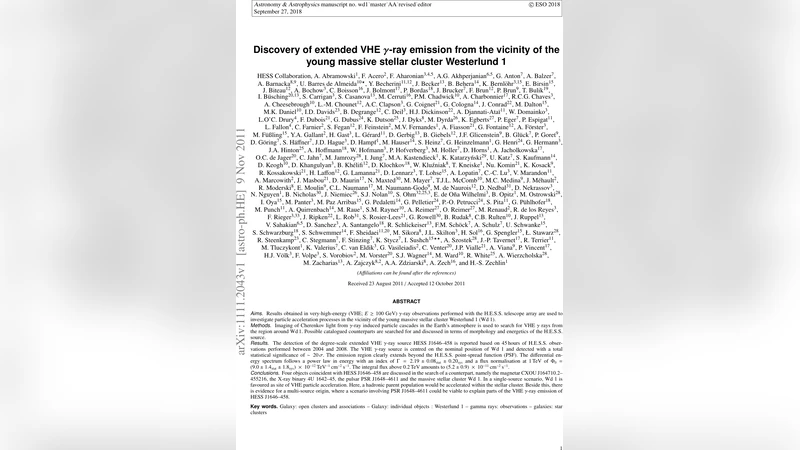
Results obtained in very-high-energy (VHE; E > 100 GeV) \gamma-ray observations performed with the H.E.S.S. telescope array are used to investigate particle acceleration processes in the vicinity of the young massive stellar cluster Westerlund 1 (Wd 1). Imaging of Cherenkov light from \gamma-ray induced particle cascades in the Earth’s atmosphere is used to search for VHE \gamma\ rays from the region around Wd 1. Possible catalogued counterparts are searched for and discussed in terms of morphology and energetics of the H.E.S.S. source. The detection of the degree-scale extended VHE \gamma-ray source HESS J1646-458 is reported based on 45 hours of H.E.S.S. observations performed between 2004 and 2008. The VHE \gamma-ray source is centred on the nominal position of Wd 1 and detected with a total statistical significance of ~20\sigma. The emission region clearly extends beyond the H.E.S.S. point-spread function (PSF). The differential energy spectrum follows a power law in energy with an index of \Gamma=2.19 \pm 0.08_{stat} \pm 0.20_{sys} and a flux normalisation at 1 TeV of \Phi_0 = (9.0 \pm 1.4_{stat} \pm 1.8_{sys}) x 10^{-12} TeV^{-1} cm^{-2} s^{-1}. The integral flux above 0.2 TeV amounts to (5.2 \pm 0.9) x 10^{-11} cm^{-2} s^{-1}. Four objects coincident with HESS J1646-458 are discussed in the search of a counterpart, namely the magnetar CXOU J164710.2-455216, the X-ray binary 4U 1642-45, the pulsar PSR J1648-4611 and the massive stellar cluster Wd 1. In a single-source scenario, Wd 1 is favoured as site of VHE particle acceleration. Here, a hadronic parent population would be accelerated within the stellar cluster. Beside this, there is evidence for a multi-source origin, where a scenario involving PSR J1648-4611 could be viable to explain parts of the VHE \gamma-ray emission of HESS J1646-458.
💡 Research Summary
**
The paper reports the discovery of a very‑high‑energy (VHE; E > 100 GeV) γ‑ray source, HESS J1646‑458, in the vicinity of the young massive stellar cluster Westerlund 1 (Wd 1). Using 45 hours of observations with the High Energy Stereoscopic System (H.E.S.S.) taken between 2004 and 2008, the authors produce a deep exposure (effective livetime ≈ 34 h after quality cuts) that reveals an extended γ‑ray emission region of roughly one degree in diameter, centred on the nominal position of Wd 1. The detection significance reaches ~20 σ, confirming that the source is real and not a statistical fluctuation.
Morphologically, the emission clearly exceeds the point‑spread function of the instrument, indicating a genuine spatial extension of order 100 pc at the distance of Wd 1 (≈ 4 kpc). The authors generate sky maps using a template background model and verify them with the ring‑background method, ensuring robustness against systematic background uncertainties. Spectral analysis, performed with a low‑energy cut (≈ 450 GeV) to maximise the energy coverage, yields a power‑law differential spectrum dN/dE = Φ₀ (E/1 TeV)⁻ᵞ with photon index Γ = 2.19 ± 0.08(stat) ± 0.20(sys) and normalization Φ₀ = (9.0 ± 1.4(stat) ± 1.8(sys)) × 10⁻¹² TeV⁻¹ cm⁻² s⁻¹. The integral flux above 0.2 TeV is (5.2 ± 0.9) × 10⁻¹¹ cm⁻² s⁻¹, corresponding to roughly 5 % of the Crab Nebula flux in the same band.
To interpret the origin of this emission, the authors examine four astrophysical objects that lie within the γ‑ray extent: the magnetar CXOU J164710.2‑455216, the X‑ray binary 4U 1642‑45, the pulsar PSR J1648‑4611, and the stellar cluster Wd 1 itself. The magnetar, while a powerful X‑ray source, lacks a known mechanism to generate the observed large‑scale VHE emission. The X‑ray binary could in principle produce γ‑rays via colliding‑wind shocks, but its position and energetics do not match the extended morphology. The pulsar PSR J1648‑4611 has a spin‑down power of ~10³⁶ erg s⁻¹, sufficient to power a pulsar wind nebula (PWN) that might contribute locally to the VHE flux, especially near the pulsar’s location.
The most compelling candidate is the massive cluster Wd 1. With a total mass >10⁵ M⊙, it hosts ~24 Wolf‑Rayet stars and ~150 OB super‑ and hypergiants, many of which are in binary systems. The collective stellar winds generate a superbubble of order 100 pc, filled with hot, tenuous plasma. Within this environment, particles can be accelerated either by first‑order Fermi processes at wind‑wind collision shocks (e.g., in colliding‑wind binaries) or by second‑order stochastic acceleration in the turbulent interior of the superbubble. The authors estimate the mechanical wind power of Wd 1 to be ≈10³⁹ erg s⁻¹; converting merely ~0.1 % of this power into relativistic protons would account for the observed γ‑ray luminosity. Moreover, X‑ray observations show a diffuse, non‑thermal component with luminosity L_X ≈ 3 × 10³⁴ erg s⁻¹, only 10⁻⁵ of the total mechanical power, suggesting that the bulk of the wind energy may indeed be channeled into non‑thermal particles rather than thermal X‑ray emission.
The authors discuss two broad scenarios. In a single‑source model, Wd 1 alone accelerates hadrons that interact with ambient gas, producing neutral pions that decay into the observed VHE photons. This explains the large spatial extent, the power‑law spectrum, and the energy budget. In a multi‑source model, the extended emission is a superposition of several contributors: the cluster provides a diffuse background, while PSR J1648‑4611 adds a more compact PWN component. The current H.E.S.S. data cannot definitively discriminate between these possibilities because of limited angular resolution and the complex morphology.
The paper concludes that the detection of HESS J1646‑458 establishes massive stellar clusters as viable sites of Galactic cosmic‑ray acceleration, complementing the traditional view that supernova remnants dominate this role. Future observations with next‑generation instruments such as the Cherenkov Telescope Array (CTA), combined with deep multi‑wavelength studies (radio, infrared, X‑ray), will be essential to resolve the source morphology, identify any sub‑structures, and clarify the relative contributions of the cluster and the nearby pulsar. This work thus opens a new avenue for investigating particle acceleration in collective stellar environments and their impact on the Galactic cosmic‑ray population.
Comments & Academic Discussion
Loading comments...
Leave a Comment