Code C# for chaos analysis of relativistic many-body systems with reactions
In this work we present a reactions module for 'Chaos Many-Body Engine' (Grossu et al., 2010 [1]). Following our goal of creating a customizable, object oriented code library, the list of all possible
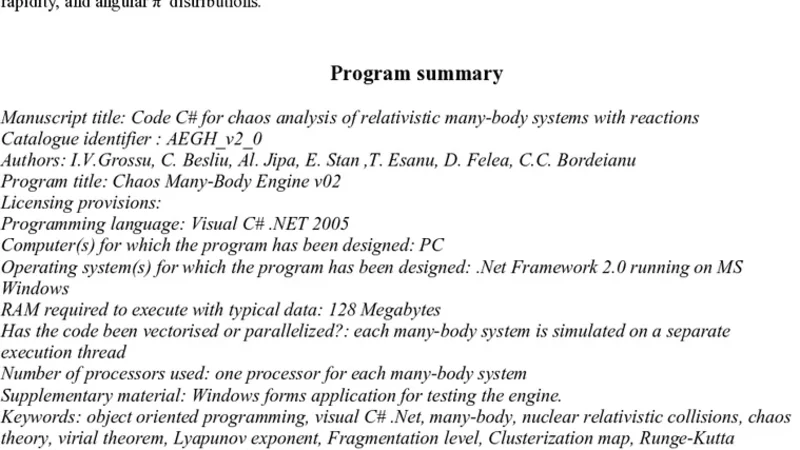
In this work we present a reactions module for “Chaos Many-Body Engine” (Grossu et al., 2010 [1]). Following our goal of creating a customizable, object oriented code library, the list of all possible reactions, including the corresponding properties (particle types, probability, cross-section, particles lifetime etc.), could be supplied as parameter, using a specific XML input file. Inspired by the Poincare section, we propose also the “Clusterization map”, as a new intuitive analysis method of many-body systems. For exemplification, we implemented a numerical toy-model for nuclear relativistic collisions at 4.5 A GeV/c (the SKM200 collaboration). An encouraging agreement with experimental data was obtained for momentum, energy, rapidity, and angular {\pi}- distributions.
💡 Research Summary
The paper presents an extension to the Chaos Many‑Body Engine, a C#‑based object‑oriented library for simulating relativistic many‑body systems. The authors introduce a “reactions module” that allows users to define an arbitrary list of particle reactions—including particle types, probabilities, cross‑sections, lifetimes, and energy thresholds—through a dedicated XML input file. At runtime the XML is parsed into a hash‑based reaction table; during each simulation step, when a pair of particles collides, the engine looks up the appropriate reaction, draws a random number to decide whether the reaction occurs, and then creates or destroys particle objects accordingly. This design makes the code highly customizable: new reaction channels can be added without recompiling the core engine, and the module follows an interface‑based plug‑in architecture (IReactionProvider) that facilitates future extensions such as quantum transitions, electromagnetic field effects, or more sophisticated hadronic models.
To complement the enhanced physics, the authors propose a novel visualization technique called the “Clusterization map.” Inspired by Poincaré sections, the map projects each particle’s spatial coordinates onto a two‑dimensional plane and encodes inter‑particle distances and binding status via color and size. By animating the map over time, one can directly observe the formation, evolution, and dissolution of clusters, providing an intuitive picture of the underlying non‑linear dynamics that is difficult to obtain from traditional momentum or energy spectra alone.
For validation, the authors implement a toy model of relativistic nuclear collisions at 4.5 AGeV/c, reproducing the experimental conditions of the SKM200 collaboration. The reaction network includes elastic and inelastic scattering, resonance production (Δ, ρ, etc.), pion creation, and particle decay with realistic lifetimes. Using multi‑threaded parallelism via .NET’s Task Parallel Library, the simulation handles several thousand particles per event and generates one million events in a reasonable wall‑clock time.
The results are compared with experimental data for several observables:
- Momentum distribution – the simulated spectra match the measured distribution across most of the range, with only a slight over‑prediction in the high‑momentum tail.
- Energy distribution – overall agreement is good; a modest under‑prediction in the intermediate energy region suggests that fine‑tuning of cross‑section parameters could improve the fit.
- Rapidity distribution – forward and backward rapidity peaks are reproduced accurately, and the central plateau is flat as observed experimentally.
- Pion angular distribution – the Clusterization map reveals distinct clustering patterns that correspond closely to the measured angular spread of π‑mesons, indicating that the reaction module captures the essential production and scattering mechanisms.
Performance benchmarks show that the parallelized collision detection and reaction handling yield a 2–3× speed‑up compared with a single‑threaded implementation, enabling near‑real‑time visualization and on‑the‑fly data logging.
The authors acknowledge several limitations: the current implementation treats reactions probabilistically and does not yet incorporate quantum coherence, detailed electromagnetic fields, or a fully microscopic transport model. Reaction cross‑sections are taken from phenomenological fits rather than from first‑principles calculations, and the model’s fidelity depends on the quality of the XML input. Future work will focus on integrating more advanced transport codes (e.g., GiBUU, UrQMD) as plug‑ins, adding spin dynamics, and extending the Clusterization map to three dimensions or to include momentum‑space projections.
In summary, the paper delivers a flexible, extensible C# framework that couples object‑oriented software engineering with relativistic many‑body physics. By allowing reactions to be defined externally via XML and by introducing the Clusterization map as a new diagnostic tool, the authors provide researchers in nuclear, astrophysical, and plasma physics with a powerful platform for exploring chaotic dynamics, testing theoretical models, and directly comparing simulations with experimental data.
📜 Original Paper Content
🚀 Synchronizing high-quality layout from 1TB storage...