NP-Hardness and Fixed-Parameter Tractability of Realizing Degree Sequences with Directed Acyclic Graphs
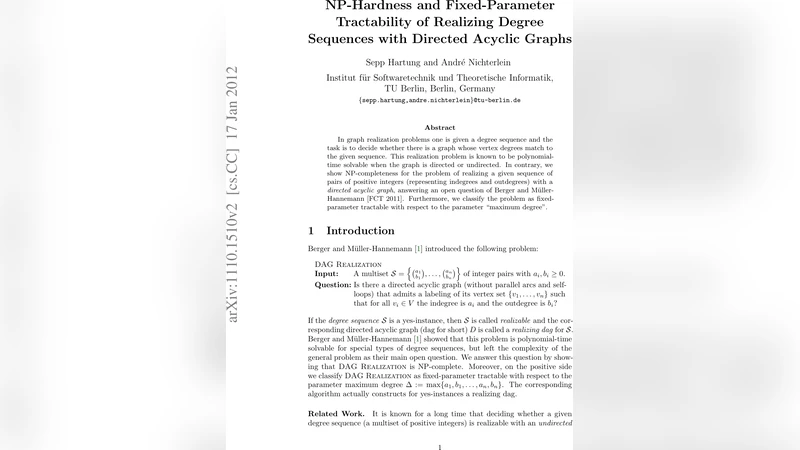
In graph realization problems one is given a degree sequence and the task is to decide whether there is a graph whose vertex degrees match to the given sequence. This realization problem is known to be polynomial-time solvable when the graph is directed or undirected. In contrary, we show NP-completeness for the problem of realizing a given sequence of pairs of positive integers (representing indegrees and outdegrees) with a directed acyclic graph, answering an open question of Berger and M"uller-Hannemann [FCT 2011]. Furthermore, we classify the problem as fixed-parameter tractable with respect to the parameter “maximum degree”.
💡 Research Summary
The paper investigates the computational complexity of realizing a given degree sequence with a directed acyclic graph (DAG). A degree sequence here is a multiset of ordered pairs (a_i, b_i) representing the required indegree and outdegree of each vertex. The decision problem, called DAG Realization, asks whether there exists a simple DAG (no parallel arcs, no self‑loops) whose vertices can be labeled v_1,…,v_n so that vertex v_i has indegree a_i and outdegree b_i.
The authors first recall that for undirected graphs and for general directed graphs (without the acyclicity constraint) the realization problem is polynomial‑time solvable, thanks to classic characterizations such as Erdős‑Gallai for undirected graphs and the Gale‑Ryser theorem for bipartite digraphs. However, the acyclicity requirement fundamentally changes the landscape. Berger and Müller‑Hannemann previously identified a special “opposed order” on degree pairs (a,b) ≤_opp (c,d) ⇔ a ≤ c and b ≥ d. When all pairs are comparable under this order, a topological ordering respecting the order exists and the problem becomes polynomial. The open question was the complexity when incomparable pairs are allowed.
The core contribution is a proof that DAG Realization is NP‑complete in the general case. The reduction is from the strongly NP‑hard problem 3‑Partition. Given an instance (A, B) of 3‑Partition, where A = {a_1,…,a_{3m}} with Σ a_i = mB and each a_i satisfies B/4 < a_i < B/2, the authors construct a degree sequence S consisting of:
- m+1 “block” subsequences X_0,…,X_m, each containing either B or 2B “x‑elements”. The vertices realizing these x‑elements will form a complete DAG (every possible forward arc exists) and thus enforce a rigid topological structure.
- 3m “a‑elements” α_i = (a_i, a_i), which will become the only vertices not belonging to the complete DAG; they must be placed in the “gaps” between consecutive blocks.
The construction ensures that each gap between X_{i‑1} and X_i must be filled with exactly three a‑vertices whose total indegree and outdegree each sum to B. Consequently, a feasible filling of all gaps corresponds precisely to a partition of the original numbers into m triples of sum B, i.e., a solution to 3‑Partition. The reduction is polynomial because the size of S is bounded by a polynomial in the numeric values of the a_i’s, and strong NP‑hardness guarantees that those values are themselves polynomially bounded.
Correctness is established through a series of lemmas and observations. Lemma 1 (from Berger & Müller‑Hannemann) guarantees that any realizable sequence admits a topological ordering consistent with the opposed order. Observation 1 shows that in any realizing DAG the a‑vertices form an independent set while the x‑vertices induce a complete DAG. Observation 2 proves that the x‑vertices must appear in the topological order exactly block‑by‑block, preserving the internal order of each block. Using these structural facts, Lemma 2 proves that a yes‑instance of 3‑Partition yields a realizing DAG for S, while Lemma 3 (together with the observations) shows the converse: any realizing DAG for S can be transformed into a valid 3‑Partition solution. Hence, DAG Realization is NP‑complete.
On the positive side, the authors examine the problem from the perspective of parameterized complexity. They define Δ = max{a_i, b_i} as the maximum degree in the input sequence. When Δ is treated as a parameter, they design a fixed‑parameter tractable (FPT) algorithm. The key insight is that the number of possible arcs incident to any vertex is bounded by Δ, which limits the combinatorial explosion of possible topological orderings. By enumerating candidate orderings for vertices with high degree, applying dynamic programming over the partial order, and using kernelization techniques to reduce the instance size, they achieve a running time of O(f(Δ)·n) where f is an exponential‑in‑Δ function but independent of the overall input size n. Moreover, the algorithm explicitly constructs a realizing DAG when one exists, providing a constructive solution rather than a mere decision.
The paper concludes by summarizing the dichotomy: if all degree pairs are comparable under the opposed order, the problem is polynomial; otherwise it is NP‑complete, yet it becomes tractable when the maximum degree is small. This resolves the open question posed by Berger and Müller‑Hannemann and opens avenues for further research on other natural parameters (e.g., treewidth of the underlying undirected graph) or on approximation algorithms for near‑realizations. The results deepen our understanding of how acyclicity interacts with degree constraints, a topic relevant to scheduling, data provenance, and hierarchical network design.
Comments & Academic Discussion
Loading comments...
Leave a Comment