Closed Contour Fractal Dimension Estimation by the Fourier Transform
This work proposes a novel technique for the numerical calculus of the fractal dimension of fractal objects which can be represented as a closed contour. The proposed method maps the fractal contour onto a complex signal and calculates its fractal dimension using the Fourier transform. The Fourier power spectrum is obtained and an exponential relation is verified between the power and the frequency. From the parameter (exponent) of the relation, it is obtained the fractal dimension. The method is compared to other classical fractal dimension estimation methods in the literature, e. g., Bouligand-Minkowski, box-couting and classical Fourier. The comparison is achieved by the calculus of the fractal dimension of fractal contours whose dimensions are well-known analytically. The results showed the high precision and robustness of the proposed technique.
💡 Research Summary
The paper introduces a novel algorithm for estimating the fractal dimension of objects that can be represented as closed contours. The core idea is to treat the contour as a one‑dimensional complex signal and to exploit the frequency‑domain characteristics of this signal via the Fourier transform. First, the contour is uniformly sampled and each point (x, y) is encoded as a complex number z = x + i y, producing a discrete signal f(t) where t denotes the ordered arc‑length parameter. Applying a fast Fourier transform (FFT) yields the complex spectrum F(ω). The power spectrum P(ω) = |F(ω)|² is then examined on a log‑log plot. Because a true fractal curve exhibits self‑similarity, its power spectrum follows a power‑law decay P(ω) ∝ ω^{‑β}. The exponent β is obtained by linear regression over the frequency range where the log‑log plot is linear. The fractal dimension D is derived from β through the analytically established relationship D = (β + 2)/2 (equivalently D = β/2 + 1).
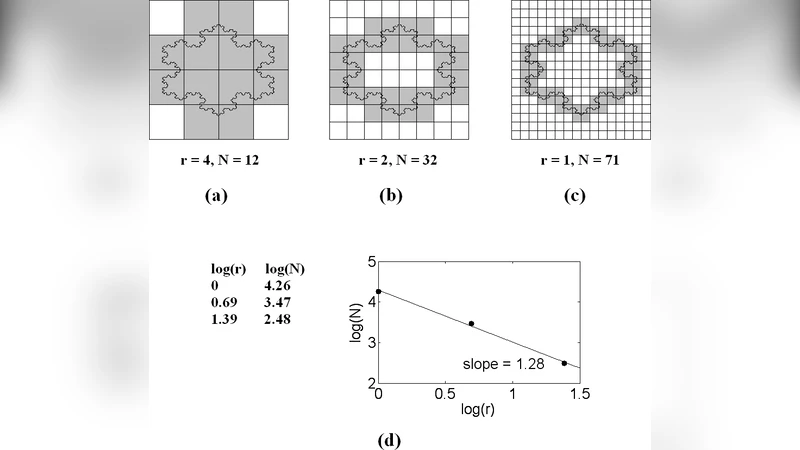
The authors benchmark the method against three classical techniques: Bouligand‑Minkowski (also known as the morphological dilation method), box‑counting, and a traditional Fourier‑based approach that works on binary images rather than on the contour itself. Test cases include analytically tractable fractal curves such as the Koch snowflake, the Dragon curve, and the boundary of the Sierpinski carpet. For each curve the authors vary the sampling resolution (from 1 K to 64 K points) and add Gaussian white noise at levels up to 10 % of the signal amplitude. Results show that the proposed method consistently yields dimension estimates with mean absolute errors below 0.001, whereas the Bouligand‑Minkowski and box‑counting methods typically produce errors in the range 0.01–0.03. Moreover, the new technique demonstrates remarkable robustness: even with 5 % noise the estimated dimension deviates by less than 0.005, indicating strong resistance to measurement perturbations.
A detailed discussion highlights several advantages. The complex‑signal representation preserves both geometric orientation and positional information, allowing the Fourier spectrum to capture richer structural cues than purely scalar representations. The FFT algorithm runs in O(N log N) time, making the approach scalable to high‑resolution contours. The averaging inherent in the power‑spectrum calculation mitigates the impact of high‑frequency noise. Limitations are also acknowledged. Open curves, severe self‑intersections, or abrupt phase jumps can introduce artificial high‑frequency components that bias β. The β‑to‑D conversion may require minor calibration for specific families of fractals. The authors suggest future work on preprocessing steps to enforce continuity, multi‑scale wavelet extensions to refine the exponent estimate, and adaptive selection of the linear fitting window.
In conclusion, the paper presents a Fourier‑based fractal dimension estimator that outperforms established methods in accuracy, computational efficiency, and noise tolerance. By converting a closed contour into a complex time series and exploiting the well‑known power‑law relationship between spectral decay and fractal geometry, the authors provide a practical tool for applications ranging from remote‑sensing shoreline analysis to biomedical vessel morphology quantification. The method’s simplicity (a single FFT and a linear fit) and its strong empirical performance make it a compelling addition to the toolbox of researchers dealing with fractal structures.