Plasma diagnostic in eruptive prominences from SDO/AIA observations at 304 {AA}
Context. Theoretical calculations have shown that when solar prominences move away from the surface of the Sun, their radiative output is affected via the Doppler dimming or brightening effects. Aims. In this paper we ask whether observational signatures of the changes in the radiative output of eruptive prominences can be found in EUV (extreme ultraviolet) observations of the first resonance line of ionised helium at 304 {\AA}. We also investigate whether these observations can be used to perform a diagnostic of the plasma of the eruptive prominence. Methods. We first look for suitable events in the SDO/AIA database. The variation of intensity of arbitrarily selected features in the 304 channel is studied as a function of velocity in the plane of the sky. These results are then compared with new non-LTE radiative transfer calculations of the intensity of the He II 304 resonance line. Results. We find that observations of intensities in various parts of the four eruptive prominences studied here are sometimes consistent with the Doppler dimming effect on the He II 304 {\AA} line. However, in some cases, one observes an increase in intensity in the 304 channel with velocity, in contradiction to what is expected from the Doppler dimming effect alone. The use of the non-LTE models allows us to explain the different behaviour of the intensity by changes in the plasma parameters inside the prominence, in particular the column mass of the plasma and its temperature. Conclusions. The non-LTE models used here are more realistic than what was used in previous calculations. They are able to reproduce qualitatively the range of observations from SDO/AIA analysed in this study. Thanks to non-LTE modelling, we can infer the plasma parameters in eruptive prominences from SDO/AIA observations at 304 {\AA}.
💡 Research Summary
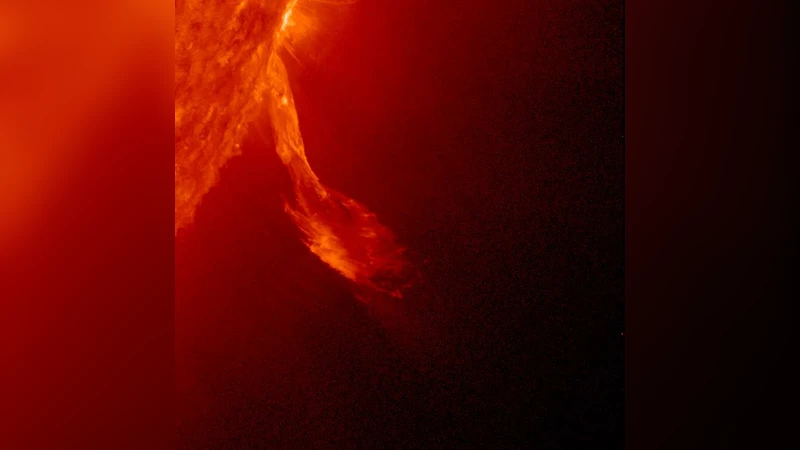
This paper investigates whether the predicted Doppler dimming (or brightening) effects on the He II 304 Å resonance line, which arise when solar prominences move away from the solar surface, can be detected in real observations and used to diagnose prominence plasma parameters during eruptions. The authors searched the SDO/AIA database for suitable eruptive prominence events and identified four cases (June 13 2010, September 8 2010, March 19 2011, and June 10 2011). For each event, they manually tracked distinct features in the 304 Å channel, measured the average intensity over a nine‑pixel region, and normalized the intensities by exposure time and by the lowest‑velocity intensity, so that values >1 indicate brightening with speed and <1 indicate dimming.
Three of the four events (June 13, September 8, March 19) displayed the classic Doppler dimming signature: as the plane‑of‑sky velocity increased (up to ~150 km s⁻¹), the normalized 304 Å intensity decreased by 20–40 %. The June 10 event, a “failed eruption,” showed a more complex behavior: one tracked feature dimmed with speed, while another brightened as it accelerated. This contradictory brightening cannot be explained by Doppler dimming alone.
To interpret these observations, the authors constructed a new set of non‑Local Thermodynamic Equilibrium (non‑LTE) radiative‑transfer models. Each model represents the prominence as a 1‑D vertical slab characterized by nine input parameters: radial velocity (0–300 km s⁻¹), central temperature (6000–12000 K), central pressure (0.001–1.1 dyn cm⁻²), boundary pressure (0.001–0.1 dyn cm⁻²), transition‑region gradient γ (2–20), column mass (10⁻⁶–10⁻⁴ g cm⁻²), microturbulent velocity (5–15 km s⁻¹), slab altitude (10 000–140 000 km), and slab thickness derived from hydrostatic equilibrium. By randomly sampling realistic ranges, they generated 100 models and solved the coupled radiative‑transfer and statistical‑equilibrium equations for hydrogen and helium to obtain emergent He II 304 Å intensities.
The model grid reproduces both dimming and brightening trends. When only the velocity is increased while keeping other parameters fixed, the intensity declines, confirming the classic Doppler dimming mechanism. However, if the column mass is raised (e.g., from 10⁻⁵ to 10⁻⁴ g cm⁻²) or the central temperature is increased, the emissivity of the slab grows, partially or fully compensating the loss of scattered photons. In some combinations, the net result is an intensity increase despite higher speeds, matching the brightening observed in the September 8 and June 10 events. The authors also note that variations in microturbulence and the steepness of the prominence‑corona transition region (γ) can modulate the line formation, but the dominant factors are column mass and temperature.
Comparing observations with the model outcomes, the authors conclude that the three events showing dimming are consistent with a scenario where the prominence plasma parameters remain roughly constant during the eruption, so Doppler dimming dominates. The events with brightening must involve significant changes in plasma conditions—most plausibly an increase in column mass (compression) and/or heating—during the eruption. Thus, the He II 304 Å intensity alone cannot uniquely determine velocity; it must be interpreted together with a realistic non‑LTE model that accounts for evolving plasma parameters.
The paper demonstrates that modern non‑LTE modeling, combined with high‑cadence, high‑resolution SDO/AIA 304 Å data, can qualitatively reproduce the observed range of intensity‑velocity behaviors in eruptive prominences. This opens the possibility of using the 304 Å channel as a diagnostic tool for prominence plasma, provided that model‑based inversions are employed to disentangle Doppler dimming from intrinsic plasma evolution. The authors suggest that future work should incorporate multi‑wavelength observations (e.g., the Si XI 303.3 Å line) and spectroscopic data to achieve quantitative diagnostics of temperature, density, and column mass during prominence eruptions.
Comments & Academic Discussion
Loading comments...
Leave a Comment