On the flow-level stability of data networks without congestion control: the case of linear networks and upstream trees
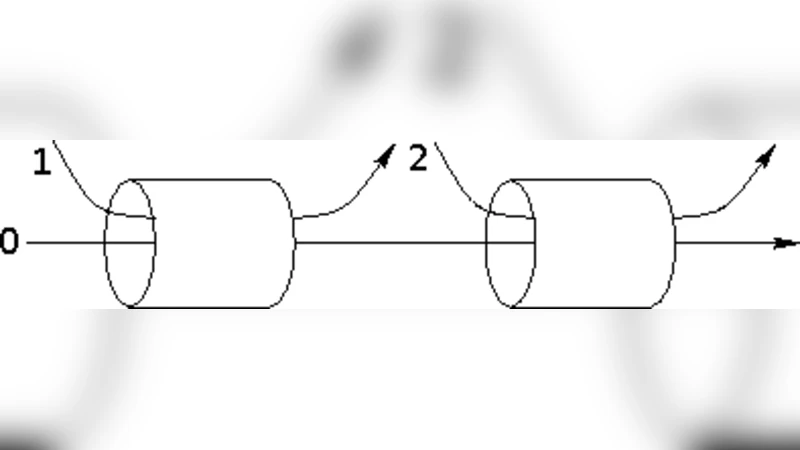
In this paper, flow models of networks without congestion control are considered. Users generate data transfers according to some Poisson processes and transmit corresponding packet at a fixed rate equal to their access rate until the entire document is received at the destination; some erasure codes are used to make the transmission robust to packet losses. We study the stability of the stochastic process representing the number of active flows in two particular cases: linear networks and upstream trees. For the case of linear networks, we notably use fluid limits and an interesting phenomenon of “time scale separation” occurs. Bounds on the stability region of linear networks are given. For the case of upstream trees, underlying monotonic properties are used. Finally, the asymptotic stability of those processes is analyzed when the access rate of the users decreases to 0. An appropriate scaling is introduced and used to prove that the stability region of those networks is asymptotically maximized.
💡 Research Summary
The paper investigates the stability of data networks in which users transmit at a fixed “access rate” without any congestion‑control mechanism such as TCP. Each flow arrives according to a Poisson process and has an exponentially distributed size. The network is modeled at the flow level: a set of K flow classes, each class k characterized by an access rate aₖ and a fixed route of dₖ links. Bandwidth sharing follows a simple “tail‑dropping” policy: when the total input rate at a link exceeds its capacity Cₗ, the link becomes saturated and the output rate of each class is reduced proportionally to its input rate so that the sum of output rates equals Cₗ. This yields an explicit allocation rule (equation 3) that depends only on the numbers of active flows in each class.
Two specific topologies are studied: (i) linear networks (a chain of L links) and (ii) upstream trees (a rooted tree where flows split downstream). In a linear network there are L + 1 classes: class‑0 traverses all links, while class‑k (k ≥ 1) uses only link k. Assuming unit link capacities, the optimal stability condition is ρ₀ + ρₖ < 1 for every k, where ρₖ = λₖ/µₖ is the traffic intensity of class k.
The authors employ fluid‑limit techniques. They scale the Markov process describing the numbers of active flows and consider limits of the form (\bar Z(t)). A key observation is that classes 2,…,L (the “local” classes) dominate the bandwidth of their respective links. If any of these classes has ρₖ < 1, its fluid component decays linearly to zero in finite time, regardless of the state of classes 0 and 1. Consequently, while any local class is present, the end‑to‑end class 0 receives essentially no service (its fluid derivative is λ₀). Once all local classes have vanished, the system reduces to a two‑dimensional fluid subsystem involving only classes 0 and 1, whose dynamics are given by equations (6)–(7). This separation of time scales—fast decay of local classes versus slow evolution of the end‑to‑end class—allows the authors to prove that if all ρₖ < 1 (k ≥ 2) and the optimal condition ρ₀ + ρₖ < 1 holds, the fluid trajectory reaches the origin in finite time, implying positive recurrence of the original Markov process.
To explore the effect of very small access rates, the paper introduces a scaling where aₖ → 0. Under this scaling the stochastic process converges to a deterministic limit whose only constraints are the per‑link capacity inequalities. The authors prove that the stationary distributions of the scaled processes converge to the stationary point of the deterministic limit, establishing an “inversion” result: as access rates shrink, the stability region expands and asymptotically coincides with the optimal region defined solely by the link capacities. Thus, in the limit of infinitesimal access rates, the network behaves as if an optimal congestion‑control policy were in place.
For upstream trees, the analysis relies on monotonicity: decreasing the flow count on a parent node cannot increase the load on any child node. This property enables a recursive construction of fluid limits and a similar scaling argument. The authors show that, again, when access rates tend to zero, the stability region of the tree converges to the set of traffic intensities satisfying the per‑link capacity constraints.
Overall, the paper delivers a rigorous mathematical treatment of networks without congestion control, demonstrating that aggressive greedy transmission can be stable provided that (i) the traffic intensities on each link respect the link capacities, and (ii) the users’ access rates are sufficiently small. The results illuminate the trade‑off between aggressive utilization of bandwidth and the need for rate throttling, offering valuable guidance for the design of future high‑throughput protocols that rely on source coding and erasure correction rather than traditional TCP‑style congestion avoidance.
Comments & Academic Discussion
Loading comments...
Leave a Comment