Relativistic MHD in dynamical spacetimes: Improved EM gauge condition for AMR grids
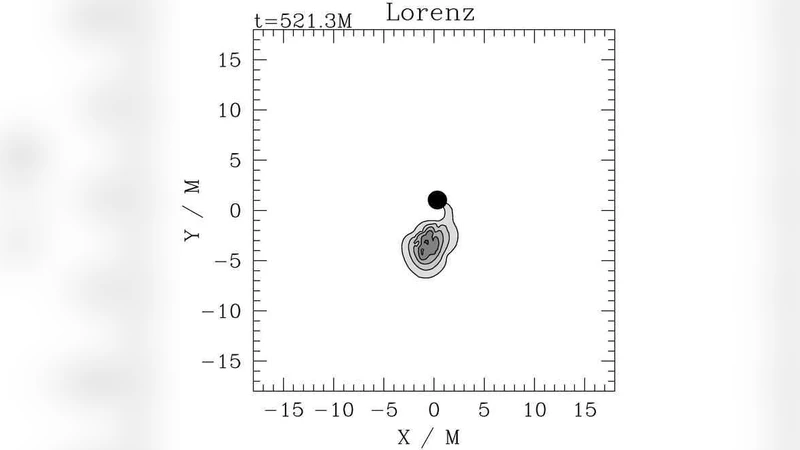
We recently developed a new general relativistic magnetohydrodynamic code with adaptive mesh refinement that evolves the electromagnetic (EM) vector potential (A) instead of the magnetic fields directly. Evolving A enables one to use any interpolation scheme on refinement level boundaries and still guarantee that the magnetic field remains divergenceless. As in classical EM, a gauge choice must be made when evolving A, and we chose a straightforward “algebraic” gauge condition to simplify the A evolution equation. However, magnetized black hole-neutron star (BHNS) simulations in this gauge exhibit unphysical behavior, including the spurious appearance of strong magnetic fields on refinement level boundaries. This spurious behavior is exacerbated when matter crosses refinement boundaries during tidal disruption of the NS. Applying Kreiss-Oliger dissipation to the evolution of the magnetic vector potential A slightly weakens this spurious magnetic effect, but with undesired consequences. We demonstrate via an eigenvalue analysis and a numerical study that zero-speed modes in the algebraic gauge, coupled with the frequency filtering that occurs on refinement level boundaries, are responsible for the creation of spurious magnetic fields. We show that the EM Lorenz gauge exhibits no zero-speed modes, and as a consequence, spurious magnetic effects are quickly propagated away, allowing for long-term, stable magnetized BHNS evolutions. Our study demonstrates how the EM gauge degree of freedom can be chosen to one’s advantage, and that for magnetized BHNS simulations the Lorenz gauge constitutes a major improvement over the algebraic gauge.
💡 Research Summary
This paper presents a comprehensive study of electromagnetic (EM) gauge choices in a general‑relativistic magnetohydrodynamic (GRMHD) code that employs adaptive mesh refinement (AMR) and evolves the magnetic vector potential A rather than the magnetic field B directly. Evolving A guarantees a divergence‑free magnetic field on any grid because B is reconstructed as the curl of A, allowing arbitrary interpolation at refinement‑level boundaries. However, the vector potential carries a gauge freedom that must be fixed to close the system of equations.
Two gauges are examined:
-
Algebraic gauge – defined by Φ = (1/α) βᵢ Aⁱ, which reduces the evolution of A to a simple advection‑type equation ∂ₜAᵢ = εᵢⱼₖ vʲ Bᵏ. This gauge introduces a zero‑speed (static) mode because the characteristic analysis reveals an eigenvalue equal to zero. Consequently, perturbations in A that arise at AMR refinement interfaces do not propagate away; they remain trapped and are amplified by the high‑frequency filtering inherent to AMR prolongation/restriction.
-
Lorenz gauge – defined by ∇_μA^μ = 0, which yields a coupled wave‑like evolution for Φ and A. The characteristic analysis shows only non‑zero eigenvalues (±α ± β·k), meaning all EM disturbances travel at roughly the speed of light. No static mode exists, so any spurious perturbation generated at a refinement boundary is quickly radiated outward.
The authors perform a linear eigenvalue analysis of the EM subsystem (decoupled from the BSSN and fluid equations in the short‑wavelength limit) to demonstrate the presence of the zero‑speed mode in the algebraic gauge and its absence in the Lorenz gauge.
To assess the practical impact, they conduct full 3+1 GRMHD simulations of a black‑hole–neutron‑star (BH‑NS) binary with mass ratio 3:1, initially on a quasi‑circular orbit, and seed the neutron star with a weak poloidal magnetic field (~10¹² G). The same AMR hierarchy, BSSN puncture gauge, and high‑resolution shock‑capturing (HRSC) scheme are used for both gauge choices.
Results with the algebraic gauge:
- During tidal disruption, matter streams across refinement boundaries, causing interpolation errors in A.
- The static mode retains these errors, leading to the rapid growth of artificial magnetic fields at the boundaries.
- The magnetic energy spikes, violating energy‑momentum conservation, and the simulation crashes after only a few milliseconds of physical time.
- Adding Kreiss‑Oliger dissipation (KOD) to A mildly damps the spurious fields but also damps legitimate physical waves, reducing overall accuracy without eliminating the underlying instability.
Results with the Lorenz gauge:
- The same physical processes generate only transient perturbations in A.
- Because all EM modes propagate, the spurious fields are radiated away from the refinement interfaces.
- Magnetic energy remains well behaved, global constraints stay satisfied, and the simulation proceeds stably for tens of milliseconds, covering the entire merger and post‑merger phases.
- Applying KOD on top of the Lorenz gauge offers no further benefit and only increases computational cost.
The study concludes that the choice of EM gauge is not a mere convenience but a critical factor for numerical stability in AMR‑based GRMHD simulations, especially when strong gravity and fluid motion cause frequent crossing of refinement boundaries. The Lorenz gauge eliminates zero‑speed modes, ensuring that any gauge‑related noise is promptly expelled from the computational domain. Consequently, for long‑term, high‑fidelity simulations of magnetized compact‑object binaries, the Lorenz gauge should be adopted as the default.
Beyond BH‑NS mergers, the findings have broader implications for any relativistic astrophysical scenario involving coupled Einstein‑MHD dynamics on adaptive grids, such as core‑collapse supernovae, magnetized binary neutron‑star mergers, and accretion flows onto rotating black holes. Future work may combine the Lorenz gauge with higher‑order AMR prolongation operators and absorbing boundary conditions to further reduce reflections and improve accuracy, paving the way for next‑generation, fully relativistic, magnetized astrophysics simulations.
Comments & Academic Discussion
Loading comments...
Leave a Comment