Pattern avoidance in labelled trees
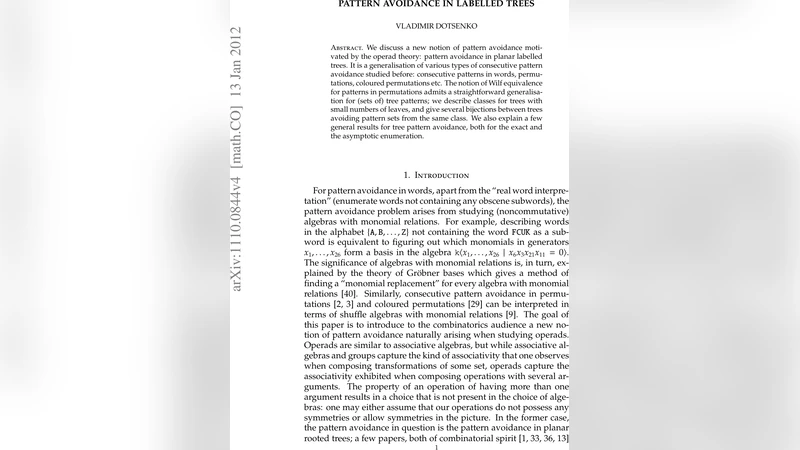
We discuss a new notion of pattern avoidance motivated by the operad theory: pattern avoidance in planar labelled trees. It is a generalisation of various types of consecutive pattern avoidance studied before: consecutive patterns in words, permutations, coloured permutations etc. The notion of Wilf equivalence for patterns in permutations admits a straightforward generalisation for (sets of) tree patterns; we describe classes for trees with small numbers of leaves, and give several bijections between trees avoiding pattern sets from the same class. We also explain a few general results for tree pattern avoidance, both for the exact and the asymptotic enumeration.
💡 Research Summary
The paper introduces a novel notion of pattern avoidance in planar labelled rooted trees, motivated by operad theory. An operad models operations with multiple inputs, and the authors capture this combinatorial structure by considering rooted trees whose internal vertices have at least two children, each labelled by an element of a graded alphabet X = ⋃_{n≥2} X_n. Leaves are labelled by the integers 1,…,ℓ in a bijective way, and a “local increasing condition” forces the minimal leaf label among the descendants of each internal vertex to increase from left to right among its children. This definition simultaneously encodes the tree shape and a labelling order, making it a natural analogue of consecutive pattern avoidance for words, permutations, and coloured permutations.
A pattern P is defined as the standardisation of a subtree S of a larger tree T: one relabels the leaves of S by 1,…,|S| preserving the relative order, while keeping internal vertex labels unchanged. If such a standardised subtree equals P, we say that T contains P; otherwise T avoids P. The authors then extend Wilf‑equivalence from permutation patterns to tree patterns: two pattern sets P and P′ are Wilf‑equivalent (denoted P ∼_W P′) if for every leaf count ℓ the numbers of ℓ‑leaf trees avoiding P and P′ coincide. A stronger equivalence (P ∼ P′) requires equality of the full distribution of the number of occurrences for each ℓ and each k≥0.
The main enumerative tool is the exponential generating function
f_P(z) = Σ_{ℓ≥1} |LT_{ℓ, no‑P}(X)| z^ℓ/ℓ! ,
where LT_{ℓ, no‑P}(X) denotes the set of ℓ‑leaf trees avoiding P. A key structural result (Proposition 2) shows that if a tree is built by grafting a pattern K at the root and then independently attaching trees from a class L to each leaf of K, the generating function of the resulting class M satisfies
f_M(z) = f_K( f_L(z) ).
Thus the combinatorial composition of tree patterns translates directly into functional composition of generating functions, mirroring the operadic substitution operation.
When the alphabet consists of a single binary label (X = X_2), the framework recovers known consecutive pattern avoidance: left‑comb trees correspond to permutations, and right‑comb trees correspond to words. Consequently, any set of consecutive permutation patterns Π can be encoded as a set P_Π of left‑comb trees (together with the minimal three‑leaf right‑comb), and the number of (n+1)‑leaf trees avoiding P_Π equals the number of length‑n permutations avoiding Π. Similarly, word‑avoidance problems are captured by right‑comb trees.
Beyond exact enumeration, the authors apply the Golod–Shafarevich technique to obtain lower bounds on the growth rate of avoidance classes, showing that for a finite forbidden set the number of avoiding trees grows at least exponentially with a computable base. They also discuss “shuffle regularity”: under certain algebraic conditions on the forbidden set, the generating function satisfies a non‑linear differential equation with polynomial coefficients, making it differentially algebraic (i.e., satisfying an algebraic differential equation).
Section 4 presents an exact enumeration theorem derived from earlier work with Khoroshkin, which yields closed formulas for the number of trees avoiding a given pattern set when the patterns are “simple” (e.g., single internal vertex patterns). The authors illustrate how these formulas specialize to known sequences (Catalan numbers, Schröder numbers, etc.) and also produce new sequences that appear unrelated to classical combinatorial families.
Finally, Section 5 exhaustively analyses patterns with a small number of leaves (up to five). For each such pattern they determine the Wilf‑equivalence class, construct explicit bijections (often simple leaf‑relabelings or tree rotations) between avoidance classes, and formulate conjectures about the structure of equivalence classes for larger leaf counts. An appendix explains how the tree‑pattern framework arises from operadic Gröbner bases and shuffle operads, providing the algebraic motivation behind the combinatorial definitions.
In summary, the paper makes six major contributions: (1) a rigorous definition of planar labelled tree patterns and their avoidance; (2) the extension of Wilf‑equivalence to tree patterns; (3) a functional‑composition principle for generating functions of grafted trees; (4) asymptotic lower bounds via Golod–Shafarevich methods; (5) identification of differential‑algebraic nature of generating functions under shuffle regularity; and (6) a complete classification of small‑leaf patterns together with explicit bijections. This work bridges operad theory, algebraic combinatorics, and classical pattern‑avoidance literature, opening new avenues for the study of structured combinatorial objects beyond words and permutations.
Comments & Academic Discussion
Loading comments...
Leave a Comment