The merger of binary white dwarf-neutron stars: Simulations in full general relativity
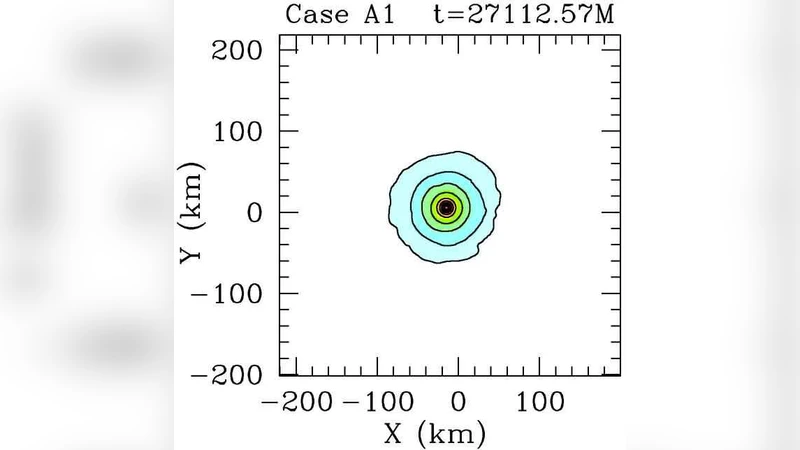
We present fully general relativistic (GR) simulations of binary white dwarf-neutron star (WDNS) inspiral and merger. The initial binary is in a circular orbit at the Roche critical separation. The goal is to determine the ultimate fate of such systems. We focus on binaries whose total mass exceeds the maximum mass (Mmax) a cold, degenerate EOS can support against gravitational collapse. The time and length scales span many orders of magnitude, making fully general relativistic hydrodynamic (GRHD) simulations computationally prohibitive. For this reason, we model the WD as a “pseudo-white dwarf” (pWD) as in our binary WDNS head-on collisions study [PRD83:064002,2011]. Our GRHD simulations of a pWDNS system with a 0.98-solar-mass WD and a 1.4-solar-mass NS show that the merger remnant is a spinning Thorne-Zytkow-like Object (TZlO) surrounded by a massive disk. The final total rest mass exceeds Mmax, but the remnant does not collapse promptly. To assess whether the object will ultimately collapse after cooling, we introduce radiative thermal cooling. We first apply our cooling algorithm to TZlOs formed in WDNS head-on collisions, and show that these objects collapse and form black holes on the cooling time scale, as expected. However, when we cool the spinning TZlO formed in the merger of a circular-orbit WDNS binary, the remnant does not collapse, demonstrating that differential rotational support is sufficient to prevent collapse. Given that the final total mass exceeds Mmax, magnetic fields and/or viscosity may redistribute angular momentum and ultimately lead to delayed collapse to a BH. We infer that the merger of realistic massive WDNS binaries likely will lead to the formation of spinning TZlOs that undergo delayed collapse.
💡 Research Summary
This paper presents the first fully general‑relativistic (GR) simulations of the late inspiral and merger of a white‑dwarf–neutron‑star (WD‑NS) binary, focusing on systems whose total rest mass exceeds the maximum mass that a cold, degenerate equation of state (EOS) can support. Because the physical size of a white dwarf (WD) is orders of magnitude larger than that of a neutron star (NS), a direct GR hydrodynamic simulation would require prohibitive resolution. The authors therefore adopt a “pseudo‑white‑dwarf” (pWD) approach: they replace the real WD with a scaled‑down version that has the same mass but a smaller radius, preserving the Mach number of the encounter and the ratio of thermal to rotational support (T/|W|). This scaling ensures that the results can be extrapolated to realistic WD‑NS mergers.
The EOS employed is a six‑parameter piecewise polytropic model designed to reproduce the key features of realistic cold nuclear EOSs for both WDs and NSs, including stable and unstable branches on the mass–central‑density curve. Parameters are chosen so that the maximum NS gravitational mass is 1.8 M⊙ (matching the APR EOS) and the maximum WD mass is the Chandrasekhar limit (≈1.43 M⊙). The pWD radius is set to be ten times smaller than a realistic WD, giving a NS‑to‑pWD radius ratio of 10:1 while keeping the NS structure essentially unchanged.
Initial data consist of a circular binary at the Roche‑lobe overflow limit, with a 0.98 M⊙ pWD and a 1.4 M⊙ NS. The mass ratio q≈0.7 exceeds the critical value q_crit≈0.5, placing the system in the unstable mass‑transfer (UMT) regime. The simulations are performed with the Illinois adaptive‑mesh‑refinement GR hydrodynamics code, evolving the spacetime using the BSSN formulation and the fluid with high‑resolution shock‑capturing methods.
Two sets of experiments are reported. First, the authors test their radiative cooling prescription on the remnants of head‑on pWD‑NS collisions studied previously. In those head‑on cases there is no rotation; when cooling is turned on the hot Thorne‑Zytkow‑like object (TZlO) collapses promptly to a black hole, confirming that thermal pressure alone was preventing collapse.
The second, central, experiment follows the inspiral‑merger scenario. After the WD is tidally disrupted, the NS core is embedded in a hot, massive mantle, forming a differentially rotating TZlO surrounded by an extended, hot accretion disk of ≈0.2–0.3 M⊙. The total rest mass of the remnant is ≈2.5 M⊙, well above both the cold EOS maximum mass (≈1.92 M⊙) and the uniformly rotating maximum (≈2.1 M⊙). Nevertheless, during the simulated ≈10 ms the remnant does not undergo prompt collapse; the differential rotation provides sufficient centrifugal support (T/|W|≈0.2). When the cooling algorithm is applied to this rotating remnant, it remains stable, demonstrating that rotation, not thermal pressure, is the dominant stabilizing factor.
The authors argue that, over longer timescales, viscosity or magnetic stresses (e.g., MRI) will redistribute angular momentum, reducing differential rotation and eventually leading to delayed collapse to a black hole. They estimate the redistribution timescale to range from seconds to minutes, depending on the efficiency of the angular‑momentum transport mechanisms. They also discuss possible nuclear burning during the merger, concluding that while it may add heat, it is unlikely to change the overall dynamical outcome.
In summary, the paper shows that (1) the pseudo‑white‑dwarf scaling is a viable method for bridging the enormous scale disparity in WD‑NS mergers, (2) a massive, differentially rotating TZlO can temporarily support a mass well beyond the cold EOS limit, and (3) the ultimate fate of such remnants is likely delayed black‑hole formation after angular‑momentum redistribution. These results have important implications for gravitational‑wave astronomy (e.g., LISA, DECIGO) and for electromagnetic counterparts such as short gamma‑ray bursts, providing a theoretical framework for interpreting future multi‑messenger observations of WD‑NS mergers.
Comments & Academic Discussion
Loading comments...
Leave a Comment