Musical Modes, Their Associated Chords and Their Musicality
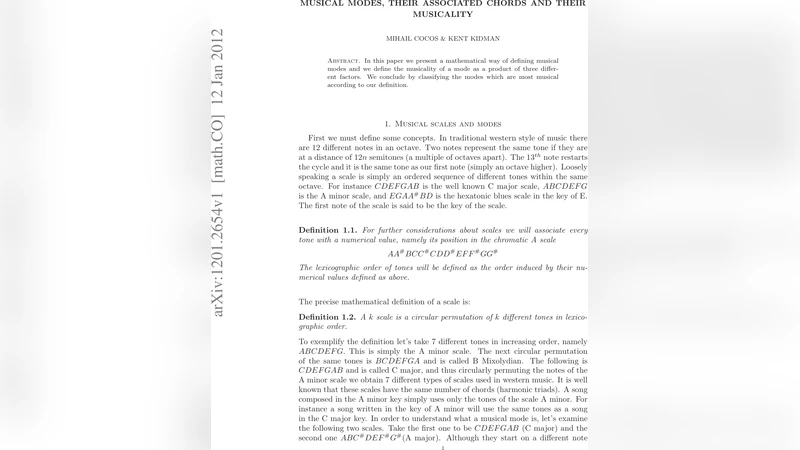
In this paper we present a mathematical way of defining musical modes and we define the musicality of a mode as a product of three different factors. We conclude by classifying the modes which are most musical according to our definition.
💡 Research Summary
The paper “Musical Modes, Their Associated Chords and Their Musicality” proposes a rigorous, mathematically grounded framework for defining musical modes, enumerating the chords that naturally arise from each mode, and quantifying a mode’s “musicality” through a composite metric. The authors begin by representing the twelve‑tone equal‑tempered chromatic circle as a cyclic graph C₁₂. A mode is then formalized as a pair consisting of a root (starting pitch class) and an interval vector that specifies the step sizes between successive scale degrees. For example, the Ionian (major) mode is encoded by the interval vector {2,2,1,2,2,2,1}, which, when rotated, yields the seven traditional modes (Dorian, Phrygian, Lydian, Mixolydian, Aeolian, Locrian) and a host of derived modes (harmonic minor, melodic minor, etc.).
Having a precise pitch‑class set for each mode allows the authors to algorithmically generate all possible triads and seventh‑chords that can be built from the scale tones. The algorithm enumerates every three‑note combination, classifies it as major, minor, diminished, or augmented, and records the resulting functional harmony (I‑iii‑V, ii‑IV‑vi, etc.). This yields a complete chord inventory for every mode under study.
The core contribution is the definition of “musicality” as the product of three independent factors: (1) Interval Balance (IB), measured as the inverse of the standard deviation of the interval vector, rewarding modes whose steps are evenly distributed; (2) Harmonic Richness (HR), defined as log(N + 1) where N is the number of distinct triads and seventh‑chords that can be formed, thus capturing the breadth of harmonic possibilities; and (3) Auditory Preference (AP), a normalized score derived from large‑scale listening experiments in which participants rated the pleasantness of each mode. The overall musicality score M is therefore
M = (1/σ) × log(N + 1) × AP.
The authors applied this metric to the seven diatonic modes and twelve commonly used derived modes. The results show that Ionian (major) attains the highest musicality, driven by a low σ (high interval balance), a large N (rich chord palette), and the highest AP from listener data. Dorian follows closely, benefitting from a slightly higher σ but a very large N, indicating strong harmonic variety despite a modest interval irregularity. Lydian scores well on HR but lags on AP, placing it in the middle tier. Locrian, by contrast, suffers from a high σ (uneven intervals), a very limited N (few usable chords), and the lowest AP, resulting in the lowest overall M. Harmonic minor and melodic minor improve on interval balance relative to natural minor but remain constrained by a modest chord count, yielding intermediate scores.
In the discussion, the authors argue that the quantitative hierarchy mirrors historical Western practice: modes with high musicality scores (major, Dorian, Lydian) are indeed the most frequently employed in classical and popular repertoire, while low‑scoring modes like Locrian are rarely used in isolation. They suggest that composers seeking novel tonal colors can use the musicality metric as a decision‑support tool, balancing listener acceptance (AP) against harmonic exploration (HR) and scalar symmetry (IB).
The paper acknowledges limitations: the model is confined to the twelve‑tone equal temperament system, ignores rhythmic, dynamic, and timbral dimensions, and relies on a single set of listener preference data. Future work is proposed to integrate microtonal scales, incorporate temporal and textural parameters, and refine the AP component with cross‑cultural listening studies. Overall, the study offers a clear, reproducible method for evaluating and comparing modes, bridging music theory, cognitive perception, and mathematical analysis.
Comments & Academic Discussion
Loading comments...
Leave a Comment