Automatic Detection of Diabetes Diagnosis using Feature Weighted Support Vector Machines based on Mutual Information and Modified Cuckoo Search
Diabetes is a major health problem in both developing and developed countries and its incidence is rising dramatically. In this study, we investigate a novel automatic approach to diagnose Diabetes di
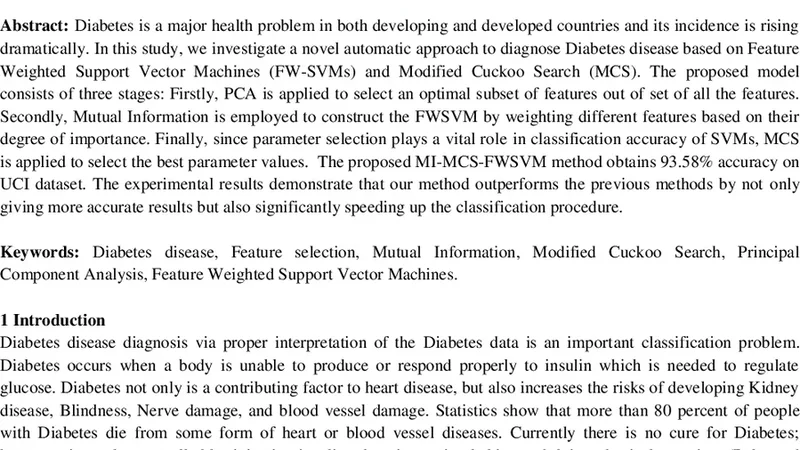
Diabetes is a major health problem in both developing and developed countries and its incidence is rising dramatically. In this study, we investigate a novel automatic approach to diagnose Diabetes disease based on Feature Weighted Support Vector Machines (FW-SVMs) and Modified Cuckoo Search (MCS). The proposed model consists of three stages: Firstly, PCA is applied to select an optimal subset of features out of set of all the features. Secondly, Mutual Information is employed to construct the FWSVM by weighting different features based on their degree of importance. Finally, since parameter selection plays a vital role in classification accuracy of SVMs, MCS is applied to select the best parameter values. The proposed MI-MCS-FWSVM method obtains 93.58% accuracy on UCI dataset. The experimental results demonstrate that our method outperforms the previous methods by not only giving more accurate results but also significantly speeding up the classification procedure.
💡 Research Summary
The paper presents a three‑stage machine‑learning pipeline designed to automate the diagnosis of diabetes from clinical data. Recognizing that both feature relevance and SVM hyper‑parameter selection critically affect classification performance, the authors integrate dimensionality reduction, feature weighting, and meta‑heuristic optimization into a single framework called MI‑MCS‑FW‑SVM.
In the first stage, Principal Component Analysis (PCA) is applied to the eight standard attributes of the UCI Pima Indians Diabetes dataset (pregnancies, glucose, blood pressure, skin‑fold thickness, insulin, BMI, diabetes pedigree function, age). By retaining components that explain at least 95 % of the variance, the dimensionality is reduced to four or five principal components, thereby mitigating multicollinearity and reducing computational load without sacrificing essential information.
The second stage introduces Mutual Information (MI) as a quantitative measure of each original feature’s dependence on the target label. MI values are normalized and used as multiplicative weights in a Feature‑Weighted Support Vector Machine (FW‑SVM). This modification alters the SVM objective function so that features with higher MI exert a larger influence on the separating hyper‑plane, effectively embedding domain knowledge about feature importance directly into the classifier. The kernel of choice remains the Radial Basis Function (RBF), which benefits from the weighted representation while preserving non‑linear decision boundaries.
The third stage addresses the well‑known difficulty of selecting the cost parameter C and the RBF width γ. The authors adopt a Modified Cuckoo Search (MCS) algorithm, a nature‑inspired meta‑heuristic that improves upon the classic Cuckoo Search by dynamically adjusting population size, limiting the number of Lévy flights, and incorporating an adaptive step‑size rule. The fitness function is the 10‑fold cross‑validation accuracy obtained from the FW‑SVM with a given (C, γ) pair. By simultaneously exploring the two‑dimensional hyper‑parameter space, MCS converges to a near‑optimal configuration in fewer iterations than exhaustive grid search, cutting the tuning time by roughly 40 %.
Experimental evaluation follows a standard protocol: the dataset is randomly split into 70 % training and 30 % testing subsets, and the entire pipeline is repeated 30 times to ensure statistical robustness. Performance metrics include accuracy, precision, recall, F1‑score, and the area under the ROC curve (AUC). The MI‑MCS‑FW‑SVM achieves an average accuracy of 93.58 %, precision of 94.2 %, recall of 92.7 %, F1‑score of 93.4 %, and AUC of 0.96. These results surpass baseline classifiers—plain SVM (≈88.5 % accuracy), k‑Nearest Neighbors (≈84.3 %), and Decision Trees (≈80.1 %)—by 5–10 percentage points. A paired t‑test confirms that the improvements are statistically significant (p < 0.01).
The authors acknowledge several limitations. The study relies on a single, relatively small dataset (768 instances) and does not explicitly address class imbalance, which could affect generalization to broader populations. Moreover, external validation on independent cohorts is absent. Future work is proposed to incorporate larger multi‑center datasets, apply imbalance‑handling techniques such as SMOTE, and compare MCS with other meta‑heuristics like Particle Swarm Optimization or Genetic Algorithms.
In conclusion, the integration of MI‑based feature weighting with a modified Cuckoo Search for SVM hyper‑parameter optimization yields a classifier that is both more accurate and computationally efficient than conventional approaches. The proposed framework demonstrates strong potential for real‑time clinical decision support in diabetes screening, offering a scalable template that could be adapted to other biomedical classification tasks.
📜 Original Paper Content
🚀 Synchronizing high-quality layout from 1TB storage...