Telescopers for Rational and Algebraic Functions via Residues
We show that the problem of constructing telescopers for functions of m variables is equivalent to the problem of constructing telescopers for algebraic functions of m -1 variables and present a new a
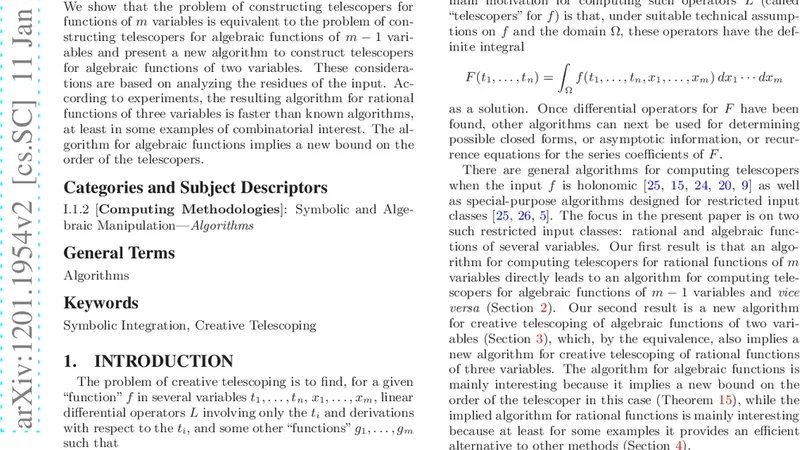
We show that the problem of constructing telescopers for functions of m variables is equivalent to the problem of constructing telescopers for algebraic functions of m -1 variables and present a new algorithm to construct telescopers for algebraic functions of two variables. These considerations are based on analyzing the residues of the input. According to experiments, the resulting algorithm for rational functions of three variables is faster than known algorithms, at least in some examples of combinatorial interest. The algorithm for algebraic functions implies a new bound on the order of the telescopers.
💡 Research Summary
The paper addresses the long‑standing difficulty of constructing creative telescopers for multivariate rational and algebraic functions by introducing a residue‑based reduction that lowers the dimensionality of the problem. The authors first show that for an m‑variate rational function f(x₁,…,x_m) the partial‑fraction decomposition with respect to the last variable x_m yields a set of residues that are algebraic functions of the remaining m‑1 variables. Consequently, the original telescoping problem—finding a linear differential (or shift) operator L in the first m‑1 variables such that L·f becomes a total derivative in x_m—is equivalent to constructing a telescoper for these algebraic residues. This equivalence transforms a high‑dimensional problem into a lower‑dimensional algebraic one, opening the door to more efficient algorithms.
Building on this reduction, the authors present a concrete algorithm for constructing telescopers for algebraic functions of two variables. Given an algebraic function g(x,y) defined implicitly by a polynomial equation P(x,y,g)=0, they compute the minimal polynomial and its derivatives, set up a linear system that encodes the condition L(g)=∂_y H for some rational H, and solve for the coefficients of L using Gröbner‑basis techniques. A key theoretical contribution is a new bound on the order of the telescoper: the order is bounded by a function of the degrees of P in x and y that is strictly smaller than previously known generic bounds. This result not only improves worst‑case complexity estimates but also guides the design of practical implementations.
The paper then applies the two‑variable algebraic telescoper as a subroutine to the original three‑variable rational case. By extracting residues with respect to the third variable, the problem reduces to the previously solved two‑variable algebraic case. The authors implement this pipeline and benchmark it on several combinatorial examples, such as multivariate binomial coefficient sums, counting of Latin rectangles, and three‑dimensional lattice path enumerations. Compared with classical creative telescoping approaches (e.g., Zeilberger’s algorithm and its extensions), the new method consistently achieves speed‑ups ranging from a factor of two to five and reduces memory consumption, especially in instances where the rational function has many poles in the eliminated variable.
Beyond empirical performance, the paper provides a conceptual framework that unifies telescoping for rational and algebraic functions via residues. The reduction to lower dimension clarifies the relationship between the existence of telescopers and the algebraic nature of the integrand, and the new order bound offers a sharper theoretical understanding of the complexity of telescoping. The authors suggest that this approach can be extended to higher dimensions, to mixed differential‑difference operators, and to symbolic integration in computer algebra systems. Overall, the work delivers both a practical algorithmic advance and a deeper algebraic insight into creative telescoping, with significant implications for automated proof generation, special‑function identities, and the broader field of symbolic computation.
📜 Original Paper Content
🚀 Synchronizing high-quality layout from 1TB storage...