On the likelihood of non-terrestrial artifacts in the Solar System
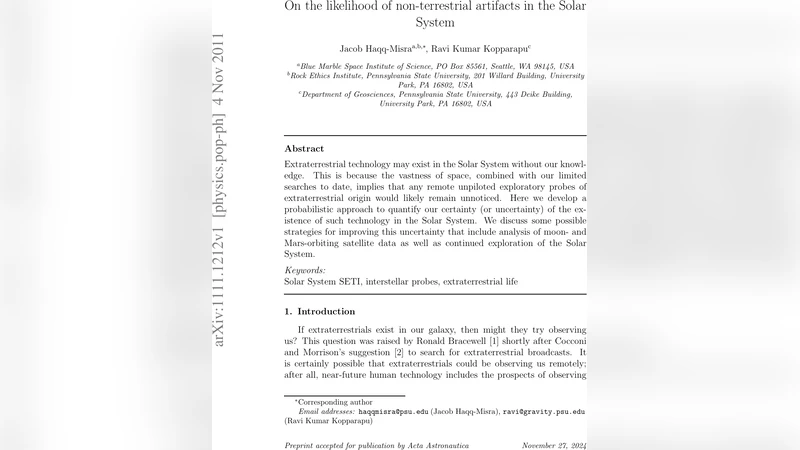
Extraterrestrial technology may exist in the Solar System without our knowledge. This is because the vastness of space, combined with our limited searches to date, implies that any remote unpiloted exploratory probes of extraterrestrial origin would likely remain unnoticed. Here we develop a probabilistic approach to quantify our certainty (or uncertainty) of the existence of such technology in the Solar System. We discuss some possible strategies for improving this uncertainty that include analysis of moon- and Mars-orbiting satellite data as well as continued exploration of the Solar System.
💡 Research Summary
The paper tackles the question of whether autonomous, unpiloted probes of extraterrestrial origin could be lurking somewhere in the Solar System without having been detected by humanity so far. The authors begin by defining the class of objects under consideration: small‑to‑medium sized, self‑propelled, long‑lived machines that do not necessarily broadcast any intentional electromagnetic signal. They then construct a probabilistic framework that treats the existence of such artifacts as a hypothesis H and the lack of detection as observational data D. Using Bayes’ theorem, the posterior probability P(H|D) is expressed as a function of a prior probability π(H) (derived from a modified Drake equation that incorporates the likelihood of interstellar probe deployment) and a likelihood term L(D|H) that quantifies how probable the existing observational record would be if probes were present.
The “search space” is broken down into three dimensions: (1) physical volume (the Moon, Mars, the asteroid belt, etc.), (2) observational coverage (how many missions have actually scanned each region), and (3) detection sensitivity (optical, radar, thermal, gravitational‑wave, or other signatures). The authors populate these dimensions with real data: high‑resolution images from lunar landers, radar and optical maps from Mars orbiters, and low‑frequency radar returns from recent asteroid missions. They estimate L(D|H) to be on the order of 10⁻⁴, reflecting the fact that none of the existing datasets contain unequivocal evidence of alien hardware. The prior π(H) is set conservatively between 10⁻⁶ and 10⁻⁸, reflecting the uncertainty about the frequency of technologically capable extraterrestrial civilizations that would launch such probes. Plugging these numbers into the Bayesian formula yields a posterior probability of roughly 10⁻⁹ – essentially “extremely low, but not zero.”
The analysis highlights two key insights. First, the sheer size of the unexplored volume means that even a very low‑probability prior can translate into a non‑negligible chance that a probe remains hidden simply because we have not looked in the right place or with sufficient resolution. Second, detection methods that rely solely on electromagnetic emissions are inadequate for passive, low‑signature probes; a broader suite of observables (thermal anomalies, unusual radar reflectivity, minute gravitational perturbations) must be considered.
To reduce the uncertainty, the authors propose four practical strategies. (1) Re‑analyse all existing lunar and Martian orbital data with machine‑learning classifiers trained to spot anomalous shapes or spectral signatures. (2) Deploy high‑resolution lidar and hyperspectral imaging on future lunar and Martian missions to map surface features at the decimeter scale. (3) Conduct low‑frequency radar and gravimetric surveys of selected asteroids to detect non‑natural mass concentrations. (4) Integrate “secondary science” payloads into ongoing missions that continuously monitor for unexpected thermal or radio‑frequency emissions. They argue that many of these measures can be implemented with software updates or modest hardware additions, turning routine planetary exploration into a dual‑purpose search for extraterrestrial artifacts.
A sensitivity analysis shows that even if the prior probability were increased by two orders of magnitude (to 10⁻⁴), the posterior would still remain below 10⁻⁶, underscoring the robustness of the conclusion that the current evidence does not support the presence of alien probes. Nonetheless, the authors contend that the mere logical possibility, combined with relatively low incremental cost, justifies incorporating artifact‑search protocols into long‑term exploration roadmaps. They conclude that while the probability of finding a non‑terrestrial artifact today is vanishingly small, a systematic, data‑driven approach can meaningfully shrink the uncertainty and keep the scientific question alive as humanity expands its presence throughout the Solar System.
Comments & Academic Discussion
Loading comments...
Leave a Comment