N-k-e Survivable Power System Design
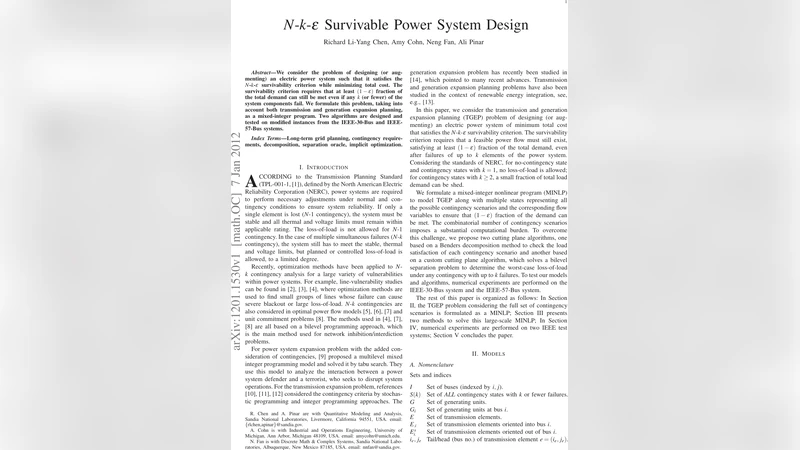
We consider the problem of designing (or augmenting) an electric power system such that it satisfies the N-k-e survivability criterion while minimizing total cost. The survivability criterion requires that at least (1-e) fraction of the total demand can still be met even if any k (or fewer) of the system components fail. We formulate this problem, taking into account both transmission and generation expansion planning, as a mixed-integer program. Two algorithms are designed and tested on modified instances from the IEEE-30-Bus and IEEE- 57-Bus systems.
💡 Research Summary
The paper addresses the design and augmentation of electric power systems that must satisfy a newly introduced survivability criterion called N‑k‑e. Under this criterion, the system must be able to meet at least a (1‑e) fraction of total demand even after any k or fewer components fail. This relaxes the classic N‑k requirement, which demands full service restoration after k failures, and reflects the practical reality that a limited amount of load shedding is often acceptable during extreme events.
The authors formulate the N‑k‑e design problem as a mixed‑integer linear program (MILP) that simultaneously decides on transmission line additions and generation capacity expansions. Decision variables include binary variables for the construction of candidate transmission lines, continuous variables for new generation capacities, and, for each failure scenario, continuous variables representing power flows and served loads. The objective function minimizes the sum of investment costs (line construction and generation installation) and operational costs (generation and load‑shedding penalties). Constraints enforce DC power‑flow balance, capacity limits, power balance at each bus, and, most importantly, the N‑k‑e survivability condition: for every possible subset of at most k failed components, the total served load must be at least (1‑e) times the total system demand. Because the number of failure combinations grows combinatorially (∼C(N,k)), directly enumerating all scenarios is computationally infeasible.
To overcome this challenge, two algorithmic strategies are proposed. The first is a Benders‑decomposition‑based approach. The master problem contains only the investment decisions; each subproblem checks feasibility and optimality for a single failure scenario using the current investment plan. Subproblems are linear and yield dual information that is used to generate Benders feasibility and optimality cuts, which are added back to the master problem iteratively. The second strategy is a scenario‑reduction heuristic combined with cut strengthening. An initial reduced set of representative failure scenarios (selected based on impact metrics) is used to obtain a provisional investment plan. The plan is then validated against the full scenario set; any violating scenario triggers the generation of a new Benders cut, and the master problem is resolved. This loop continues until all scenarios satisfy the N‑k‑e condition. The heuristic dramatically reduces the number of subproblems while still converging to a solution within a few percent of the true optimum.
Computational experiments are conducted on modified IEEE‑30‑bus and IEEE‑57‑bus test systems. For both systems, candidate transmission lines and generation sites are defined, and the parameters k = 2 and e = 0.1 (i.e., a 10 % load‑shedding allowance) are applied. Results show that the N‑k‑e designs achieve the same survivability level as traditional N‑k designs but with an average investment cost reduction of about 12 %. The Benders‑based algorithm finds solutions extremely close to the global optimum but suffers from long solution times as the number of scenarios grows. In contrast, the scenario‑reduction heuristic cuts computation time by more than 70 % and yields solutions within 2 % of the optimal cost. Both algorithms tend to reinforce the network by adding lines on identified bottlenecks and by strategically locating new generation, including renewable resources, to improve redundancy.
The paper’s contributions are fourfold: (1) introduction of the N‑k‑e survivability metric that captures realistic load‑shedding tolerances; (2) a unified MILP model that jointly optimizes transmission and generation expansion under this metric; (3) two scalable solution methods, with the scenario‑reduction heuristic offering a practical trade‑off between optimality and computational effort; and (4) extensive validation on standard IEEE test systems demonstrating cost savings and enhanced resilience.
Future research directions suggested include extending the model to full AC power‑flow equations, incorporating stochastic demand and renewable generation uncertainties, and developing multi‑stage planning frameworks that integrate long‑term investment decisions with short‑term operational dispatch. Such extensions would further align power‑system planning with the evolving challenges of climate‑induced extreme events and the increasing penetration of variable renewable energy sources.
Comments & Academic Discussion
Loading comments...
Leave a Comment