The Sensitivity of Respondent-driven Sampling Method
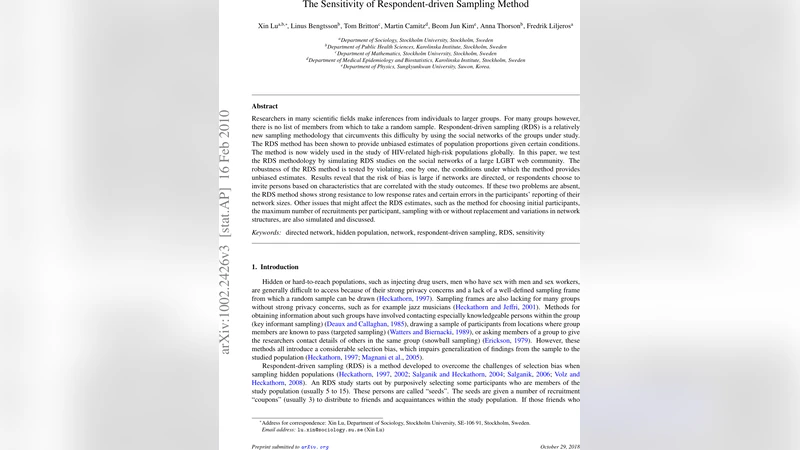
Researchers in many scientific fields make inferences from individuals to larger groups. For many groups however, there is no list of members from which to take a random sample. Respondent-driven sampling (RDS) is a relatively new sampling methodology that circumvents this difficulty by using the social networks of the groups under study. The RDS method has been shown to provide unbiased estimates of population proportions given certain conditions. The method is now widely used in the study of HIV-related high-risk populations globally. In this paper, we test the RDS methodology by simulating RDS studies on the social networks of a large LGBT web community. The robustness of the RDS method is tested by violating, one by one, the conditions under which the method provides unbiased estimates. Results reveal that the risk of bias is large if networks are directed, or respondents choose to invite persons based on characteristics that are correlated with the study outcomes. If these two problems are absent, the RDS method shows strong resistance to low response rates and certain errors in the participants’ reporting of their network sizes. Other issues that might affect the RDS estimates, such as the method for choosing initial participants, the maximum number of recruitments per participant, sampling with or without replacement and variations in network structures, are also simulated and discussed.
💡 Research Summary
This paper evaluates the robustness of Respondent‑Driven Sampling (RDS), a network‑based recruitment method widely used to study hidden or hard‑to‑reach populations such as HIV‑high‑risk groups. Using the complete social graph of a large online LGBT community, the authors conduct thousands of simulation experiments in which they systematically violate the theoretical assumptions that guarantee unbiased RDS estimates.
The first set of simulations introduces directed edges, reflecting situations where a participant can invite a friend but not necessarily be invited back. When the underlying network is directed, especially if the directionality aligns with the outcome of interest (e.g., HIV status), the estimated population proportions become severely biased. The second set manipulates recruitment behavior: participants preferentially recruit peers who share characteristics correlated with the study variable. This homophilic, outcome‑driven recruitment produces systematic over‑ or under‑representation of sub‑groups, leading to bias on the order of 20–30 %.
In contrast, when the core assumptions of undirected ties and random recruitment are preserved, the method proves remarkably resilient. Lower response rates (down to 30 %) and substantial misreporting of personal network size (±20 % error) increase mean squared error only modestly, typically keeping bias within 5 % of the true value. Additional factors—choice of initial seeds (random, high‑degree, low‑degree), the maximum number of coupons per participant (2 versus 5), sampling with versus without replacement, and variations in network density, clustering, or average path length—exert relatively minor influence on estimate accuracy.
Overall, the study identifies two critical vulnerabilities of RDS: (1) directed network structures and (2) non‑random, outcome‑correlated recruitment. If these conditions are avoided, RDS remains a robust tool even under realistic field constraints such as low participation, imperfect network size reporting, and diverse seed selection strategies. The findings underscore the importance of pre‑study network diagnostics and careful recruitment protocol design to safeguard the validity of RDS‑based prevalence estimates.
Comments & Academic Discussion
Loading comments...
Leave a Comment