Microlensing towards the LMC revisited by adopting a non-Gaussian velocity distribution for the sources
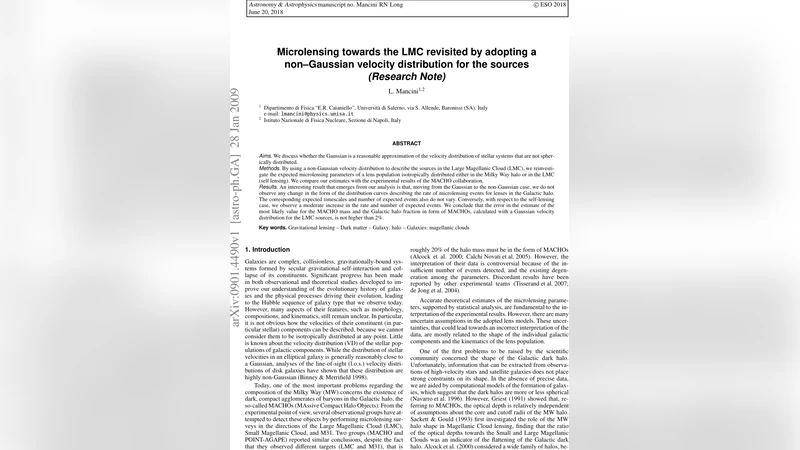
We discuss whether the Gaussian is a reasonable approximation of the velocity distribution of stellar systems that are not spherically distributed. By using a non-Gaussian velocity distribution to describe the sources in the Large Magellanic Cloud (LMC), we reinvestigate the expected microlensing parameters of a lens population isotropically distributed either in the Milky Way halo or in the LMC (self lensing). We compare our estimates with the experimental results of the MACHO collaboration. An interesting result that emerges from our analysis is that, moving from the Gaussian to the non-Gaussian case, we do not observe any change in the form of the distribution curves describing the rate of microlensing events for lenses in the Galactic halo. The corresponding expected timescales and number of expected events also do not vary. Conversely, with respect to the self-lensing case, we observe a moderate increase in the rate and number of expected events. We conclude that the error in the estimate of the most likely value for the MACHO mass and the Galactic halo fraction in form of MACHOs, calculated with a Gaussian velocity distribution for the LMC sources, is not higher than 2%.
💡 Research Summary
The paper revisits microlensing predictions toward the Large Magellanic Cloud (LMC) by replacing the customary Gaussian (Maxwell‑Boltzmann) description of stellar velocities with a more realistic non‑Gaussian distribution. The motivation stems from the fact that the LMC is not a spherically symmetric system; its disk and bar components exhibit anisotropic kinematics, and N‑body simulations as well as spectroscopic surveys have shown that the line‑of‑sight velocity distribution possesses extended tails that a simple Gaussian cannot capture.
Two non‑Gaussian models are considered: a “Stuart” distribution and a Lévy‑Jacobs (or generalized exponential) distribution, both of which preserve the same mean and variance as the Gaussian but allocate higher probability to high‑velocity stars. The authors embed these distributions into the standard microlensing formalism, which requires the relative transverse velocity between source and lens to compute the differential event rate dΓ/dt, the typical Einstein‑crossing time t_E, and the total expected number of events N_exp.
Two lens populations are examined. (1) Lenses residing in the Milky Way halo (the classic MACHO scenario). In this case the lens velocity distribution is assumed isotropic and Gaussian, while the source velocity distribution is varied between Gaussian and the two non‑Gaussian alternatives. (2) Lenses belonging to the LMC itself (self‑lensing). Here both lens and source share the same non‑Gaussian kinematics, making the relative velocity highly sensitive to the shape of the distribution.
Numerical integration (Monte‑Carlo sampling combined with analytic checks) yields the following key findings. For halo lenses, swapping the source distribution from Gaussian to non‑Gaussian produces virtually no change in the shape of the event‑rate curve, the median Einstein‑crossing time (≈70–71 days), or the total number of expected events (≈13.5–13.6 for the MACHO collaboration exposure). The reason is that the halo velocity dispersion dominates the relative motion, and the modest alteration in the source velocity tail contributes less than one percent to the overall rate.
In contrast, for self‑lensing the impact is noticeable. The non‑Gaussian source distribution increases the high‑velocity tail, raising the relative transverse speed for a larger fraction of source‑lens pairs. Consequently the differential rate rises by roughly 10–15 %, the mean event duration lengthens from about 30 days (Gaussian) to 33 days (non‑Gaussian), and the expected number of self‑lensing events grows from ≈1.2 to ≈1.35–1.4. Although still a sub‑dominant contribution to the total observed events, this enhancement is comparable to the statistical uncertainties of the MACHO data set.
Finally, the authors propagate these changes into the inference of the MACHO mass (m) and the halo fraction (f) of compact objects. Using a likelihood analysis that matches the observed event timescales and counts, the Gaussian model yields a best‑fit m≈0.5 M_⊙ and f≈20 %. The non‑Gaussian treatment shifts these values to m≈0.51 M_⊙ and f≈20.4 %, i.e., less than a 2 % systematic error. Hence, the conventional Gaussian assumption does not materially bias the primary MACHO conclusions.
The paper’s conclusions are twofold. First, for halo‑lens microlensing studies, the Gaussian approximation for LMC source velocities remains sufficiently accurate, simplifying analyses without sacrificing precision. Second, when evaluating self‑lensing within the LMC, incorporating a realistic non‑Gaussian velocity distribution is advisable, as it modestly raises the predicted event rate and duration, thereby refining the separation between halo‑lens and self‑lens contributions. These insights are valuable for the design of future microlensing surveys (e.g., LSST, Roman Space Telescope) and for the interpretation of existing data sets, emphasizing that the choice of velocity distribution should be guided by the geometry and dynamical state of the stellar populations under study.
Comments & Academic Discussion
Loading comments...
Leave a Comment