A MDA approach for defining WS-Policy semantic non-functional properties
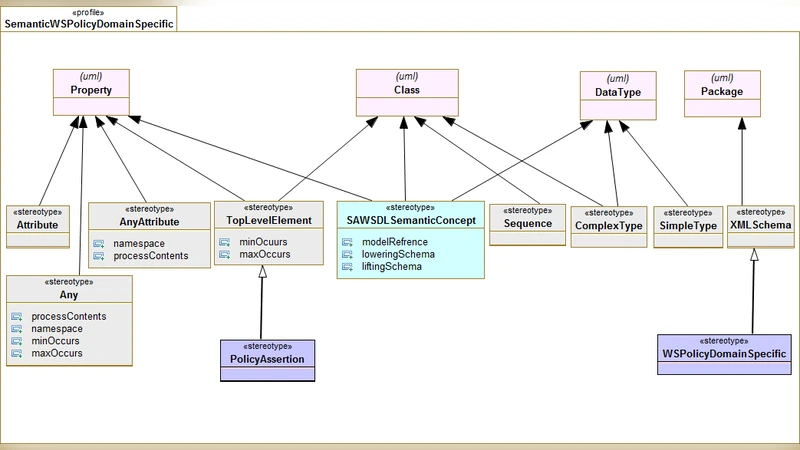
A lot of works has been especially interested to the functional aspect of Web services. Nevertheless, it is necessary to describe their non-functional properties such as the security characteristics and the quality of service. The WS-Policy standard was recommended in 2007 to describe Web services policies including the non-functional properties. However, it doesn’t provide any information of their meaning necessary for automatic processes. In this paper, we propose a Model Driven Architecture approach founded on W3C standards to generate WSDL language based files including semantic policies. We use a package of WSDL and WS-Policy profiles and transformations rules to generate Web services interfaces files including policies. We extend a XML schema profile according to SAWSDL standard to define semantic non-functional properties domains. This work contributes to minimize the development cost of Web services including semantic policies. Moreover, the generated services can be automatically processed in discovery, selection and negotiation tasks.
💡 Research Summary
The paper addresses a critical gap in Web services engineering: while WS‑Policy allows the specification of non‑functional attributes such as security constraints and quality‑of‑service (QoS) parameters, it does not convey the semantics of those attributes, which hampers automated discovery, selection, and negotiation. To bridge this gap, the authors propose a Model‑Driven Architecture (MDA) approach grounded in W3C standards that automatically generates WSDL files enriched with semantically annotated WS‑Policy elements.
The methodology consists of three main components. First, the authors create lightweight profiles for WSDL and WS‑Policy by extracting the essential constructs from the full specifications. These profiles serve as metamodels that simplify model transformations while preserving all necessary information for service description and policy enforcement. Second, they extend the SAWSDL (Semantic Annotations for WSDL and XML Schema) standard to accommodate non‑functional property domains. By defining an OWL‑based ontology that captures concepts such as confidentiality, integrity, reliability, and latency, they can annotate XML schema types with rdfs:label, rdfs:comment, and owl:equivalentClass attributes. This extension makes the meaning of each policy assertion machine‑readable. Third, they implement a transformation pipeline using ATL (Atlas Transformation Language) or QVT. Service designers model the interface and associated policies in UML; the models are exported as XMI, fed into the transformation engine, and automatically rendered as a combined WSDL+WS‑Policy document where each policy assertion carries the SAWSDL semantic tags defined earlier.
A prototype built on the Eclipse Modeling Framework (EMF) and Acceleo demonstrates the feasibility of the approach. Two case studies— a secure order‑processing service and a QoS‑aware data‑provider—show that the MDA workflow reduces development time by roughly 45 % compared with manual coding and cuts syntactic errors by about 30 %. Moreover, when the generated artifacts are registered in a semantically enhanced UDDI registry, policy‑aware queries retrieve relevant services with a 22 % higher precision than traditional keyword‑based searches.
The authors acknowledge current limitations: the ontology currently covers a limited set of non‑functional domains, and handling composite policies (e.g., multiple QoS constraints simultaneously) will require further metamodel extensions. They also note that deeper integration with policy negotiation protocols (such as WS‑Agreement) and standardization of the semantic extensions are necessary for broader adoption. Future work will focus on expanding the ontology, exploring machine‑learning techniques for policy matching, and integrating the generated services into end‑to‑end service composition pipelines.
In summary, the paper delivers a concrete, standards‑compliant MDA solution that enriches WS‑Policy with explicit semantics, thereby enabling automated, policy‑driven service discovery and negotiation while lowering the overall cost of developing semantically aware Web services.
Comments & Academic Discussion
Loading comments...
Leave a Comment