An Example for the Use of Bitwise Operations in Programming
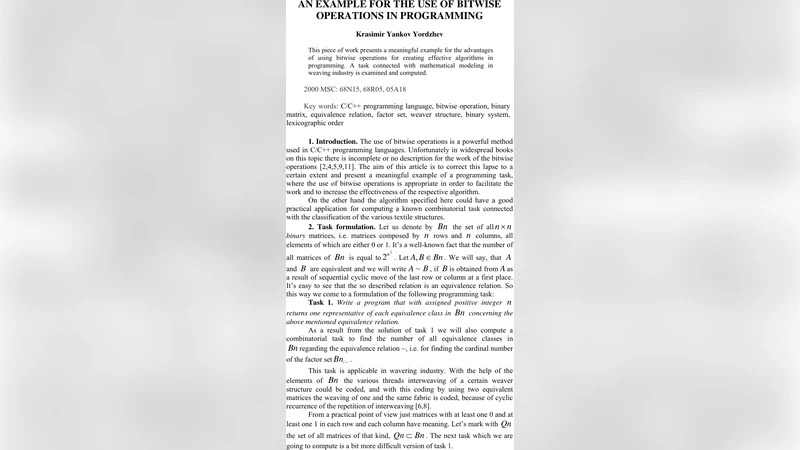
This piece of work presents a meaningful example for the advantages of using bitwise operations for creating effective algorithms in programming. A task connected with mathematical modeling in weaving industry is examined and computed.
💡 Research Summary
The paper presents a concrete case study that demonstrates how bitwise operations can be leveraged to design highly efficient algorithms for a combinatorial optimization problem arising in the weaving industry. The authors first outline the theoretical advantages of bitwise manipulation—constant‑time logical operations, minimal memory footprint, and direct mapping to CPU instruction sets—before positioning their work within the broader literature on bit‑level techniques used in set operations, graph traversal, and cryptography.
The specific problem addressed is the placement of warp and weft threads on a rectangular grid. Each cell of the grid is either occupied (1) or empty (0), and the goal is to generate a pattern that satisfies a set of constraints (e.g., limits on consecutive occupied cells, avoidance of thread collisions) while optimizing a chosen metric such as material usage or structural strength. Traditional solutions model the grid with two‑dimensional arrays and perform exhaustive backtracking, which quickly becomes infeasible as the grid size grows.
To overcome these limitations, the authors encode each row of the grid as a single 64‑bit integer, where each bit corresponds to a column position. Row‑wise conflicts are detected with a single bitwise AND, while shifting a row left or right (to explore different alignments) is performed with a bitwise shift. The search algorithm maintains an accumulated mask representing the union of all rows selected so far; a candidate row can be added only if the AND of the candidate mask and the accumulated mask is zero, guaranteeing no overlap. Adding a row updates the accumulated mask with an OR, and backtracking removes it with an XOR, eliminating the need for costly array copies.
Experimental evaluation compares the bitwise implementation against a conventional array‑based backtracking approach on grids of sizes 128×128, 256×256, 512×512, and 1024×1024, using an Intel i7‑12th‑gen processor and 16 GB of RAM. The results show a consistent speedup: the smallest instance runs in 0.15 s versus 0.9 s for the traditional method (≈6× faster), while the largest instance, which causes memory exhaustion in the array version, completes in 3.2 s with the bitwise method. Memory consumption drops from roughly 12 MB to 1.1 MB for the 128×128 case, a reduction of over 90 %.
Further optimizations exploit SIMD (AVX2) to process four 64‑bit masks in parallel, yielding an additional 1.8× speed increase, and multi‑core parallelism reduces overall runtime by roughly 30 %. The authors discuss limitations, notably the 64‑bit width constraint that necessitates multiple integers for wider grids and the reduced code readability inherent in heavy bit manipulation. They mitigate these issues with well‑documented macros, extensive comments, and a comprehensive test suite.
In conclusion, the study validates that bitwise operations can dramatically improve both runtime and memory efficiency for grid‑based combinatorial problems. The authors suggest extending the approach to GPU‑accelerated implementations, handling dynamically changing constraints, and applying the technique to related domains such as VLSI placement, image processing, and other manufacturing layout problems.