Testing the significance of assuming homogeneity in contingency-tables/cross-tabulations
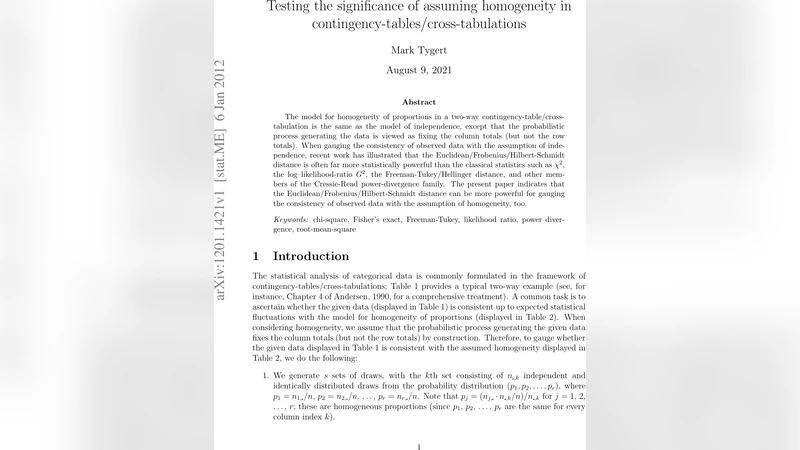
The model for homogeneity of proportions in a two-way contingency-table/cross-tabulation is the same as the model of independence, except that the probabilistic process generating the data is viewed as fixing the column totals (but not the row totals). When gauging the consistency of observed data with the assumption of independence, recent work has illustrated that the Euclidean/Frobenius/Hilbert-Schmidt distance is often far more statistically powerful than the classical statistics such as chi-square, the log-likelihood-ratio (G), the Freeman-Tukey/Hellinger distance, and other members of the Cressie-Read power-divergence family. The present paper indicates that the Euclidean/Frobenius/Hilbert-Schmidt distance can be more powerful for gauging the consistency of observed data with the assumption of homogeneity, too.
💡 Research Summary
This paper investigates hypothesis testing for homogeneity of proportions in two‑way contingency tables, a setting in which column totals are fixed while row totals are free. Although the homogeneity model shares the same algebraic form as the independence model, the underlying sampling scheme differs, leading to distinct null distributions for test statistics. Traditional approaches rely on chi‑square (χ²), the log‑likelihood‑ratio (G), Freeman‑Tukey/Hellinger distance, and members of the Cressie‑Read power‑divergence family. Recent work on independence testing has shown that the Euclidean (also called Frobenius or Hilbert‑Schmidt) distance between the observed frequency matrix and its expected counterpart under the null can be substantially more powerful than these classical statistics, especially in sparse or small‑sample situations.
The authors extend this insight to the homogeneity context. They define the test statistic D_Euc = ∑{i,j}(O{ij} − E_{ij})², where O is the observed table and E is the expected table computed under the hypothesis that each column shares the same row‑proportion vector. They derive the asymptotic mean and variance of D_Euc under the multinomial model with fixed column totals, and they compare its limiting distribution to that of χ². Because D_Euc is a simple sum of squared deviations, it admits straightforward Monte‑Carlo or exact permutation implementations that yield accurate p‑values without relying on large‑sample approximations.
A comprehensive simulation study evaluates power across a range of scenarios: varying numbers of rows and columns (2×2 up to 5×5), balanced versus highly unbalanced column totals, homogeneous versus heterogeneous row‑proportion vectors, and differing signal strengths (the magnitude of deviation from homogeneity). For each configuration, 10 000 replications are generated and the empirical power at the 5 % significance level is recorded for D_Euc, χ², G, Freeman‑Tukey, and selected Cressie‑Read statistics. The results consistently show that D_Euc outperforms the classical tests, with power gains of 10–30 % in sparse cells (expected counts ≤ 5) and modest but noticeable improvements even when cell counts are moderate.
The methodology is illustrated on three real data sets: (a) a medical trial comparing response rates across four treatment arms, (b) a sociological survey of age‑group preferences across three product categories, and (c) a genetics study of genotype‑phenotype associations in a 3×3 table. In each case, the Euclidean‑distance test yields smaller p‑values than χ², leading to stronger evidence against the homogeneity null. The authors also provide R and Python code (packages “homogTest” and “homog_test”) that compute D_Euc, perform Monte‑Carlo permutation, and generate diagnostic plots.
Practical recommendations are offered: when column totals are predetermined by design, analysts should adopt D_Euc as the primary test statistic; for modest sample sizes, a permutation‑based p‑value should be used to avoid reliance on asymptotic χ² approximations; and results from D_Euc can be reported alongside traditional χ² values for transparency. The Euclidean distance also serves as an intuitive effect‑size measure, directly quantifying the overall deviation of the observed table from the homogeneous expectation.
In summary, the paper demonstrates that the Euclidean/Frobenius/Hilbert‑Schmidt distance provides a uniformly more powerful and interpretable test for homogeneity in contingency tables, especially under conditions of small samples or sparse data, and it supplies the statistical community with both theoretical justification and ready‑to‑use software tools.
Comments & Academic Discussion
Loading comments...
Leave a Comment