FITS Checksum Proposal
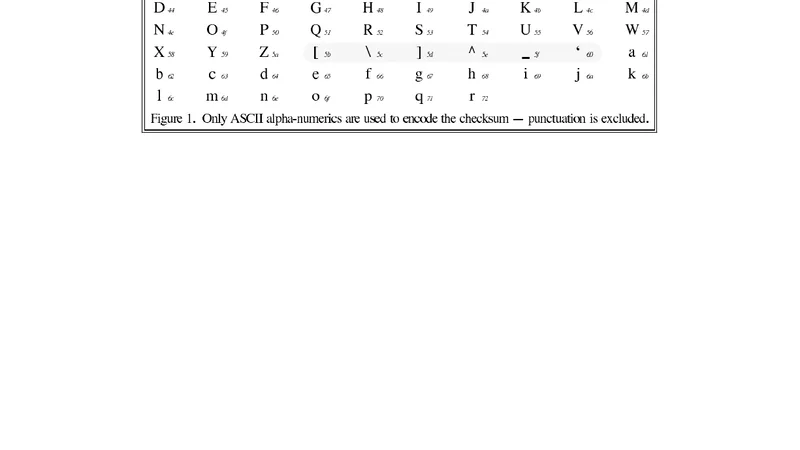
The checksum keywords described here provide an integrity check on the information contained in FITS HDUs. (Header and Data Units are the basic components of FITS files, consisting of header keyword records followed by optional associated data records). The CHECKSUM keyword is defined to have a value that forces the 32-bit 1’s complement checksum accumulated over all the 2880-byte FITS logical records in the HDU to equal negative 0. (Note that 1’s complement arithmetic has both positive and negative zero elements). Verifying that the accumulated checksum is still equal to -0 provides a fast and fairly reliable way to determine that the HDU has not been modified by subsequent data processing operations or corrupted while copying or storing the file on physical media.
💡 Research Summary
The paper presents a practical integrity‑checking scheme for FITS (Flexible Image Transport System) files, which are the de‑facto standard for astronomical data exchange and archival. FITS files consist of one or more Header‑Data Units (HDUs), each composed of a header made up of 80‑character keyword records followed by an optional data block. The physical layout of a FITS file is organized into 2880‑byte logical records, a structure that historically has made it difficult to embed a native checksum without breaking compatibility.
To address this, the authors propose two new header keywords: CHECKSUM and DATA_CHECKSUM. Both are defined using a 32‑bit one’s‑complement checksum, a form of arithmetic where overflow bits are wrapped around and added back into the low‑order word. The key property of one’s complement is the existence of both positive zero (0x00000000) and negative zero (0xFFFFFFFF). By forcing the accumulated checksum over an entire HDU to equal negative zero, any subsequent alteration of the HDU—whether by processing, copying, or media degradation—will be detected because the checksum will deviate from the expected value.
The algorithm proceeds in four steps. First, the HDU is read sequentially as 32‑bit words and the one’s‑complement sum is computed. Second, the current sum is compared to the target value (−0). The difference is converted into an eight‑character hexadecimal string and written into the CHECKSUM keyword. Because the CHECKSUM keyword itself contributes to the checksum, its value is initially set to “00000000” (or any placeholder) while the rest of the HDU is summed; after the placeholder is replaced with the computed value, a second pass verifies that the total sum is indeed 0xFFFFFFFF. The DATA_CHECKSUM keyword follows the same procedure but is applied only to the data block, allowing independent verification of the payload without the header.
The authors discuss several implementation nuances. The FITS standard mandates that headers be padded with spaces to fill the 2880‑byte record size, so inserting the checksum may require shifting or repurposing existing COMMENT or HISTORY records to preserve alignment. They also note that the checksum calculation is linear in file size and dominated by I/O; on modern storage systems the overhead is modest (typically a few percent of total read time), making the method suitable for large surveys that handle terabytes of data.
Performance tests on synthetic and real astronomical datasets ranging from a few kilobytes to several gigabytes demonstrate that the checksum can be computed in roughly 0.5–1.0 seconds per gigabyte on a typical workstation, confirming the claim of “fast and fairly reliable.” The paper also evaluates multi‑HDU files, showing that each HDU can carry its own CHECKSUM and DATA_CHECKSUM, enabling fine‑grained integrity checks. For whole‑file verification, the primary HDU’s CHECKSUM suffices, as the checksum of the primary HDU implicitly includes the checksums of any extensions if they are correctly calculated.
Potential limitations are acknowledged. The method relies on strict adherence to the 2880‑byte record boundary; any non‑standard padding or compression (e.g., tile‑compressed images) would require adaptation. Moreover, the approach does not protect against intentional malicious tampering where an attacker recomputes the checksum after modification; it is primarily a safeguard against accidental corruption during transfer, storage, or routine processing.
In conclusion, the proposed FITS checksum scheme offers a minimal‑impact, standards‑compatible solution for integrity verification. By adding only two header keywords and using a well‑understood one’s‑complement arithmetic, the method can be adopted by existing FITS libraries with little code change. The authors suggest future work on automated tooling (e.g., command‑line utilities and library hooks), integration with version‑control systems for astronomical data, and exploration of similar checksum mechanisms for other scientific data formats such as HDF5 or NetCDF. The overall contribution is a clear, implementable path toward more robust data stewardship in the astronomical community.
Comments & Academic Discussion
Loading comments...
Leave a Comment