Varying disc-magnetosphere coupling as the origin of pulse profile variability in SAX J1808.4-3658
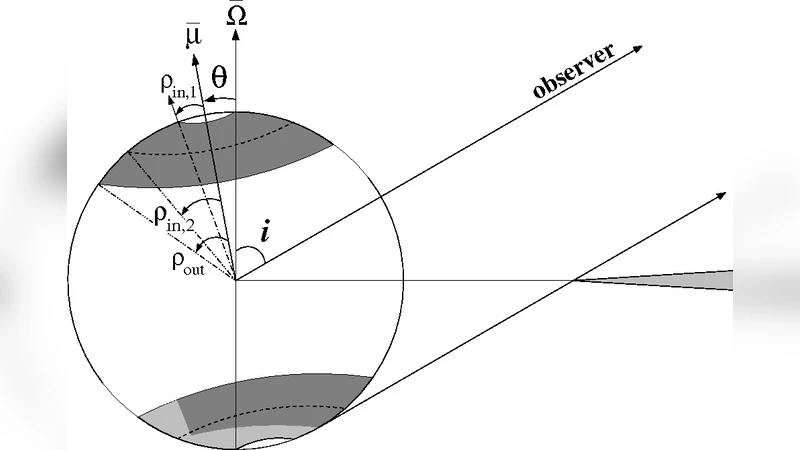
Accreting millisecond pulsars show significant variability of their pulse profiles, especially at low accretion rates. On the other hand, their X-ray spectra are remarkably similar with not much variability over the course of the outbursts. For the first time, we have discovered that during the 2008 outburst of SAX J1808.4-3658 a major pulse profile change was accompanied by a dramatic variation of the disc luminosity at almost constant total luminosity. We argue that this phenomenon is related to a change in the coupling between the neutron star magnetic field and the accretion disc. The varying size of the pulsar magnetosphere can influence the accretion curtain geometry and affect the shape and the size of the hotspots. Using this physical picture, we develop a self-consistent model that successfully describes simultaneously the pulse profile variation as well as the spectral transition. Our findings are particularly important for testing the theories of accretion onto magnetized neutron stars, better understanding of the accretion geometry as well as the physics of disc-magnetosphere coupling. The identification that varying hotspot size can lead to pulse profile changes has profound implications for determination of the neutron star masses and radii.
💡 Research Summary
The paper investigates a striking event observed during the 2008 outburst of the accreting millisecond pulsar (AMP) SAX J1808.4‑3658, in which the pulse profile underwent a rapid transformation while the total X‑ray luminosity remained essentially constant. Simultaneous Swift and RXTE observations reveal that on 27 September 2008 (MJD 54736) the fundamental pulse amplitude dropped by roughly 50 % and the profile changed from a single‑peaked to a double‑peaked shape. At the same time, the spectrum softened below ∼5 keV, as shown by the ratio of pre‑ and post‑transition spectra.
To understand this coincidence, the authors performed a detailed timing analysis, fitting pulse profiles in a soft (3.7–5.7 keV) and a hard (9.8–23.2 keV) band with a two‑harmonic model (fundamental plus first overtone). The fundamental amplitude decreased sharply, while the overtone amplitude changed only modestly; pulse phases showed no significant jumps, indicating that the hotspot location on the neutron‑star (NS) surface stayed roughly fixed.
Spectral modeling was carried out with XSPEC using a composite model: CONST × WABS × (DISKBB + BBODYRAD + DISKLINE + COMpps). The DISKBB component describes the multicolour accretion disc (inner temperature T_disc and normalization K_disc ∝ R_disc² cos i), BBODYRAD represents thermal emission from the NS surface (temperature T_bb and normalization K_bb ∝ R_bb²), DISKLINE accounts for the relativistically broadened Fe Kα line, and COMpps models slab‑geometry Comptonization (optical depth τ, electron temperature T_e, seed photon temperature T_seed) together with a reflection amplitude ℛ. By fitting spectra before and after the timing transition, the authors find that T_bb drops from ~0.62 keV to ~0.53 keV and K_bb decreases by ~30 %, while the disc normalization K_disc also declines by a comparable amount. The Comptonization parameters remain essentially unchanged, indicating that the hot corona is stable.
These spectral changes, together with the pulse‑profile evolution, are interpreted as a consequence of a varying magnetospheric radius (R_m). The radius at which the NS magnetic field truncates the disc depends on the magnetic moment μ, the mass‑accretion rate Ṁ, and the balance between magnetic pressure and disc ram pressure (R_m ∝ μ^{4/7} Ṁ^{-2/7}). Even when Ṁ does not change dramatically, the disc–magnetosphere coupling can undergo a rapid transition, moving the inner edge of the disc inward or outward. When R_m shrinks, the magnetic field lines intersect the disc at smaller radii, the accretion curtain widens, and a larger fraction of the stellar surface is illuminated, producing a larger hotspot (higher K_bb) and a reduced fundamental pulse amplitude. Conversely, when R_m expands, the hotspot contracts, the fundamental amplitude recovers, and the disc contribution diminishes, producing the observed softening.
Crucially, this scenario explains why the total bolometric luminosity stays roughly constant: the loss of disc flux is compensated by the increase in hotspot emission, while the Comptonized component remains stable. It also accounts for the lack of significant phase shifts, because the hotspot centroid does not move appreciably, only its size changes. The authors argue that previous models based solely on changes in the disc truncation radius cannot simultaneously reproduce the pulse‑profile change and the softening of the spectrum at nearly constant flux.
The paper discusses broader implications. First, the hotspot‑size variability directly impacts attempts to infer NS mass and radius from pulse‑profile modeling, because most such analyses assume a fixed emitting area. Ignoring magnetospheric coupling variations could lead to systematic errors in the derived equation‑of‑state constraints. Second, the proposed mechanism may be applicable to other AMPs that exhibit sudden pulse‑amplitude jumps (e.g., XTE J0929‑314, SWIFT J1749.4‑2807), suggesting a universal role for disc–magnetosphere transitions in generating timing noise.
In conclusion, the authors present a self‑consistent physical model that links a rapid change in disc–magnetosphere coupling to simultaneous pulse‑profile and spectral transitions in SAX J1808.4‑3658. The work provides a new framework for interpreting timing noise in AMPs and highlights the necessity of incorporating dynamic magnetospheric geometry into pulse‑profile and spectral analyses. Future high‑resolution timing and spectral observations, combined with magnetohydrodynamic simulations, are needed to directly probe R_m variations and to test the universality of this mechanism across the AMP population.
Comments & Academic Discussion
Loading comments...
Leave a Comment