X-ray bursting neutron star atmosphere models: spectra and color corrections
X-ray bursting neutron stars in low mass X-ray binaries constitute an appropriate source class to constrain masses and radii of neutron stars, but a sufficiently extended set of corresponding model at
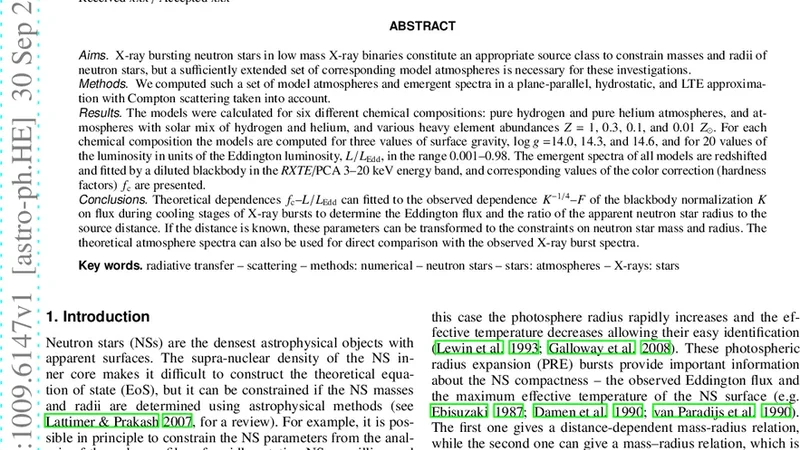
X-ray bursting neutron stars in low mass X-ray binaries constitute an appropriate source class to constrain masses and radii of neutron stars, but a sufficiently extended set of corresponding model atmospheres is necessary for these investigations. We computed such a set of model atmospheres and emergent spectra in a plane-parallel, hydrostatic, and LTE approximation with Compton scattering taken into account. The models were calculated for six different chemical compositions: pure hydrogen and pure helium atmospheres, and atmospheres with solar mix of hydrogen and helium, and various heavy element abundances Z = 1, 0.3, 0.1, and 0.01 Z_sun. For each chemical composition the models are computed for three values of surface gravity, log g =14.0, 14.3, and 14.6, and for 20 values of the luminosity in units of the Eddington luminosity, L/L_Edd, in the range 0.001–0.98. The emergent spectra of all models are redshifted and fitted by a diluted blackbody in the RXTE/PCA 3–20 keV energy band, and corresponding values of the color correction (hardness factors) f_c are presented. Theoretical dependences f_c - L/L_Edd can fitted to the observed dependence K^{-1/4} - F of the blackbody normalization K on flux during cooling stages of X-ray bursts to determine the Eddington flux and the ratio of the apparent neutron star radius to the source distance. If the distance is known, these parameters can be transformed to the constraints on neutron star mass and radius. The theoretical atmosphere spectra can also be used for direct comparison with the observed X-ray burst spectra.
💡 Research Summary
The paper presents a comprehensive set of neutron‑star atmosphere models specifically designed for the analysis of photospheric‑radius‑expansion (PRE) X‑ray bursts observed in low‑mass X‑ray binaries (LMXBs). The authors compute plane‑parallel, hydrostatic, LTE atmospheres while explicitly treating Compton scattering, which dominates the radiative transfer at the high temperatures (∼10⁸–10⁹ K) typical of burst photospheres. Six chemical compositions are considered: pure hydrogen, pure helium, a solar‑abundance H/He mixture, and the same mixture with heavy‑element mass fractions Z = 1, 0.3, 0.1, 0.01 Z⊙. For each composition three surface gravities (log g = 14.0, 14.3, 14.6) are used, spanning the range expected for neutron‑star masses of 1.2–2.0 M⊙ and radii of 10–14 km. The luminosity is varied from 0.001 to 0.98 L_Edd in twenty steps, thereby covering the entire burst evolution from the cooling tail to near‑Eddington expansion.
Each model spectrum is redshifted (including both gravitational and cosmological redshift) and then fitted in the RXTE/PCA 3–20 keV band with a diluted blackbody of the form I_E = w B_E(f_c T_eff). The fitting yields the color‑correction (hardness) factor f_c and the dilution factor w. The authors find that f_c varies systematically with L/L_Edd, typically ranging from ≈1.3 at low luminosities to ≈1.9 near the Eddington limit, with a pronounced rise in the 0.7–0.9 L_Edd interval. This behavior is robust across different compositions, although metal‑rich atmospheres show slightly lower f_c at a given luminosity because bound‑free opacity softens the emergent spectrum.
The central methodological advance is the mapping of the theoretical f_c–L/L_Edd relation onto the observable K⁻¹/⁴–F curve, where K is the blackbody normalization (∝(R_∞/D)²) and F is the measured flux. By fitting the observed cooling‑track data with the theoretical curve, one can simultaneously determine the Eddington flux F_Edd (hence the distance‑independent quantity L_Edd/D²) and the apparent radius‑to‑distance ratio (R_∞/D). If the source distance D is known from independent methods (e.g., globular‑cluster membership or parallax), these two quantities can be combined to solve for the neutron‑star mass M and radius R, providing a powerful constraint on the dense‑matter equation of state.
In addition to the indirect method based on K and F, the authors emphasize that the full model spectra can be directly compared with high‑resolution burst observations (e.g., NICER, Athena). Such a direct spectral fitting approach would exploit subtle features such as metal absorption edges, offering an alternative route to constrain surface gravity and composition, and thereby further tighten M–R constraints.
The paper also discusses limitations and future extensions. The current models assume LTE, plane‑parallel geometry, and neglect magnetic fields and rapid rotation. Non‑LTE effects, spherical expansion, and magnetic opacities may become important for the most luminous bursts or for strongly magnetised neutron stars. Nevertheless, the presented grid—spanning composition, gravity, and luminosity—constitutes the most extensive publicly available library of burst atmosphere models to date.
In summary, the work delivers (1) a detailed theoretical framework for color‑correction factors across a realistic parameter space, (2) a practical recipe for converting observed burst cooling tracks into constraints on the Eddington flux and apparent radius, and (3) a set of spectra ready for direct fitting to modern X‑ray data. These tools together enable more accurate and model‑independent measurements of neutron‑star masses and radii, thereby advancing our understanding of ultra‑dense matter.
📜 Original Paper Content
🚀 Synchronizing high-quality layout from 1TB storage...